
Wholesale specialty coffee sourcing is defined as the bulk procurement of beans graded 87 or above on the Specialty Coffee Association (SCA) cupping scale, purchased in quantities that reduce per-unit cost while maintaining traceable origin quality. For cafe owners, this means buying at volumes from 2lb bags up to pallet and container levels, rather than paying retail prices for small batches. Bulk purchasing typically yields a 10–20% discount compared to retail pricing. That saving compounds quickly across a busy cafe’s weekly usage. Getting this right requires understanding quality metrics, supplier types, and order logistics before you commit to a commercial relationship.
What quality metrics must you evaluate when sourcing specialty beans wholesale?
Bean quality is measurable, not subjective. The two most important benchmarks are moisture content and SCA cupping score. Specialty beans maintain moisture content between 10.5% and 11.5% and must score 87 or above on the SCA scale to qualify as specialty grade. Beans outside this moisture range deteriorate faster in storage, which directly affects flavour consistency in your cups.
Beyond the numbers, you need origin documentation. A reputable supplier provides origin files covering the farm or cooperative, processing method, altitude, and harvest date. These details tell you whether the bean’s flavour profile will suit your menu and brewing equipment.
Processing methods matter more than most cafe owners realise. The three main categories are:
- Washed: Clean, bright acidity with clear terroir expression. Suits filter and pour-over menus well.
- Honey: Partial fruit mucilage left on during drying, producing sweetness and body. Works well in espresso blends.
- Natural: Full fruit drying, creating intense, fruity, wine-like notes. Excellent for single-origin espresso or cold brew.
Altitude also shapes flavour. Beans grown above 1,500 metres develop denser cell structure, slower maturation, and more complex acidity. This is worth checking on every origin file you receive.
Pro Tip: Request roasted samples alongside green bean samples before placing any wholesale order. Thorough sample evaluation reduces risk significantly. Tasting the roasted product tells you whether the green bean’s potential translates to your roast profile and equipment.
How to identify and choose reliable wholesale coffee suppliers for your cafe
The most reliable wholesale coffee suppliers control the supply chain from green bean import through to roasting and packaging. Suppliers managing the full supply chain reduce intermediaries, which lowers costs and improves traceability for your cafe. When a supplier handles import, roasting, and despatch under one roof, you get cleaner documentation and fewer points of failure.

Understanding the difference between artisan roasters and industrial-scale suppliers helps you match the right partner to your cafe’s needs. Artisan roasters offer personalised service and smaller batches, while industrial suppliers focus on automation and larger volumes. Neither is universally better. A 30-seat independent cafe with a rotating single-origin menu needs a different partner than a multi-site operation running a consistent house blend.
When shortlisting wholesale coffee suppliers in the UK and Europe, check for the following:
- Traceability documentation: Can they provide farm-level origin data, not just country of origin?
- Quality management: Do they conduct cupping and moisture analysis on incoming green coffee?
- Export compliance: Are they registered with relevant food safety and import authorities?
- Minimum order flexibility: Do their minimum order quantities suit your current volume without forcing over-purchasing?
- Roast-to-order capability: Do they roast fresh to your order, or despatch from aged stock?
Supplier relationships also need to flex with your menu. Successful cafe sourcing moves toward season-by-season, origin-led beans with suppliers who accommodate that flexibility. A supplier who locks you into a single SKU for 12 months is a poor fit for a cafe that wants to rotate its offering quarterly.
Pro Tip: Build a shortlist of two or three suppliers rather than relying on one. Seasonal crop failures and shipping delays are real. A backup relationship protects your menu continuity without panic buying.
What are the typical wholesale order volumes and how to manage bulk purchasing logistics?
Wholesale coffee purchasing operates across three broad volume tiers. Understanding where your cafe sits determines your pricing, payment terms, and storage requirements.
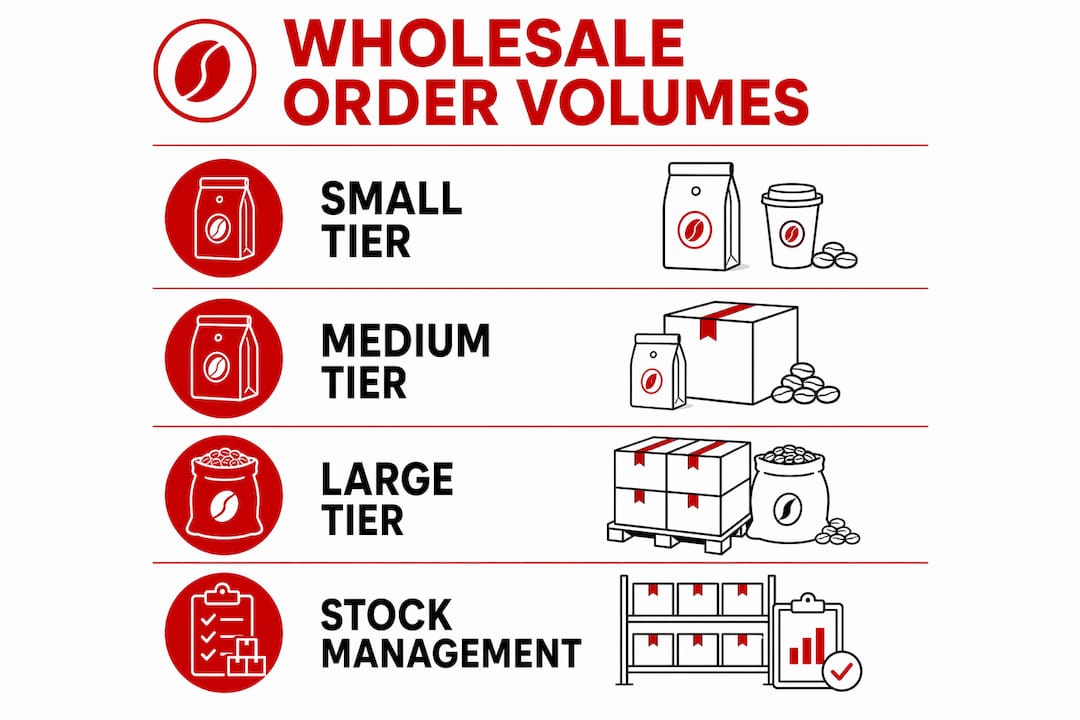
| Volume tier | Approximate quantity | Key characteristics |
|---|---|---|
| Small wholesale | 2lb–5lb bags (cases) | Retail-adjacent pricing, minimal storage, suited to small independents |
| Pallet level | ~1,200kg | Commercial pricing and improved logistical terms, requires dedicated storage |
| Container level | 17,000kg+ | Lowest per-kg cost, complex supply chain management, suited to roasters or large groups |
Most independent cafes begin at the small wholesale tier and graduate to pallet-level purchasing as volume and confidence grow. Pallet-level sourcing at around 1,200kg is the point where pricing and logistics terms improve meaningfully. Container-level purchasing exceeds 17,000kg and involves customs clearance, warehousing contracts, and significant working capital commitment.
Ordering volumes must balance avoiding stockouts and tying up capital, typically starting with 1,200kg pallets before scaling. Tying up too much cash in green coffee stock creates cash flow pressure, particularly for smaller operators. The practical solution is linking your ordering cycle to your roasting or delivery schedule so stock turns over before quality degrades.
Packaging also affects shelf life. Specialty green coffee stored in GrainPro or vacuum-sealed bags retains quality for 12 months or longer. Roasted coffee, by contrast, peaks within two to four weeks of roasting. Your order frequency should reflect whichever form you are purchasing.
Pro Tip: Use a live stock management system tied to your supplier’s roasting schedule. This removes guesswork from reorder timing and keeps your cafe serving fresh coffee without emergency orders at premium prices.
How to effectively incorporate wholesale specialty beans into your cafe’s menu and operations
Bulk sourcing specialty coffee must fit your cafe’s brewing equipment and customer preferences rather than defaulting to generic blends. A bean that scores 90 on the SCA scale is wasted if your grinder cannot express its nuance or your customers prefer a lower-acidity cup. Start with your equipment and your customers, then work backwards to the bean.
The practical steps for moving from sourcing to menu update are:
- Request samples from two or three shortlisted suppliers. Taste roasted samples across your standard brew methods, including espresso, filter, and batch brew if relevant.
- Cup internally with your team. Use a simple scoring sheet covering aroma, flavour, acidity, body, and aftertaste. Your baristas’ input matters because they will be serving it daily.
- Align the bean with your equipment. Check grind settings, extraction times, and dose weights. A new bean often requires calibration before it performs consistently.
- Plan your inventory cycle. Decide how many weeks of stock you want to hold and set a reorder trigger point. Link this to your supplier’s lead time.
- Update your menu with origin context. Customers respond well to brief, honest descriptions: the country, the processing method, and one or two flavour notes. This adds perceived value without overcomplicating your menu.
- Review after four weeks. Check sales data, customer feedback, and any waste. Adjust your order volume or bean selection based on real performance, not assumptions.
Shifting to seasonally changing, origin-led sourcing enhances your cafe’s ability to offer fresh, unique coffee experiences. Rotating your offering quarterly or seasonally also gives your team something to talk about with customers, which builds loyalty and repeat visits. A static menu with the same house blend year-round is a missed opportunity in a market where coffee literacy among consumers is growing steadily.
Key takeaways
Sourcing specialty beans wholesale for your cafe requires matching SCA-graded quality metrics, reliable supplier relationships, and order volumes that suit your cash flow and storage capacity.
| Point | Details |
|---|---|
| Quality benchmarks are non-negotiable | Require SCA scores of 87+ and moisture content of 10.5%–11.5% from every supplier. |
| Supplier type must match your scale | Artisan roasters suit smaller, rotating menus; integrated supply chain partners suit higher volumes. |
| Start small, then scale volume | Begin at small wholesale or pallet level before committing to container-scale purchasing. |
| Sample before you commit | Request roasted samples and moisture data before placing any commercial order. |
| Rotate your menu seasonally | Origin-led, seasonal sourcing keeps your offering fresh and builds customer interest. |
What I have learned from years of watching cafes source wholesale beans
The cafes that get wholesale sourcing right share one habit: they treat their supplier as a partner, not a vendor. That sounds obvious, but most cafe owners I have seen approach it transactionally. They chase the lowest price per kilogram and end up with inconsistent quality, poor documentation, and no flexibility when a crop fails.
The more interesting mistake is over-ordering. A cafe commits to a pallet of a single origin because the price per kilogram looks attractive, then struggles to move it before quality drops. The maths only work if the bean sells. Freshness is a perishable asset, and bulk purchasing amplifies both the upside and the downside.
My honest view is that the best approach for most independent cafes is a split sourcing model. Keep a reliable, well-priced house blend from a supplier with strong supply chain control. Then run one or two rotating single-origin offerings sourced in smaller quantities from an artisan roaster. This gives you cost stability on your core menu and creative flexibility on your specials board.
The transparency question is also underrated. A supplier who cannot tell you the farm name, the harvest date, and the processing method is not selling you specialty coffee. They are selling you a story. Ask for the documentation. If they hesitate, move on.
— Harvey
Wholesale specialty coffee from Ads-coffee-supplies
Ads-coffee-supplies has supplied UK cafes, offices, and coffee professionals with quality beans and equipment since 1993. If you are ready to move from retail purchasing to a proper wholesale relationship, the Ads-coffee-supplies wholesale range covers specialty beans, blends, and the equipment to brew them consistently.
Orders over £69 qualify for free next working day delivery, which makes regular restocking straightforward without minimum order pressure. The team brings a family-run approach to every account, meaning you get genuine advice on bean selection, not a generic catalogue recommendation. Whether you are sourcing your first wholesale batch or reviewing an existing supplier relationship, Ads-coffee-supplies is worth a conversation.
FAQ
What is the minimum order for wholesale specialty coffee?
Most wholesale suppliers start at 2lb to 5lb bag cases for small operators, with pallet-level purchasing beginning around 1,200kg. Your minimum will depend on the supplier and the pricing tier you want to access.
What SCA score qualifies as specialty grade?
The Specialty Coffee Association defines specialty grade as a cupping score of 87 or above out of 100. Beans scoring below this threshold do not meet specialty classification regardless of their origin or marketing.
How do I verify bean quality before placing a wholesale order?
Request roasted samples and ask for moisture analysis data on the green coffee. Moisture content should sit between 10.5% and 11.5%. Tasting the roasted sample across your brew methods confirms whether the bean suits your equipment and menu.
Should I use one supplier or several?
Using two or three suppliers reduces risk from crop failures, shipping delays, and quality inconsistencies. A single supplier relationship is convenient but leaves your menu vulnerable to supply disruption.
How often should I rotate my wholesale bean selection?
Rotating your single-origin offerings quarterly or seasonally keeps your menu fresh and reflects real crop availability. Your house blend can remain consistent while your specials board changes with the harvest calendar.

