
A disappointing bowl of matcha (bitter, clumpy or barely frothed) almost always comes down to missing or mismatched tools rather than bad powder. Anyone who’s tried whisking matcha with a dinner fork or settling for a mug instead of a proper bowl knows the frustration. A good matcha set solves this by giving you the sifter, bamboo whisk, wide bowl and dosing spoon that work together to produce consistent foam and flavour every time.
That’s exactly what this guide covers. We’ll walk through the essential components of a matcha set, explain the difference between manual and electric matcha whisk setups, cover how to match matcha grade to drink type, and share preparation ratios that stop bitterness before it starts. As a family-run UK coffee and drinks supplier trading since 1993, we put together ready-made matcha kit bundles for exactly this reason, so buyers don’t have to guess which pieces they actually need.
Read on and you’ll know precisely what separates a reliable matcha starter kit from one that leaves you disappointed after the first bowl.
Key Takeaways
- A matcha set is built around four essentials: a sieve, a bamboo whisk (chasen), a wide bowl and a dosing spoon that makes measurement repeatable.
- Manual bamboo whisk kits suit purists who want the traditional hand-whisked ritual, while electric whisk kits suit speed, consistency, and daily or multi-person use.
- Grade selection matters just as much as the equipment: ceremonial grade for bowls drunk straight, culinary grade for lattes, iced drinks and baking.
- Water between 75 and 80°C and the correct powder-to-water ratio prevent the bitterness and clumping most beginners struggle with.
- Offices and cafés making several drinks at a time are usually better served by an electric whisk or batch-friendly kit than by single-bowl tools.
Jump to section
- What Is a Matcha Set and Why Does It Matter?
- What Are the Essential Components of a Matcha Set?
- Manual vs Electric Matcha Sets: Which Should You Choose?
- How Do You Choose the Right Matcha Powder Grade?
- How Should You Prepare Matcha for Consistent Results?
- Scaling Up: Matcha Sets for Offices, Cafés, and Catering
- The Takeaway
- Frequently Asked Questions
What Is a Matcha Set and Why Does It Matter?
A matcha set is a coordinated collection of tools, typically a sifter, a bamboo whisk, a wide ceramic bowl and a dosing spoon, designed to work together so the powder dissolves evenly and develops a stable, fine-bubbled foam. Each piece exists because matcha behaves differently to a tea bag or coffee grounds. It’s a whole-leaf powder that needs mechanical agitation rather than steeping, which is why the tools matter as much as the tea itself.
Most of the disappointing results people blame on “bad matcha” actually trace back to the kit rather than the powder. Whisking with a standard fork or metal whisk can’t replicate the fine aeration that 80 to 120 bamboo tines produce, leaving flat foam and undissolved clumps sitting at the bottom of the cup. A narrow mug also cramps the whisking motion, causing splashing and uneven mixing regardless of how good the matcha grade is.
This is why pairing the right equipment with the right grade of powder matters more than chasing the most expensive tin of matcha on the shelf. A mid-range culinary grade whisked properly in a full matcha set will usually taste better than a premium ceremonial grade whisked badly with the wrong tools. Getting the fundamentals of the set right first makes every other decision (grade, ratio, temperature) far easier to get right afterwards.
What Are the Essential Components of a Matcha Set?
Every reliable matcha set, whether bought as a bundle or assembled piece by piece, is built around four non-negotiable components that each handle a distinct job in the preparation process:
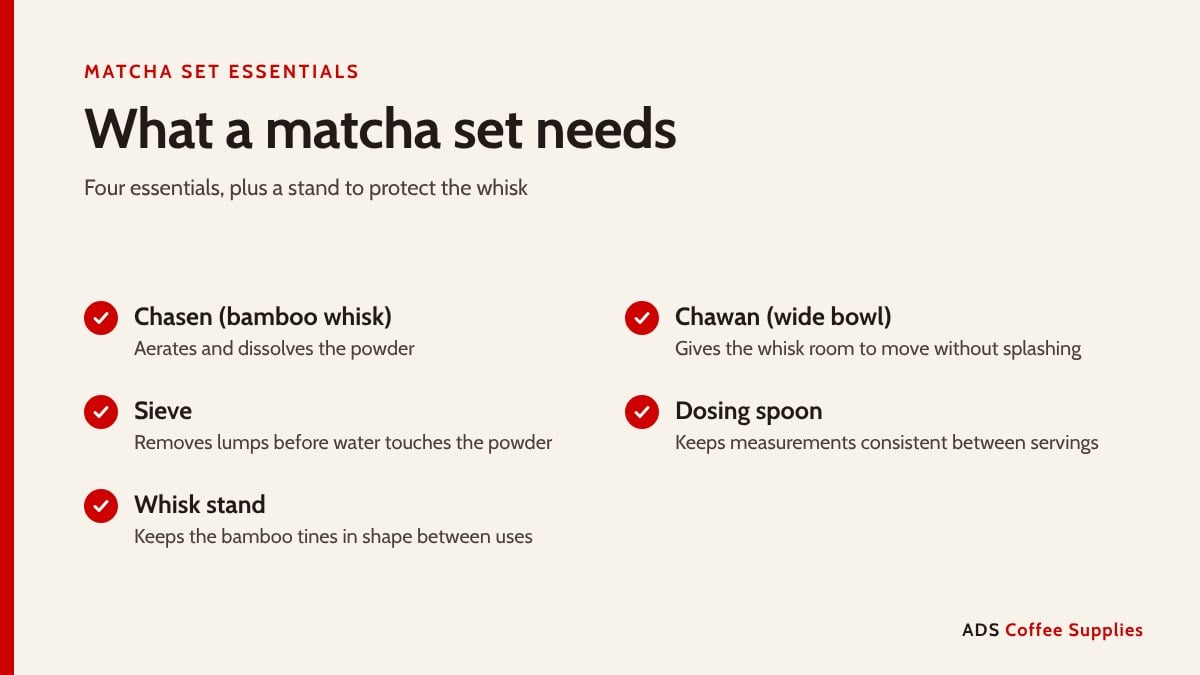
- Chasen (bamboo whisk): aerates and dissolves the powder
- Chawan (wide bowl): gives the whisk room to move without splashing
- Sieve: removes lumps before water ever touches the powder
- Dosing spoon: keeps measurements consistent between servings
Skipping any one of these tends to show up directly in the finished drink, whether that’s a gritty texture from unsifted powder or splashing from a bowl that’s too narrow. Material quality matters too, since a flimsy whisk splits after a few weeks of use and a poorly glazed bowl lets powder stick stubbornly to its sides. Buying these four pieces together, rather than hunting them down individually from different suppliers, is usually the quickest way to a matcha tea set that performs reliably from the first use.
The Matcha Whisk, Bowl, and Sieve Explained
The bamboo matcha whisk, or chasen, typically features between 80 and 120 delicate tines carved from a single piece of bamboo, and it’s this fine structure that creates matcha’s characteristic frothy texture. It needs rinsing in warm water and air-drying upright immediately after each use, since dried powder left on the tines causes them to stiffen and eventually snap. The matcha bowl, or chawan, should have a wide, deep interior measuring roughly 10 to 12 centimetres so there’s enough room to whisk vigorously without splashing onto the counter, and many modern versions add a pouring spout for easier serving. A stainless steel sieve comes before both of these in the process, breaking apart the clumps that form naturally in stored matcha powder, a step most beginners skip entirely and then wonder why their drink tastes gritty.
Dosing Spoons and Supporting Accessories
Precision dosing spoons standardise how much powder goes into each bowl, removing the guesswork that leads to inconsistent strength between one preparation and the next. This matters more than it sounds, since even half a gram of extra powder can tip a smooth usucha into something unpleasantly strong and bitter. Whisk stands are the other accessory worth having, since they keep the bamboo tines suspended and properly shaped between uses rather than resting flat where moisture collects and warping begins. Buying a complete matcha starter kit that already bundles the sieve, spoon, bowl and whisk together removes the trial and error of sourcing each piece separately from different retailers.
Manual vs Electric Matcha Sets: Which Should You Choose?
Choosing between a manual bamboo whisk set and an electric matcha whisk set comes down to how much you value ritual and control versus speed and repeatability. A manual chasen demands a learned wrist technique, roughly 20 to 30 seconds of brisk whisking, and rewards the user with the traditional, slightly meditative preparation process that many matcha drinkers specifically seek out. It also gives finer control over foam texture, which matters for ceremonial grade matcha served on its own where the subtlety of flavour and mouthfeel is the whole point. An electric matcha whisk, by contrast, removes the technique curve almost entirely, producing a consistent froth in seconds regardless of who’s operating it, which makes it a practical choice for offices, busy households, or anyone preparing more than one bowl at a time. Neither option is objectively better; the right matcha kit depends on whether the priority is tradition and control or speed and consistency across multiple servings.
Our Manual and Electric Matcha Bundles
We offer two curated bundles that map directly onto these two preparation styles, so buyers don’t have to piece a kit together themselves.
- Manual Matcha Bundle: a stainless steel sieve, a ceramic mixing bowl, precision dosing spoons, a bamboo whisk and a ceramic whisk stand, built for traditional, hand-whisked texture. Matcha powder isn’t included, so add your own.
- Electric Matcha Bundle: a ceramic mixing bowl with a pouring spout, an electric handheld whisk, a sieve and a dosing spoon, paired with Summit 100% Pure Organic Matcha (100g), giving a complete, mess-free starter set in a single order.
Both bundles sit in our matcha accessories range alongside the individual bowl, sieve, whisk stand and spare whisks, so you can also build a kit piece by piece and answer the “which tools do I actually need” question in one order rather than several.
How Do You Choose the Right Matcha Powder Grade?
Choosing the right Japanese matcha powder grade means matching how the drink will be served to how delicate or robust the powder’s flavour needs to be. Ceremonial grade matcha, made from the youngest, first-flush leaves, delivers a naturally sweet, complex flavour that’s best appreciated in a bowl drunk straight with nothing added to dilute it. Culinary grade matcha, harvested slightly later in the season, carries a more assertive, grassy flavour that stands up well to milk, ice and sweeteners without getting lost in the mix, making it the practical choice for lattes, iced matcha and baking. For home users buying a single matcha set, one mid-range culinary powder usually covers most needs. For cafés and offices running a wider menu, a sensible buying rule is to stock one powder for straight or ceremonial-style drinks, one culinary powder for milk-based menu items, and a small buffer of backup stock to manage any supply disruption.
Avoiding Common Grade-Matching Mistakes
The most frequent and costly mistake is using an expensive, delicate ceremonial powder in a milk-heavy latte, where its subtle sweetness and complexity are completely overwhelmed by dairy and syrup. This wastes money without improving the drink in any noticeable way, since the drinker will never taste the nuance that justified the higher price. The practical fix is to match grade to drink format first, before worrying about brand, origin or price point, since even the best Uji-grown ceremonial matcha performs no better than a mid-range culinary powder once it’s buried under oat milk and vanilla syrup.
How Should You Prepare Matcha for Consistent Results?
Consistent matcha preparation comes down to two variables that beginners most often get wrong: water temperature and powder-to-water ratio. Water that’s too hot, anything near boiling, scorches the delicate compounds in matcha and produces a sharp, bitter taste that masks the tea’s natural sweetness, so the ideal range sits between 75 and 80°C rather than straight from a just-boiled kettle. Ratio matters just as much as temperature. Thin matcha (usucha) uses roughly 1 to 2 grams of powder with around 70 to 80ml of water to produce a smooth, drinkable everyday bowl, while thick matcha (koicha) uses 3 to 4 grams with just 30 to 40ml of water for a dense, intense preparation traditionally reserved for ceremonial occasions. Sifting the powder before adding water, then whisking usucha briskly in a W or M motion for around 20 to 30 seconds, produces the fine, stable foam that signals a properly prepared bowl rather than a flat, clumpy one. For the full method, see our step-by-step guide to preparing matcha tea.
Tip: Sift every time, even if the powder looks fine. Clumps that are invisible in a dry tin become obvious the moment water hits them.
Table: Quick Reference for Temperature and Ratios
The table below gives a quick reference for the two most common preparation styles, useful to keep near the kettle until the ratios become second nature.
| Style | Powder | Water Volume | Water Temperature | Whisking |
|---|---|---|---|---|
| Usucha (thin) | 1-2g | 70-80ml | 75-80°C | Brisk, 20-30 seconds |
| Koicha (thick) | 3-4g | 30-40ml | 70-75°C | Slow, gentle kneading |
Scaling Up: Matcha Sets for Offices, Cafés, and Catering
Scaling matcha preparation beyond a single bowl means choosing equipment that matches the volume and pace of the setting rather than relying on home-scale tools stretched past their limits. Offices and cafés making several drinks at a time are usually better served by kit that can turn out four or more servings efficiently than by one bowl and one bamboo whisk. The right tool genuinely depends on context here:
- Handheld electric whisk: suits homes and small offices well
- Steam wand: makes sense for cafés that already run espresso machines
- Shaker bottles: work best for high-volume iced matcha service where speed matters more than ceremony
Matching equipment to actual throughput, rather than defaulting to whatever a home matcha set includes, prevents bottlenecks during busy periods and keeps quality consistent across however many servings are needed.
Managing Supply Continuity and Storage
Japan’s matcha-producing regions, including Uji, Shizuoka and Yame, have reported tight supplies in recent seasons as global demand has climbed, which can mean patchier availability and longer lead times for UK buyers. Businesses that rely on a single product risk running short at exactly the moment demand peaks, so it’s sensible to keep a little backup stock and an alternative powder in mind. Good storage habits protect whatever stock is on hand regardless of its origin:
- Open only what will be used soon
- Keep powder away from heat and light
- Label opening dates
- Rotate stock so older tins get used first
If you run a café or office, we can supply matcha powder alongside your coffee, syrups and other drinks in a single order, rather than juggling separate accounts.
The Takeaway
Quality matcha starts with the right tools, not just good powder, since even premium ceremonial grade matcha performs poorly without a sifter, a proper chasen and a bowl wide enough to whisk in. The manual versus electric decision comes down to style against speed: hand-whisking for those who want the ritual and finer control, electric whisking for those who want consistent results fast, whether that’s a single home bowl or a busy office rotation.
Whichever direction suits your setting, a complete matcha set removes the guesswork of sourcing each piece separately. Browse our matcha accessories and bundles, or call the sales team on 0800 442299 for advice on which bundle fits your volume and preparation style.
Frequently Asked Questions
How much does a good matcha set cost?
A complete bundle with a sieve, bowl, dosing spoon and whisk typically costs somewhere around £40 to £60, while single pieces such as a sieve, whisk stand or replacement bamboo whisk cost well under £20 each. An electric bundle that includes the powder can actually work out cheaper than a manual set, so compare what’s in the box rather than assuming electric costs more.
Can I use a regular whisk instead of a bamboo chasen?
A standard kitchen whisk can’t replicate the fine aeration produced by 80 to 120 bamboo tines, so foam ends up flatter and powder often stays clumped. Electric handheld whisks are an acceptable modern alternative for speed, but metal balloon whisks generally aren’t suited to proper matcha texture.
How long does a bamboo matcha whisk last?
Lifespan depends almost entirely on care: rinse the whisk immediately after use, air-dry it upright on a stand, and never put it in a dishwasher. Signs it needs replacing include splitting or fraying tines and a noticeable loss of springiness during whisking.
What’s the difference between a matcha bowl and a regular bowl?
A matcha bowl, or chawan, has a wide, deep shape with roughly 10 to 12 centimetres of interior space, giving enough room to whisk briskly without splashing. Its glazing also prevents powder sticking to the surface, making it far easier to clean than standard crockery.
Is an electric matcha whisk worth it for home use?
It’s worth it for anyone preparing matcha daily or for multiple people, since it delivers consistent froth in seconds with no technique curve to learn. Traditionalists who value the ritual and finer control of hand-whisking may still prefer sticking with a bamboo chasen.
How do I stop my matcha from clumping?
Always sift the powder through a fine sieve before adding water, since this breaks apart the clumps that form naturally during storage. Keeping matcha in a cool, dark, airtight container also prevents moisture absorption, which is the main cause of stubborn clumping over time.

