
Customers who ask for a dark hot chocolate usually know exactly what they want: less sugar, more cocoa, a drink that tastes of chocolate rather than warm sweet milk. Getting that right with a dark hot chocolate powder starts with understanding the cocoa percentage on the pack, because it does not mean quite what most people assume.
We have been supplying cafés, hotels and offices from Eastbourne since 1993, and the same questions come up every winter. What does 33% cocoa actually mean? Why does nobody sell a 70% powder? How much should go in a 12oz cup? This guide answers those and covers the serving side, so your dark option tastes the same on a quiet Tuesday as it does on a packed Saturday.
Key takeaways
- Dark hot chocolate powder typically contains around 30 to 40% cocoa, compared with roughly 15 to 25% in many standard blends.
- A 70% hot chocolate is almost always made by melting 70% chocolate into milk, not from a 70% cocoa powder.
- A regular 12oz dark hot chocolate needs about 28 to 32 g of powder, mixed to a paste first and topped with milk at 60 to 65°C.
- A cup of dark hot chocolate contains roughly 10 to 25 mg of caffeine, well under a single espresso.
What cocoa percentage means on dark hot chocolate powder
On a chocolate bar, the percentage is the total cocoa content: cocoa mass, cocoa butter and any added cocoa powder combined. A 70% bar is 70% cocoa and roughly 30% sugar, plus small amounts of emulsifier and flavouring.
On a hot chocolate powder, the figure works the same way, but the starting point is very different. A powder has to dissolve in hot water or milk, carry its own sweetness and often a milk or creamer component too. That leaves less room for cocoa. Typical figures look like this:
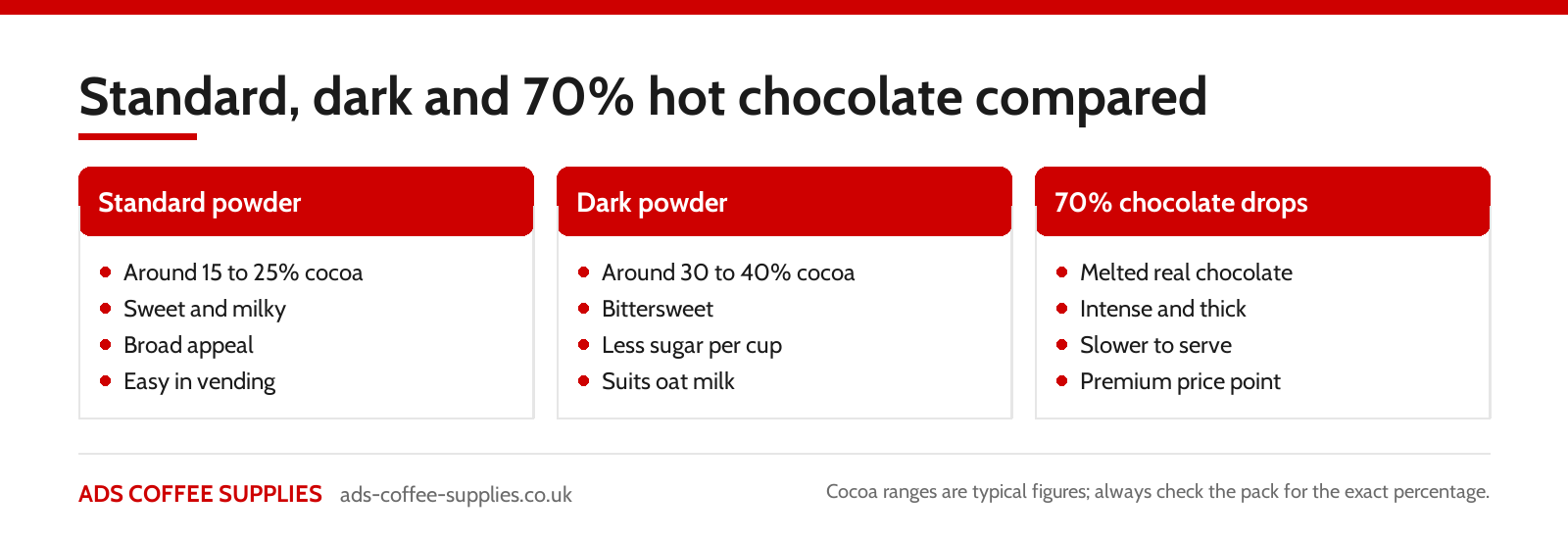
- Standard and vending hot chocolate: commonly around 15 to 25% cocoa, with sugar, whey or milk powder making up most of the rest.
- Dark hot chocolate powder: usually around 30 to 40% cocoa, with noticeably less sugar per serve.
- Pure cocoa powder: close to 100% cocoa, unsweetened and too bitter for most customers on its own.
So a dark powder at 33% is not weak. It contains well over the cocoa content of a typical standard blend, and in the cup it tastes far richer. The cocoa is also usually fat-reduced powder rather than solid chocolate, which is why it mixes cleanly instead of leaving an oily film.
If customers are confused by the difference between drinking chocolate and cocoa, our post on hot chocolate vs hot cocoa explains it in more detail.
Two dark powders worth knowing
Zuma Dark Vegan Hot Chocolate is a good example of a clearly labelled dark powder. It is made with 33% West African cocoa, has a properly bitter edge, and contains no dairy, so it works with oat, soya or dairy milk without you needing a separate vegan product.

Zuma Dark Vegan Hot Chocolate (1kg Packet)
Rich and sophisticated, with the perfect bitter balance. This delicious Dark Hot Chocolate powder is made with 33% West African cocoa. A pure taste to be…
The Summit Dark Hot Chocolate Powder sits in a similar place: a bittersweet, rich blend that suits customers who find standard hot chocolate too sugary. It comes in a tin, which is handy behind the counter, and it appears in our Veganuary range.
Summit Dark Hot Chocolate Powder
Our Summit Dark hot chocolate powder is a rich and indulgent drink with the perfect bittersweet
Is a 70% hot chocolate possible from a powder?
Short answer: not really, and not in a form most people would enjoy. When a café menu lists a 70% hot chocolate, it almost always means real chocolate (drops, flakes or callets) melted into steamed milk. The 70% refers to the chocolate, not the finished drink.
Once 30 g of 70% chocolate goes into 250 ml of milk, the cocoa content of the cup itself is well under 10%. That is worth remembering when customers compare your powder with a 70% drink elsewhere. A 33% dark powder dosed generously can taste every bit as intense.
A powder at 70% cocoa would be close to unsweetened cocoa, grainy if it was not processed carefully, and bitter enough that most customers would add sugar at the condiment station anyway. That is why manufacturers stop around the 30 to 40% mark: it is the point where the drink still dissolves well and tastes balanced.
When melted chocolate makes sense
If you run a dessert café or a premium chocolate bar concept, melted 70% chocolate gives a thicker, more luxurious mouthfeel. The trade-off is speed. It needs whisking or a dedicated melter, it splits if overheated, and it is harder to keep consistent across staff. For most coffee shops and hotels, a good dark powder gives 90% of the experience in a fraction of the time.
How to serve dark hot chocolate in a café
Dark powders are less forgiving than sweet ones. Too little and the drink tastes thin and slightly sour; too much and it turns chalky. These are the dosing starting points we give to trade customers. Always check the pack, as some blends are designed for slightly higher or lower doses.
| Cup size | Milk or water | Powder dose |
|---|---|---|
| Small, 8oz | about 200 ml | 20 to 25 g |
| Regular, 12oz | about 300 ml | 28 to 32 g |
| Large, 16oz | about 400 ml | 35 to 40 g |
At around 28 g per regular cup, a 1 kg packet gives roughly 35 drinks. Weigh the dose on scales for the first week, then mark a scoop so the team can be consistent without slowing down.
The method that avoids lumps
- Put the powder in the cup first.
- Add a splash, around 30 to 40 ml, of hot water or steamed milk and stir it into a smooth paste.
- Top up with milk steamed to 60 to 65°C, stirring as you pour.
- Give it a final stir before it goes on the counter.
The paste stage matters more with dark powders because cocoa contains fat and resists wetting. Skip it and you get dry clumps floating on top. Keep the milk below about 70°C: hotter than that and the milk starts to taste cooked, which clashes with the bitterness of the cocoa.
If you are mixing with water only, use water at around 80 to 85°C rather than straight off the boil. The drink will be lighter in body, so dark powders made for water mixing tend to work better in self-serve and vending than ones designed purely for milk.
Milk choices
Whole milk rounds off the bitterness and is the safest default. Oat milk is the standout alternative: its natural sweetness and creamy body suit dark chocolate better than almond, which can taste thin. Soya works well too, though it can curdle if poured very hot into a strongly acidic blend, so keep it at the lower end of the temperature range.
Building a dark chocolate offer on your menu
A dark hot chocolate earns its place when it is clearly different from your standard one. Describe it plainly on the board: name the cocoa percentage if you know it, say it is less sweet, and mention if it is dairy free. Customers looking for it will find it; customers who want a sweet drink will not order it by mistake and send it back.
Some simple ways to extend the range without adding complexity:
- A mocha upgrade: swap your usual chocolate for the dark powder in a mocha. Around 15 to 20 g with a double shot gives a drink that tastes of both coffee and chocolate rather than sugar.
- Orange or mint versions: a pump of orange or mint syrup pairs naturally with dark chocolate. Our orange hot chocolate post has serving ideas.
- A dairy-free finish: topping with whipped cream rules out vegan customers, so offer a drizzle instead.
For that last point, Simply Dark Vegan Chocolate Topping Sauce is completely dairy free and gives a dark, glossy finish on top of a cup or a swirl around the inside of a glass mug. Paired with a dairy-free powder and oat milk, it lets you sell a fully vegan premium drink with very little extra stock.

Simply Dark Vegan Chocolate Topping Sauce (1kg)
Add chocolatey goodness to everything with Simply Dark Chocolate Topping Sauce. This smooth sauce with delicious sweet chocolate flavour is completely dairy…
A note on caffeine
Cocoa contains a small amount of caffeine and a larger amount of theobromine, a milder stimulant. A regular dark hot chocolate made with a 30 to 40% cocoa powder typically contains somewhere around 10 to 25 mg of caffeine, depending on dose and cocoa content. That is well under a single espresso, which is usually 60 to 80 mg, so it is a reasonable evening option, though not caffeine free.
Consistency, storage and machines at volume
Dark powders contain more cocoa fat than standard blends, so they are more sensitive to moisture and warmth. Keep tins and packets sealed, store them away from the steam wand and the dishwasher, and use a dry scoop every time. A damp scoop is the most common cause of clumping we see when visiting sites.
Once opened, aim to use a packet within a few weeks. The flavour holds up longer, but the powder gradually loses the freshly roasted cocoa aroma that makes a dark drink worth paying extra for.
If your hot chocolate sales are high enough that hand-mixing is slowing the queue, a dedicated machine can take the pressure off. Our range of hot chocolate machines covers sites from small cafés to busy hotels and visitor attractions. Check with the supplier that any dark powder you plan to use is suitable for the machine, as some powders are formulated specifically for vending canisters and others for counter mixing.
If you would like help choosing a dark hot chocolate for your menu, or advice on setting up a machine, give the team a call or visit the Eastbourne showroom. We deliver UK-wide, free on orders over £69 ex VAT to mainland UK.
Frequently asked questions
What is the difference between dark hot chocolate powder and normal hot chocolate?
Dark hot chocolate powder contains more cocoa and less sugar than a standard blend. Typical dark powders sit around 30 to 40% cocoa, while many standard and vending powders are around 15 to 25%. The result is a richer, more bitter drink with a less milky, less sweet finish, which appeals to customers who find regular hot chocolate too sugary.
Can you buy 70% hot chocolate powder?
Very rarely. Most 70% hot chocolates are made by melting 70% dark chocolate drops or flakes into steamed milk, so the percentage refers to the chocolate rather than the drink. A powder at 70% cocoa would be close to unsweetened cocoa, quite bitter and harder to dissolve, which is why most dark powders stop at around 30 to 40% cocoa.
How much dark hot chocolate powder should I use per cup?
As a starting point, use 20 to 25 g for an 8oz cup, 28 to 32 g for a 12oz cup and 35 to 40 g for a 16oz cup. Mix the powder into a smooth paste with a little hot liquid first, then top up with milk steamed to 60 to 65°C. Check the pack, as some blends recommend slightly different doses.
Is dark hot chocolate vegan?
Not automatically. Some dark hot chocolate powders contain milk or whey, while others are made without dairy. Zuma Dark Vegan Hot Chocolate, for example, is dairy free and works well with oat or soya milk. Always check the ingredients list, and remember that whipped cream or dairy toppings will make the finished drink non-vegan.
Does dark hot chocolate have caffeine?
Yes, a small amount. A regular cup made with a 30 to 40% cocoa powder usually contains around 10 to 25 mg of caffeine, depending on the dose. That is much less than a single espresso at roughly 60 to 80 mg. Cocoa also contains theobromine, a milder stimulant, so dark hot chocolate is lower in caffeine but not caffeine free.

