
Is your morning coffee tasting a bit flat? Hearing strange gurgling sounds from your machine? Limescale is the likely culprit. Knowing how to descale an espresso machine isn't just a suggestion; it’s essential maintenance. It's the single most important thing you can do to protect your investment and guarantee a great-tasting cup every time.
This guide provides practical, actionable advice to help you get the job done right, whether you're a home barista or a cafe owner.
Why Descaling Your Espresso Machine Matters
Limescale, that chalky white deposit left by hard water, is the silent enemy of every coffee machine. As water heats inside the boiler and flows through internal pipes, dissolved minerals like calcium and magnesium cling to the surfaces, building up over time.
This build-up acts as an insulator, forcing your machine to work much harder to reach the right temperature. The result? Inconsistent, under-extracted coffee that just doesn’t hit the spot.
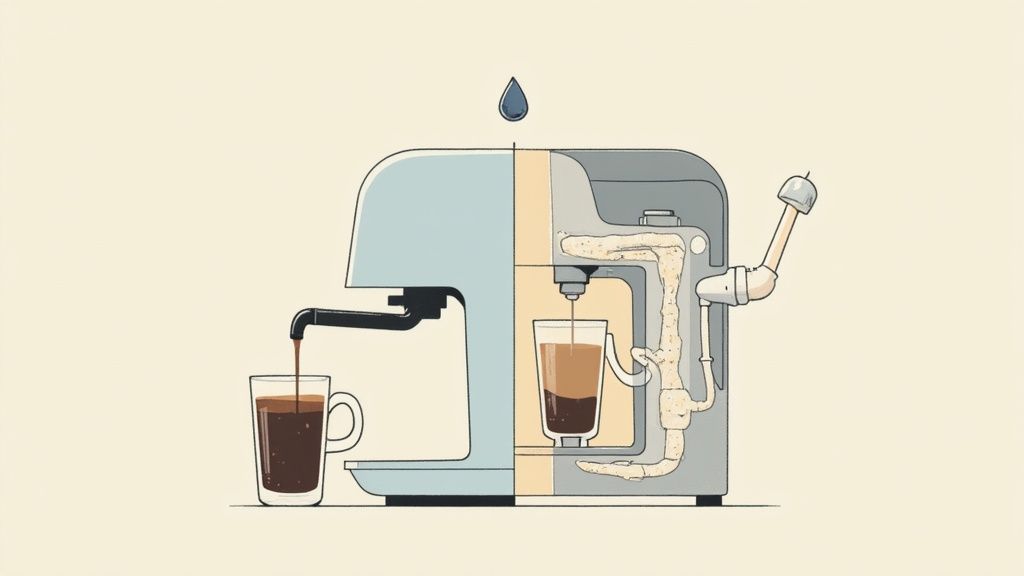
Ignoring the problem doesn’t just wreck the flavour; it can cause serious, expensive damage. Scale clogs narrow water passages, kills steam wand pressure, and can eventually cause the heating element to fail completely. Regular descaling is your first and best line of defence.
The Impact of Hard Water in the UK
Here in the UK, particularly in London and the Southeast, our water is often packed with high levels of calcium carbonate, making it 'hard'. This makes scale a massive issue for coffee equipment.
Without a routine to descale your espresso machine, you could see a 30%-50% drop in heating efficiency. Worse, your machine might need repairs up to two years earlier than one that's properly maintained. The numbers speak for themselves.
Making descaling a regular part of your coffee routine isn't just about cleaning. You're actively preserving your machine's performance, extending its lifespan, and ensuring every shot you pull is as delicious as the last.
The Benefits of a Clean Machine
A proactive approach keeps your machine running like a dream. The rewards are well worth the small effort:
- Better Coffee Flavour: When mineral deposits are gone, water flows freely and heats to the perfect temperature for a balanced and flavourful extraction.
- Longer Machine Lifespan: Preventing scale from wrecking internal parts like boilers and pumps massively cuts down the risk of costly breakdowns.
- Energy Efficiency: A clean heating element uses less electricity to hit its target temperature, saving you money on your bills over time.
While descaling is crucial, prevention is even better. Using filtered water is the most effective way to slow mineral build-up. You can learn more about how water filtration protects your machine.
Choosing the Right Descaler for Your Machine
When you need to descale your espresso machine, choosing the right product is key. While DIY solutions like vinegar or citric acid are cheap, they come with serious risks. Household acids can be too aggressive for sensitive internal parts like rubber seals, gaskets, and soft metal boilers.
Over time, using the wrong product can cause irreversible corrosion and damage. A properly formulated commercial descaler is blended specifically for this job, making it the safest and most effective choice.
Commercial Descalers vs DIY Solutions
Let’s break down your main options to find the best way to descale your espresso machine:
- Commercial Descalers: Our number one choice. Formulated for coffee equipment, they are non-corrosive, rinse away cleanly without leaving an aftertaste, and are safe for all internal components. Machine manufacturers always recommend them.
- Citric Acid: A slightly gentler alternative to vinegar, citric acid can work but often needs higher concentrations. As an uncontrolled acid, it poses a risk if you don’t get the mixture right.
- Vinegar: While it dissolves calcium, its acetic acid is notorious for damaging rubber seals. It also leaves a strong, lingering smell and taste. We strongly advise against ever using vinegar.
For the health of your equipment, a professional-grade descaler is always the smartest and safest investment. It gives you peace of mind that you're cleaning properly without causing unseen harm.
Before you decide, it helps to see the options side-by-side.
Descaling Solution Comparison
| Solution | Effectiveness | Machine Safety | Recommendation |
|---|---|---|---|
| Commercial Descalers | High. Formulated to dissolve tough mineral scale quickly and completely. | Excellent. Non-corrosive and specifically designed to be safe for all internal parts. | Highly Recommended. The safest and most effective choice for any espresso machine. |
| Citric Acid | Moderate. Can be effective but may require stronger solutions and longer contact time. | Fair. Gentler than vinegar but can still be corrosive if the concentration is too high. | Use with Caution. A potential DIY option, but risky if not mixed correctly. |
| Vinegar | High. Very effective at dissolving limescale due to its acetic acid content. | Poor. Highly corrosive to rubber seals, gaskets, and soft metals like aluminium. | Not Recommended. The risk of permanent damage is far too high. Avoid at all costs. |
As the table shows, the potential for causing long-term damage with DIY options isn't worth the small saving.
Our Top Recommendations for Descaling
- ADS Coffee Supplies: We offer a curated selection of commercial cleaning products for coffee equipment tested and proven to be both effective and safe.
- Puly Caff Descaler: A firm favourite among baristas and technicians for a reason. It’s powerful against limescale yet gentle on your machine, ensuring a thorough clean without compromise.
A Practical Guide to Descaling Your Machine
Right, let's get to the main event. While the core idea is running an acidic solution through your machine, the actual steps can vary. To descale an espresso machine properly, you need to understand your specific model.
We'll give you clear, actionable instructions for the most common types of machines, whether you're running a hands-on semi-automatic, a convenient bean-to-cup, or a classic manual lever.
Descaling Semi-Automatic and Traditional Pump Machines
These machines need a bit of TLC. The process is manual, which gives you full control.
First, mix your descaling solution according to the instructions on the bottle. A purpose-built product like the Puly Descaler Espresso 1 Litre is your best bet. Pour this mixture into your machine's empty water tank.
Now, grab a container for the group head and another for the steam wand, then switch the machine on.
- Run about a third of the solution through the group head.
- Pull another third through the hot water dispenser (if you have one).
- Send the final third through the steam wand.
- Switch the machine off and let it sit for 20-30 minutes. This gives the acid time to dissolve the scale.
After the wait, turn the machine back on and run any remaining solution through all outlets. Finally, give the water tank a thorough rinse, fill it with fresh water, and flush at least two full tanks through the machine. This final rinse is non-negotiable.
Handling Fully Automatic and Bean-to-Cup Machines
Most modern bean-to-cup machines make life easy with an automated descaling cycle. Your job is to follow the on-screen prompts.
When the machine tells you it's time to descale, don't put it off. Before you start, remove the water filter from the tank. Add the descaler and water as the manufacturer recommends, then start the cycle.
The machine handles the rest, automatically running the solution through its system. Just make sure you have a big enough container to catch all the water. Once finished, it will prompt you to rinse the tank and refill it with fresh water for the flushing phase.
A common mistake is stopping the cycle halfway. Always let the machine complete its entire programmed sequence to ensure the system is clear and the machine's internal sensors are reset.
A Quick Look at Your Descaler Options
Choosing the right descaler is the first step. This visual guide makes it clear why a commercial solution is always the safest bet.
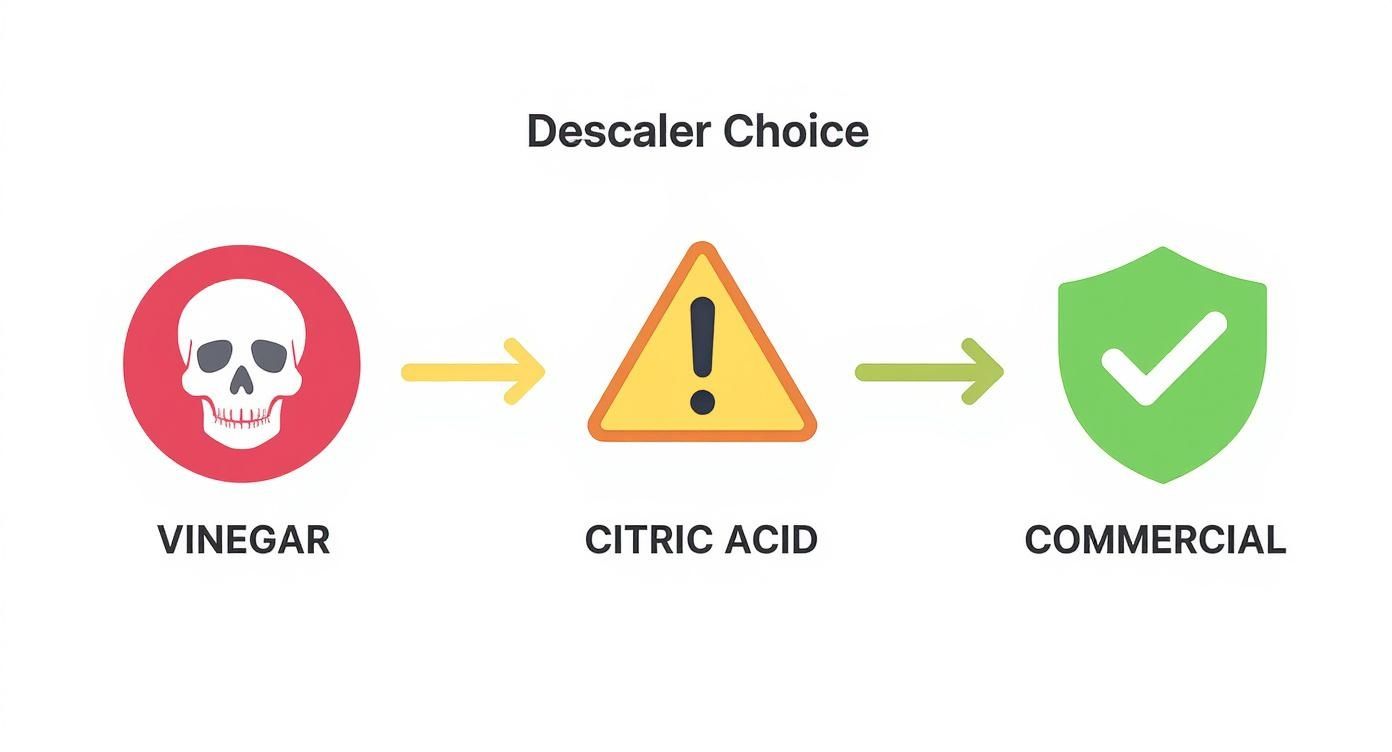
As you can see, while vinegar might seem like a cheap fix, it poses a real risk to your machine's delicate parts. Commercial descalers are designed specifically for the job, ensuring safety and performance.
The Method for Manual Lever Machines
Descaling a manual lever machine takes a bit more hands-on effort. Prepare your solution, add it to the boiler or tank, then turn the machine on to heat up.
Once at temperature, pull the lever to run some solution through the group head. Use the steam and hot water wands to get the solution circulating properly.
Let the solution sit inside the hot boiler for about 30 minutes. After this rest period, flush out all the remaining solution. The rinsing stage is especially important here; flush the machine thoroughly with fresh water two or three times.
For a similar process on a different appliance, see this practical guide on how to descale a kettle.
Creating a Smart Descaling and Prevention Routine
While it’s satisfying to run a deep clean, preventing limescale build-up in the first place is the real win. A smart, proactive routine is always better than reacting to a machine that's already struggling.
Your ideal descaling schedule depends on two things: how often you use your machine and the hardness of your water.
How Often Should You Descale?
There’s no magic number, but you can build a reliable schedule. A solid rule of thumb is to descale every 2-3 months if you're using unfiltered tap water in a hard water area. If your machine has a warning light, never ignore it.
- Hard Water & Daily Use: Every 8-12 weeks.
- Soft Water or Light Use: Every 4-6 months.
- Using Filtered Water: This is the game-changer. You can often stretch it to 6-12 months.
With more of us buying quality espresso machines, a proper maintenance routine is the only way to protect that investment.
The Ultimate Prevention Strategy: Filtered Water
The single best thing you can do to fight limescale is to stop it at the source by using filtered water.
Your tap water contains dissolved minerals that create scale. A good water filter removes a huge chunk of these minerals before they enter your machine. Using filtered water slows the scaling process dramatically, meaning less frequent maintenance and better-tasting coffee. This same principle of preventative care is seen in guides for ice machine descaling and maintenance best practices.
By filtering your water, you’re not just preventing scale—you're actively preserving the health of your machine's internal components. It's the easiest and most impactful preventative measure you can take.
An inexpensive filter jug or a dedicated in-tank filter will massively cut down on mineral deposits. To learn more, check out our guide on the importance of regularly changing your water filter.
Troubleshooting Common Descaling Problems
You’ve gone through the steps to descale your espresso machine, but something isn’t quite right. Don't worry. This section helps you fix the little issues that can pop up after a clean.
We'll tackle the most frequent issues, from a stubborn descaling light to a machine that has lost its will to pump water. These simple fixes can often save you the stress and expense of a service call.
The Descale Light Won't Go Off
This is a common headache. You've completed the cycle, but the warning light is still glaring at you. This is usually a sensor issue, not a sign of remaining scale.
Many machines use a counter that tracks water volume. The descaling program must be completed exactly as the manufacturer specifies to reset this counter. If you interrupt the cycle, the alert stays active.
The fix is usually simple: run the entire descaling cycle again using only fresh water (no descaling solution). This should complete the programmed sequence and turn off the light.
Machine Is Struggling to Pump Water
After a descale, your machine might sound like it's working, but nothing is coming out. This is usually caused by an airlock—an air bubble trapped in the pipes. It’s common if you’ve completely emptied the water tank.
To clear an airlock:
- Fill the water tank to the top.
- Turn the machine on and run the hot water wand for 30-40 seconds. This gives the pump an open path to push the air out.
- If that doesn’t work, try turning the steam knob on and off a few times while the pump is running to dislodge the trapped air.
This technique often helps the pump to re-prime itself and gets water flowing again.
My Coffee Tastes Chemical or Sour
A lingering chemical taste means you haven't rinsed the machine enough. Some descaling solution is still in the system. While commercial descalers are non-toxic, they will ruin the flavour of your espresso.
The solution is a more thorough flush. Don't just run one tank of fresh water through; run at least two full tanks. Purge water through every outlet—group head, hot water spout, and steam wand—to guarantee the system is pristine.
Frequently Asked Descaling Questions
To wrap up, let's tackle the most common questions we get about how to descale an espresso machine. This will clear up any lingering doubts.
Descaling vs. Cleaning: What's the Difference?
This is a classic point of confusion. Descaling and cleaning are two completely different jobs. Descaling deals with the invisible enemy inside, while cleaning tackles the visible gunk.
- Descaling: An internal cleanse using a mild acid to dissolve mineral scale in the boiler, pipes, and heating elements.
- Cleaning (or Backflushing): A process using a detergent to remove coffee oils and grounds from the group head, shower screen, and portafilter.
Both are essential for a healthy machine and great-tasting coffee, but they solve entirely different problems.
How Can I Tell if I Have Hard Water?
The quickest way to check is to look inside your kettle. That chalky, white film on the bottom is a dead giveaway you have hard water.
Another test is how well soap lathers; hard water makes it difficult to get a good foam. For a more scientific answer, you can buy simple water hardness test strips online for just a few pounds.
The obsession with descaling in the UK kicked off with the home coffee boom of the late 1990s. Back then, only about 25% of owners bothered to descale their machines, leading to a shocking number of breakdowns. Thankfully, awareness has grown, and modern machines with automatic alerts make maintenance easier.
What if I’ve Never Descaled My Machine?
If it's been a year or more, you need to tread carefully. A powerful descale can cause large flakes of scale to break off and block a pipe.
For a seriously neglected machine, run the first descaling cycle with a high-quality solution. If your machine is very old and has never been descaled, it might be worth getting a professional technician to give it a once-over first. For most modern machines, a top-notch product like Jura Decalcifying 2-Phase Tablets is the way to go, ensuring a controlled, effective clean.
At ADS Coffee Supplies, we know that great coffee starts with a well-maintained machine. From professional-grade descalers to everyday cleaning essentials, we have everything you need to protect your investment and brew the perfect cup.
Explore our full range of cleaning and maintenance products today.


