
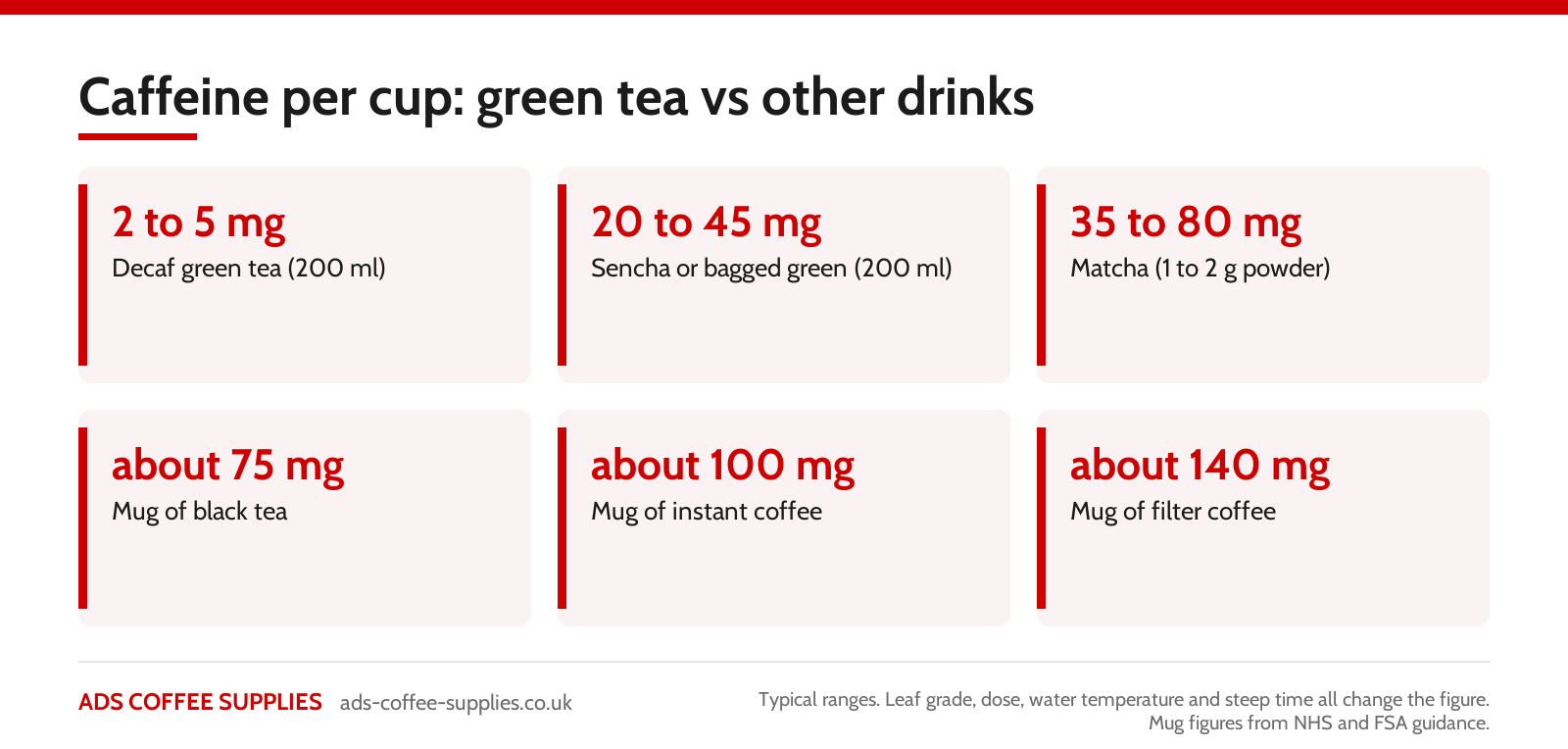
Does green tea have caffeine? Yes. Every true green tea comes from the same plant as builders’ tea, Camellia sinensis, and that plant makes caffeine to protect its leaves from insects. A standard cup of bagged green tea usually lands somewhere between 20 and 45 mg, which is roughly half what you get from a mug of black tea and about a third of a mug of filter coffee.
That average hides a lot of variation, though. A bowl of matcha can rival a single espresso, while a properly decaffeinated green tea barely registers. Below we break down the main styles, explain why the numbers move around so much, and look at what that means if you are cutting back at home or choosing teas for a café, office or hotel.
Key takeaways
- Green tea does contain caffeine, usually 20 to 45 mg in a 200 ml cup, about half the 75 mg in a mug of black tea.
- Matcha is the strongest green tea, with roughly 35 to 80 mg per 1 to 2 g serving, because the whole leaf is consumed.
- Decaffeinated green tea still contains around 2 to 5 mg of caffeine per cup, so it is low caffeine rather than caffeine free.
- Brewing green tea at 70 to 80°C for two to three minutes keeps caffeine and bitterness lower than using boiling water.
How much caffeine in green tea? The short answer by type
The figures below are realistic ranges for a normal serving, not lab maximums. We have been supplying tea and coffee to UK businesses since 1993, and the question we hear most from customers is simply “is green tea a safe swap?” This table is the quickest way to answer it.
| Green tea style | Typical serving | Caffeine (approx.) |
|---|---|---|
| Decaf green tea | 200 ml cup | 2 to 5 mg |
| Bagged green tea | 200 ml cup | 20 to 40 mg |
| Sencha (loose or pyramid) | 200 ml cup | 25 to 45 mg |
| Gyokuro (shade grown) | small Japanese serving | can exceed 100 mg |
| Matcha | 1 to 2 g whisked | 35 to 80 mg |
| Hojicha (roasted) | 200 ml cup | 10 to 25 mg |
For context, the NHS and Food Standards Agency use about 75 mg for a mug of black tea, 100 mg for a mug of instant coffee and 140 mg for a mug of filter coffee. If you want the wider picture across black, white, oolong and herbal teas, our guide to caffeine in tea covers the whole range.
Sencha and everyday green tea
Sencha is the steamed Japanese leaf most people picture when they think of green tea, and the Chinese pan-fired styles such as Mao Feng sit in a similar caffeine bracket. Most of what you will find in a café or office cupboard falls here.
Why your cup might be stronger or weaker than the label suggests
Caffeine dissolves faster in hotter water and keeps coming out the longer the leaf sits. So the same tea bag can give 20 mg or nearer 45 mg depending on how it is made. The main factors:
- Water temperature. Green tea brews best at 70 to 80°C. Boiling water pulls out more caffeine and more bitterness.
- Steep time. Two to three minutes is plenty. Leaving the bag in for five or more raises caffeine noticeably.
- Leaf grade. Young buds and tips carry more caffeine than older, larger leaves.
- Dose. Loose tea or a generous pyramid holds more leaf than a flat paper bag.
A whole-leaf option such as Teapigs Mao Feng Green Tea Temples uses larger leaves in a roomy temple, which gives a cleaner, peachy cup that stays sweet when brewed at the right temperature. Because the leaves are big and unbroken, the caffeine releases more gradually than from fine dust, so a short steep keeps it on the gentle side.

Teapigs Mao Feng Green Tea Temples (50)
Teapigs green tea blend – Mao Feng Green Tea. Regular green tea can be disappointing, this is a light and pure green tea without the disappointment. This tea…
For higher-volume settings like staff rooms, guest houses and catering, a bulk pack keeps the per-cup cost sensible. Birchall Green Tea Plant-Based Enveloped Tea Bags (250) are individually wrapped, so they stay fresh on a hospitality tray or beverage station, and the smooth, light flavour suits people who find some green teas grassy.
Birchall Green Tea Plant-Based Enveloped Tea Bags (250)
Birchall Green Tea is a purifying and restorative traditional green tea, rich in anti-oxidants. A delicious full flavoured pure green that is smooth, light and…
Matcha: the strongest green tea in the cup
Matcha behaves differently because you are not infusing the leaf and throwing it away. You whisk the whole powdered leaf into water or milk and drink all of it, caffeine included. The tea plants are also shaded for several weeks before harvest, which pushes up both caffeine and L-theanine.
A typical serving uses 1 to 2 g of powder, giving roughly 35 to 80 mg of caffeine. A large café matcha latte made with a double scoop can sit at the top of that range or beyond, comparable to a single shot of espresso. Ceremonial grades tend to be at the higher end per gram, while culinary grades used for baking and lattes vary more.
If you are adding matcha to a menu, our post on how to prepare matcha tea walks through dosing and whisking, which also helps you keep caffeine consistent from cup to cup.
Decaf green tea and lower caffeine options
Decaffeinated green tea is not caffeine free. Decaffeination removes most of it, usually around 97% or more, leaving roughly 2 to 5 mg in a cup. The better processes use carbon dioxide, which keeps more of the fresh flavour than older solvent methods. Expect a slightly softer, less grassy taste.
Other ways to get a lower caffeine green tea cup:
- Choose hojicha, a roasted green tea that is naturally lower in caffeine and pleasantly toasty.
- Brew cooler and shorter: 70°C for two minutes extracts far less than boiling water for four.
- Pick a flavoured blend, where fruit pieces or flavouring take up some of the space that would otherwise be tea leaf.
That last point is why fruit-paired greens are popular in the afternoon. Birchall Green Tea & Peach Plant-Based Enveloped Tea Bags are a good example: still a genuine green tea with caffeine, but lighter than black tea and with a sweet fruity aroma that many guests prefer later in the day.
Birchall Green Tea & Peach Plant-Based Enveloped Tea Bags (25)
Birchall Green Tea & Peach tea is floral, cleansing and rich in anti-oxidants. This is a delightful full flavoured tea with a sweet fruity fragrance. This…
If you need something with no caffeine at all, you are looking at herbal infusions such as peppermint or camomile rather than green tea. You can browse the full tea range to compare.
Green tea caffeine vs coffee: does it feel different?
Milligram for milligram, caffeine is caffeine. But plenty of people report that green tea gives a calmer, steadier lift than coffee, and there is a reasonable explanation. Green tea contains L-theanine, an amino acid linked in studies with relaxed alertness, which seems to take the edge off caffeine’s jittery side. The lower dose helps too: 30 mg spread over a slow-sipped cup is a very different experience to 140 mg in a quick mug of filter.
A practical comparison for a working day:
- Three cups of sencha: around 75 to 135 mg in total.
- Two mugs of instant coffee: around 200 mg.
- One large matcha latte: up to roughly 80 mg, sometimes more.
The NHS advises pregnant people to stay under 200 mg a day, and most healthy adults can manage up to about 400 mg. Green tea makes it much easier to stay well within either figure while still enjoying several hot drinks.
Green tea on a café, office or hotel menu
For businesses, green tea earns its place because it answers the customer who wants something lighter than coffee without going fully herbal. A few tips from years of setting up drinks stations across the UK:
- Label it clearly. Customers increasingly ask about caffeine. A simple note such as “contains caffeine, less than black tea” saves staff time.
- Offer hot water below boiling. If your machine or urn has adjustable temperature, set a green tea point around 80°C. If not, a minute’s rest after boiling helps.
- Think cold, too. Iced green tea sells well from May to September and is quick to make.
For iced drinks, Simply Watermelon Iced Green Tea Syrup lets you build a fruity cooler in seconds with water, ice, fresh mint and a slice of melon. Caffeine content in syrup-based drinks depends on the recipe, so check the bottle and tell customers if you also add brewed green tea to the glass.
Simply Watermelon Iced Green Tea Syrup (1 Litre)
The combination of juicy melon and herbal tea in Simply Watermelon Iced Green Tea Syrup is perfect during warmer weather. This bittersweet syrup is super easy…
If you would like help pairing teas with your coffee setup, our Eastbourne team can advise, and we deliver UK-wide with free next working day delivery on orders over £69 ex VAT.
Frequently asked questions
Does green tea have more caffeine than black tea?
No, in most cases green tea has less. A cup of bagged green tea usually contains 20 to 40 mg of caffeine, while a mug of black tea is around 75 mg according to NHS guidance. Matcha is the exception, as you drink the whole powdered leaf, so a serving can reach 35 to 80 mg, putting it level with or above black tea.
Is green tea caffeine free?
No. All green tea comes from the Camellia sinensis plant, which naturally contains caffeine. Even decaffeinated green tea keeps a small amount, typically 2 to 5 mg per cup. If you need a drink with no caffeine at all, choose a herbal infusion such as peppermint, camomile or rooibos, which are made from other plants and contain none.
How much caffeine is in a cup of matcha?
A typical serving of matcha uses 1 to 2 g of powder and contains roughly 35 to 80 mg of caffeine. The exact amount depends on the grade, the dose and how much you use per drink. A large café matcha latte made with a double scoop can sit at the top of that range, similar to a single espresso.
Can I drink green tea while pregnant?
Generally yes, within limits. The NHS advises keeping total caffeine under 200 mg a day during pregnancy. At 20 to 45 mg per cup, several cups of regular green tea fit comfortably, but matcha and strong brews add up faster. Count coffee, cola and chocolate too, and speak to your midwife or GP if you are unsure.
Does brewing green tea longer increase caffeine?
Yes. Caffeine keeps dissolving the longer the leaves steep and the hotter the water is. Brewing at 70 to 80°C for two to three minutes gives a sweeter cup with less caffeine. Boiling water and a five minute steep can noticeably raise caffeine and also make the tea taste bitter and astringent.

