You're probably looking at a shortlist right now and finding the same problem most buyers hit. One machine looks cheap but vague on performance. Another looks polished but gives you little detail on what happens after installation. A third seems ideal until you realise nobody has explained cleaning, filtration, spare parts, or what daily use will feel like.
That's where most filter coffee machine buying guides fall short. They compare buttons, carafe style, and headline capacity, but they don't help you judge whether a machine will still be the right choice six months after it arrives. If you're choosing filter coffee machines UK buyers can rely on for an office, café, hotel, or home setup, the better question isn't just “what features does it have?” It's “what will ownership look like from day one to year three?”
Table of Contents
- Your Guide to Choosing the Right Filter Coffee Machine
- Why Choose a Filter Coffee Machine
- Matching the Machine Type to Your Needs
- Key Features That Genuinely Improve Your Coffee
- Sizing Your Machine and Planning for Installation
- The Financials Running Costs Leasing vs Buying
- Making Your Choice and Planning for Aftercare
Your Guide to Choosing the Right Filter Coffee Machine
A good buying decision starts with the setting, not the machine. A home user making a morning pot has very different needs from an office manager serving a team, and both are different again from a café trying to move breakfast traffic quickly. If you start with finish, colour, or a long feature list, you'll usually buy the wrong thing.
Filter brewing matters more in Britain than many buyers assume. In the UK coffee machines market, drip filter coffee machines hold 28% of the market share, making them the second-largest product segment, and the UK accounts for 7% of the total European coffee machines market share according to Fortune Business Insights coffee machine market data. That tells you two useful things. First, filter coffee isn't a fringe format. Second, buyers across homes and commercial spaces still rely on it for practical daily service.
The easiest way to stay on track is to work through the decision in order:
- Define the use case. Are you serving one pot at a time, or repeated batches through the day?
- Choose the machine format. Glass jug, thermal server, or bulk brew.
- Check brewing fundamentals. Temperature control matters more than cosmetic extras.
- Plan ownership. Cleaning access, water quality, consumables, and support all affect cost.
A lot of buyers skip that final step and regret it. A machine that's easy to buy can still be awkward to live with.
If you want a broader starting point before narrowing down to filter systems, this guide on how to choose a coffee machine is a useful first filter for matching machine type to drink style and setting.
Practical rule: Buy for the busiest hour you expect, not the quietest hour you hope for.
Why Choose a Filter Coffee Machine
Filter coffee machines make sense when you need reliable volume, simple operation, and consistent black coffee without an espresso workflow. That's why they remain popular in offices, breakfast rooms, meeting spaces, and cafés that want a second coffee offer alongside espresso.
Where filter coffee works best
In offices, the biggest advantage is ease. Staff don't need to learn puck prep, milk texturing, or drink programming. They add water if it's a manual-fill machine, load the filter and coffee, and brew a batch. That simplicity reduces misuse and keeps the machine available for everyone, not just the one person who knows how it works.
In hospitality, filter coffee is often the sensible answer where speed matters more than theatre. Hotels, catering counters, and self-serve breakfast areas benefit from batch brewing because service stays smooth even when demand arrives all at once.
At home, the appeal is different. A solid filter machine gives you a full pot with little fuss, and it suits households where people drink mugs rather than short espresso-based drinks. If you enjoy clean, straightforward coffee and don't want a grinder-integrated espresso setup on your worktop, filter is often the calmer option.
A helpful way to think about it is this:
- For offices. It reduces training and keeps coffee service simple.
- For cafés. It adds a scalable black coffee option without slowing the espresso bar.
- For homes. It gives repeatable brewing without a steep learning curve.
If you're still weighing up what filter coffee is and how it differs from espresso-based long drinks, this explanation of what is filter coffee clears up the confusion that causes many wrong purchases.
Where it is the wrong choice
Filter coffee machines are not the best answer for every buyer. For those who want flat whites, cappuccinos, and lattes, a filter brewer won't solve that demand. It can complement an espresso setup, but it won't replace one.
That matters because many first-time buyers try to force one machine to cover every coffee habit. It rarely works. A filter machine is strongest when the drink brief is clear: black coffee, served consistently, in sensible volume.
Use filter brewing when the priority is batch consistency. Don't use it when the priority is milk drinks or espresso-style drinks.
Matching the Machine Type to Your Needs
The biggest ownership mistake isn't choosing a bad brand. It's choosing the wrong format. The machine may work perfectly and still be wrong for the room, the service pattern, or the people using it.
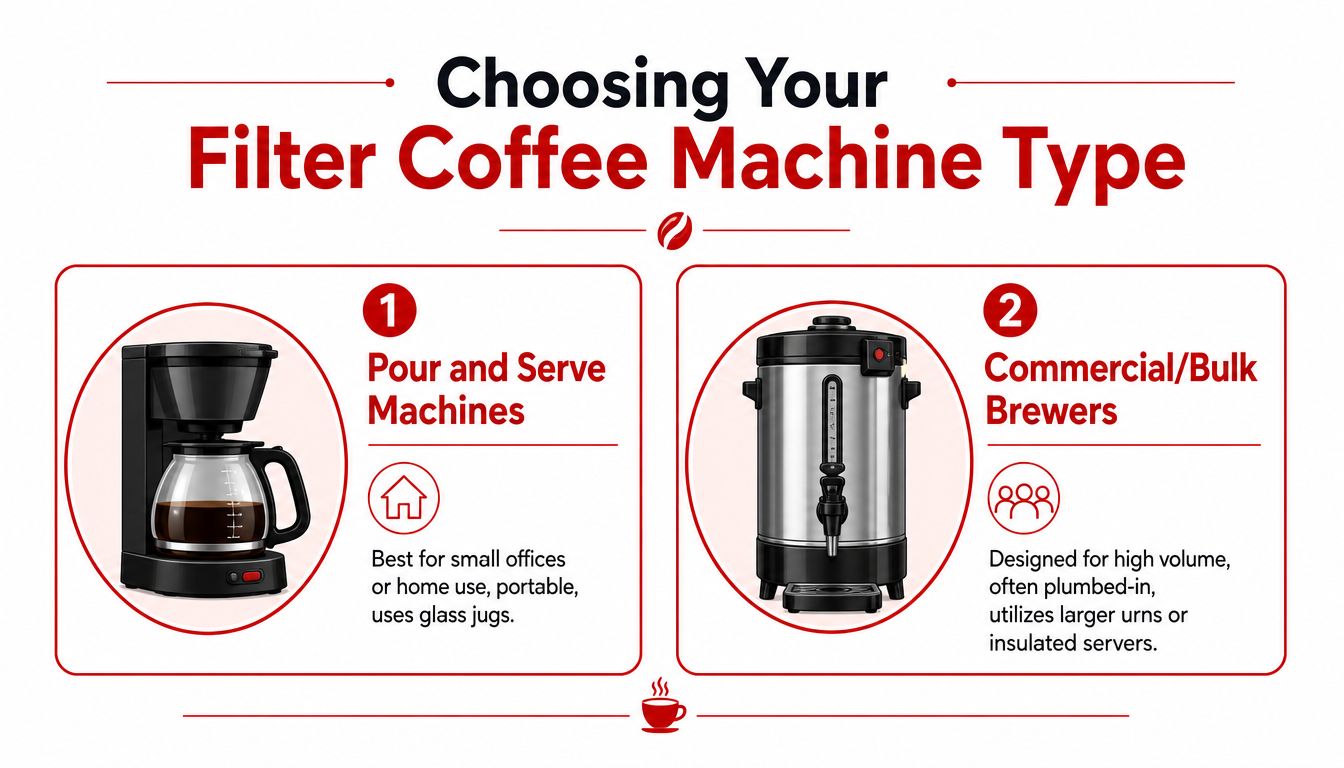
Professional demand is moving in a clear direction. The UK automatic professional drip coffee machines market is projected to reach USD 7.0 million by 2033, growing at a CAGR of 5.5%, driven by cafés and coffee shops, according to Grand View Research's UK automatic professional drip coffee machines outlook. That matters because it reflects how many commercial buyers now see filter brewing as a serious service format rather than an afterthought.
Pour and serve machines
These are the familiar machines that brew into a glass jug or insulated carafe. They suit smaller offices, meeting rooms, homes, and lower-volume hospitality spaces.
Their strengths are straightforward:
- Compact footprint. They fit under cupboards and on standard counters.
- Simple workflow. Fill, brew, serve, repeat.
- Low complexity. Staff usually understand them quickly.
Their limits are just as important. A glass jug on a hot plate can hold coffee, but it can also flatten flavour if brewed coffee sits too long. They also create more frequent brew cycles in busier spaces, which can turn a practical machine into a bottleneck.
Bulk brew and airpot systems
Bulk brewers are built for a different job. They brew into larger insulated servers, urns, or self-serve dispensers, and they suit breakfast service, event spaces, larger staff kitchens, and cafés with steady demand.
They work well when you need:
- Higher output without repeated small batches
- Better heat retention through insulated service
- Less staff intervention once the brew is complete
The trade-off is space, setup, and cleaning routine. Some models need plumbing, and many need a clearer plan for where brewed coffee will be served from. They reward organised service. They're less forgiving in cramped or casual setups.
A quick decision table
| Setting | Better fit | Main reason |
|---|---|---|
| Home kitchen | Pour and serve | Small footprint and simple batch brewing |
| Small office | Pour and serve or thermal carafe model | Easy use without a complex install |
| Meeting area | Pour and serve | Portable serving and quick reset |
| Hotel breakfast room | Bulk brew | Handles repeated service more smoothly |
| Busy café | Bulk brew or professional automatic drip | Supports higher-volume black coffee service |
One practical test helps. Ask where the coffee will be poured. If the answer is “right beside the machine”, a pour and serve unit may be enough. If the answer is “across the room, over a long breakfast period, or by multiple users”, an insulated bulk system usually ages better.
Key Features That Genuinely Improve Your Coffee
Most machine specifications are there to help sell the machine. Only a small group of features actually improve the cup.
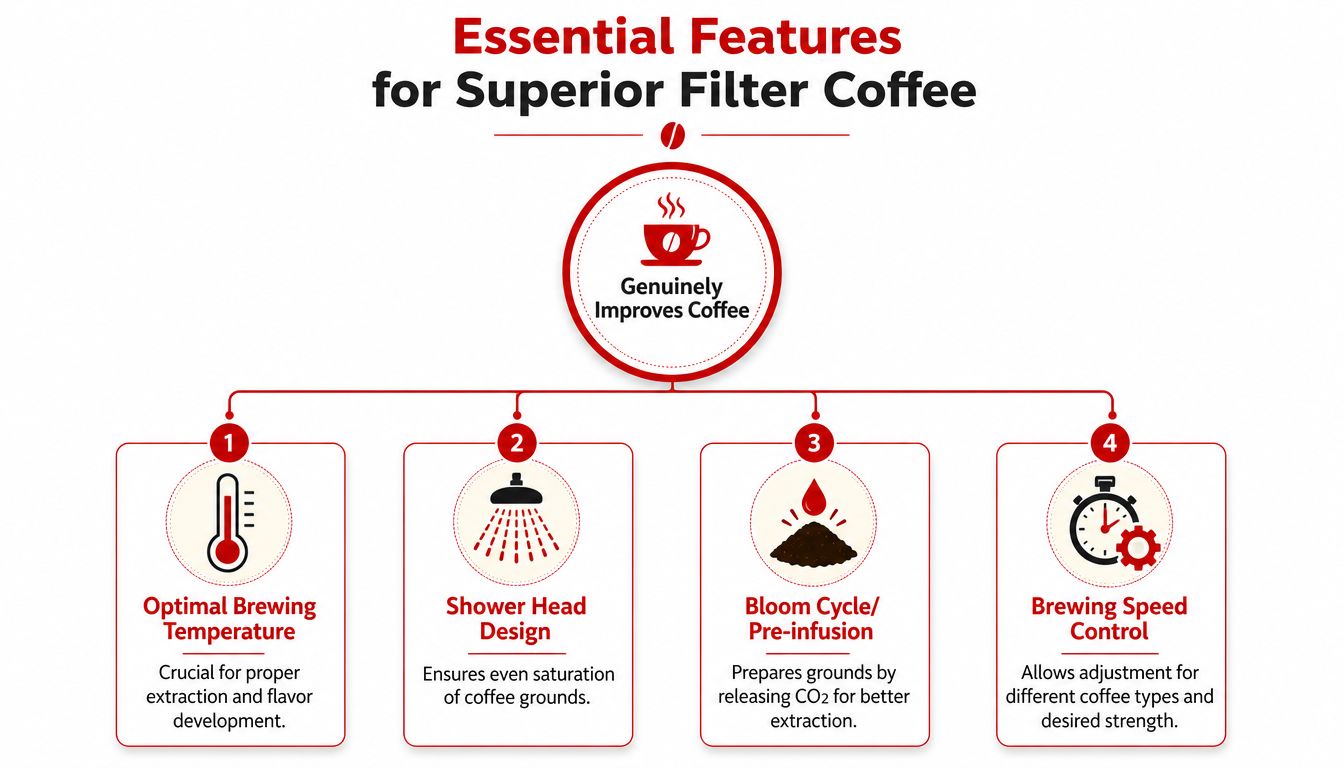
If you remember one technical point, make it temperature. High-performance filter coffee machines need to brew at 92 to 96°C for proper extraction. Machines below 90°C tend to produce sour coffee, while machines above 96°C can create bitterness, as explained in Coffee Blog's guide to filter coffee machines.
Temperature is not a luxury feature
A machine either reaches a proper brewing range or it doesn't. If it doesn't, no timer, touchscreen, or stylish finish will rescue the result.
Many buyers often get caught by low-cost machines. On paper they all seem to make filter coffee. In practice, poor heat delivery gives you weak, sour, or harsh cups, and then people compensate by overdosing coffee or leaving the brew on heat too long. That turns a cheap machine into an expensive habit.
A supplier should be able to speak clearly about brew performance, not just appearance. Water quality matters too. If scale builds up or the incoming water is poor, even a good brewer will struggle over time. This overview of water filtration and its impact on coffee flavour is worth reading before you lock in any machine decision.
To see the brewing process in action, this video gives useful visual context:
What matters after temperature
Once temperature is sorted, look at the parts that affect even extraction and day-to-day usability.
- Shower head design. Better water distribution wets the bed more evenly and reduces dry pockets.
- Pre-infusion or bloom mode. This helps the grounds release gas before the main flow, which can improve extraction consistency.
- Brewing speed control. Useful when you change coffee style or batch size.
- Filter basket design. Basket shape influences flow and contact time.
Don't pay extra for a display if the brewer can't deliver stable water temperature and even saturation.
There's also a maintenance angle. Features that improve brewing often make faults easier to diagnose. A machine with predictable temperature behaviour and clear brew controls is easier to support than one that hides poor performance behind generic presets.
Sizing Your Machine and Planning for Installation
Capacity decisions often go wrong because buyers focus on maximum jug size instead of service pattern. The right question isn't “how much can it brew?” It's “how often will people need coffee, and how quickly must the next batch be ready?”
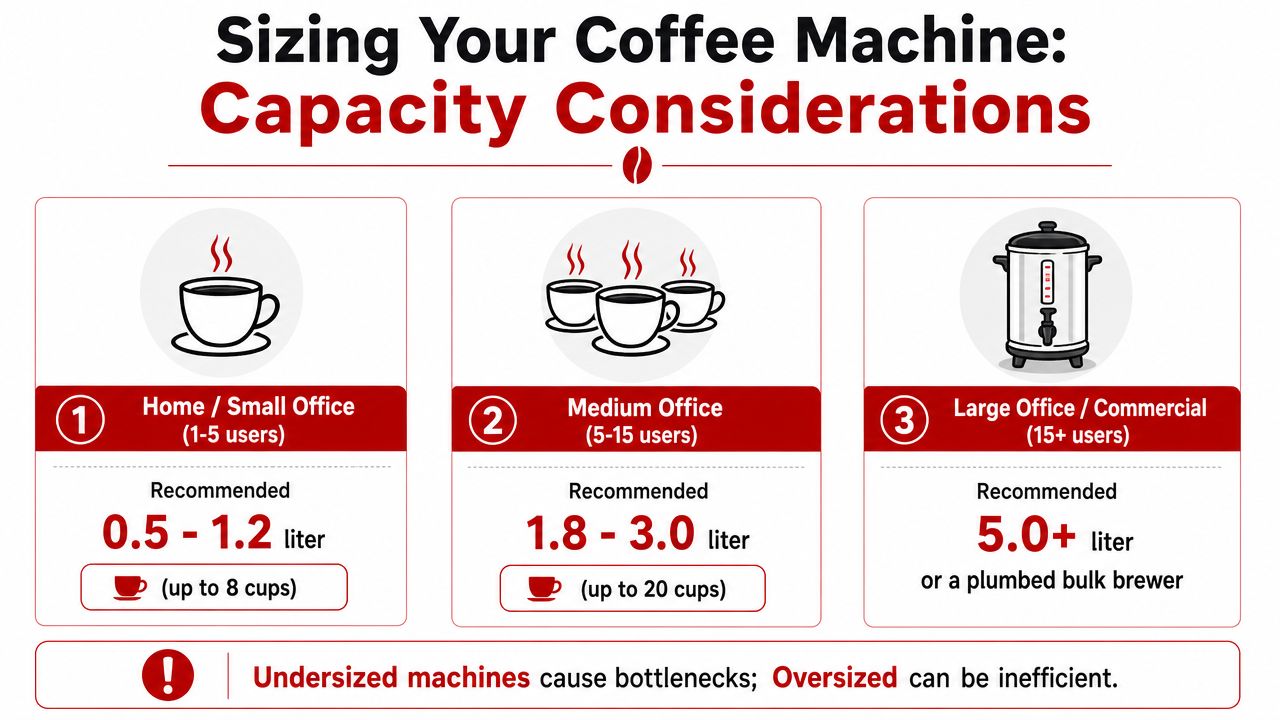
Start with service pattern not jug size
Use a simple planning method:
- Count likely users. Not everybody drinks coffee at the same time, but some environments create spikes.
- Find the peak window. Morning start, break time, breakfast service, meeting turnover.
- Decide whether coffee must stay in place or travel. That changes whether you need a jug, thermal server, or bulk dispenser.
A small office can manage with repeated fresh brews if demand is spread out. A larger office with a busy 9am rush usually can't. A café may want one filter machine for guest service and another approach entirely for back-of-house staff coffee. The room, workflow, and peak demand matter more than the marketing term on the box.
Installation details that change ownership
Installation affects taste, reliability, and maintenance burden. Manual-fill machines are simpler to place, but they rely on staff remembering to top them up correctly. Plumbed-in systems feel easier in use, but they need a sensible site check, a water point, and enough counter space for service and cleaning access.
For a proper planning checklist, this commercial coffee machine installation guide is a practical place to start.
Water quality deserves attention early. Hard water shortens service intervals and affects flavour, so filtration should be part of the install conversation, not an afterthought. In some setups, a unit such as the Brita Purity C Quell ST C1100 Water Filter may be specified as part of the wider filtration arrangement, depending on site needs and machine type.
The coffee itself needs the right preparation too. For filter coffee machines in the UK, a medium to coarse grind is the correct mechanical choice because finer coffee can cause clogging and over-extraction, as shown in this Coffee Kev video on filter brewing grind requirements.
A quick install checklist helps:
- Check clearance. Leave room to open lids, change filters, and remove jugs safely.
- Plan water treatment. Don't install first and ask about filtration later.
- Match grinder output to brewer type. Too fine a grind creates avoidable problems.
- Think about cleaning access. If staff can't reach key parts easily, cleaning standards slip fast.
The Financials Running Costs Leasing vs Buying
The purchase price is only the first line on the cost sheet. What matters more is what the machine costs to own, run, and keep producing coffee people want to drink.
What the ticket price hides
A cheap machine can become a false saving if it wastes coffee, disappoints users, or needs replacing early. Many budget filter machines sold in the UK fail to reach proper brewing temperature, creating what some buyers experience as a filter coffee illusion. The machine looks like it should make café-style coffee, but the output is sour or bitter, which raises the actual cost of ownership through poor results, according to Balance Journal's article on filter coffee machine buying pitfalls.
That shows up in several ways:
- More wasted coffee. Staff brew again because the first pot tastes poor.
- Higher ingredient use. People add extra coffee to compensate for weak brewing.
- Lower adoption. The machine sits there, but people stop using it.
- More replacement pressure. Buyers want to upgrade sooner than planned.
The cheapest machine is often the one you replace once. The most expensive one is the machine you buy twice.
Running costs also include filter papers, cleaning products, periodic descaling or filter changes, and the staff time spent managing the machine. Those costs aren't dramatic one by one, but they become very visible when the machine is awkward to use or inconsistent in output.
When buying makes sense and when leasing helps
Buying outright usually suits buyers who know exactly what they need, have capital available, and want full control over the asset. It often works well for established sites with stable demand and a clear maintenance routine.
Leasing can make more sense when cash flow matters, when a better machine would otherwise be out of reach, or when service support is part of the arrangement. For some businesses, predictable monthly cost is easier to manage than a lower-quality purchase that creates operational problems later.
This comparison of coffee machine leasing vs buying for business is useful if you're deciding based on budget structure rather than coffee quality alone.
There isn't one correct answer. The better choice is the one that matches your demand, service expectations, and ability to maintain the machine properly. A quality brewer with a sensible support plan usually beats a bargain machine that nobody trusts.
Making Your Choice and Planning for Aftercare
By the time you're ready to order, the machine itself should no longer be the only focus. The better buying question is who will help you keep it running, keep it clean, and keep it matched to your site if your needs change.
Choose the support model as carefully as the machine
A good supplier does more than dispatch equipment. They should help you confirm whether a manual-fill brewer or plumbed-in unit is more practical, what filtration needs to sit behind it, which consumables fit the basket format, and how routine cleaning will work in your setting.
That matters because ownership issues are usually ordinary, not dramatic. You need the right filter papers. You need a replacement jug. You need advice on scale prevention. You need to know whether a drop in cup quality comes from the coffee, the water, the grind, or the machine. Those are support questions, not showroom questions.
Allied Drinks Systems is one UK option for this kind of ongoing supply and equipment support. The company supplies coffee equipment, ingredients, disposables, and related parts across commercial, office, hospitality, and home settings through its contact page.
A simple final checklist
Before you sign off on any of the filter coffee machines UK buyers are comparing, check these points:
- Does the machine fit the service pattern. Not just the average day, but the busiest part of it.
- Can your team clean it properly. Daily neglect shortens machine life quickly.
- Have you planned water treatment. Good brewing starts before the water enters the machine.
- Can you get the right consumables and parts easily. A machine without ongoing support becomes a liability.
- Does the drink output match what people want. Filter coffee works brilliantly when it suits the site.
The long-term win is simple. Choose a machine that makes sense on the counter, in the cup, and in the maintenance routine. That's what turns a purchase into a dependable part of daily service rather than another problem to manage.
If you're weighing up filter coffee options for a home setup, office kitchen, café, or hospitality site, Allied Drinks Systems is a practical place to compare equipment, consumables, and support in one place.