
A single shot of espresso contains about 60 to 80 mg of caffeine. A double, which is what almost every UK café now pulls by default, contains 120 to 160 mg. Those are the numbers most people are after, so they are up front. The rest of this post is about why the range is as wide as it is, what “double espresso” actually means when you order one, and how a ristretto or lungo changes the picture.
If you want the full drink-by-drink picture including filter, instant and cold brew, we cover that separately. This post stays on espresso.
Key takeaways
- A single espresso has about 60 to 80 mg of caffeine; a double, the standard UK café shot, has 120 to 160 mg.
- A ristretto uses the same dose but stops the shot early, so it carries slightly less caffeine (100 to 140 mg), not more.
- Robusta content and dose explain most of the difference between cafés; roast level barely changes caffeine.
- UK and EU guidance sets 200 mg per sitting and 400 mg a day, roughly three doubles spread across the day.
What counts as a shot of espresso?
Historically a single espresso was 7 g of ground coffee pulled to about 25 ml. That definition still appears in Italian espresso standards, but it bears little resemblance to what comes out of a commercial machine in a British café today. The modern café shot is a double: 16 to 20 g of coffee in a double basket, extracted to 36 to 45 g of liquid in the cup over 25 to 32 seconds.
This matters for caffeine because the figure scales with the dose. Caffeine is extracted from ground coffee at a fairly stable rate under espresso pressure, roughly 90% of what the beans contain, so doubling the coffee doubles the caffeine. A café that doses 20 g will serve around 25% more caffeine per double than one dosing 16 g, from the same bag of beans.
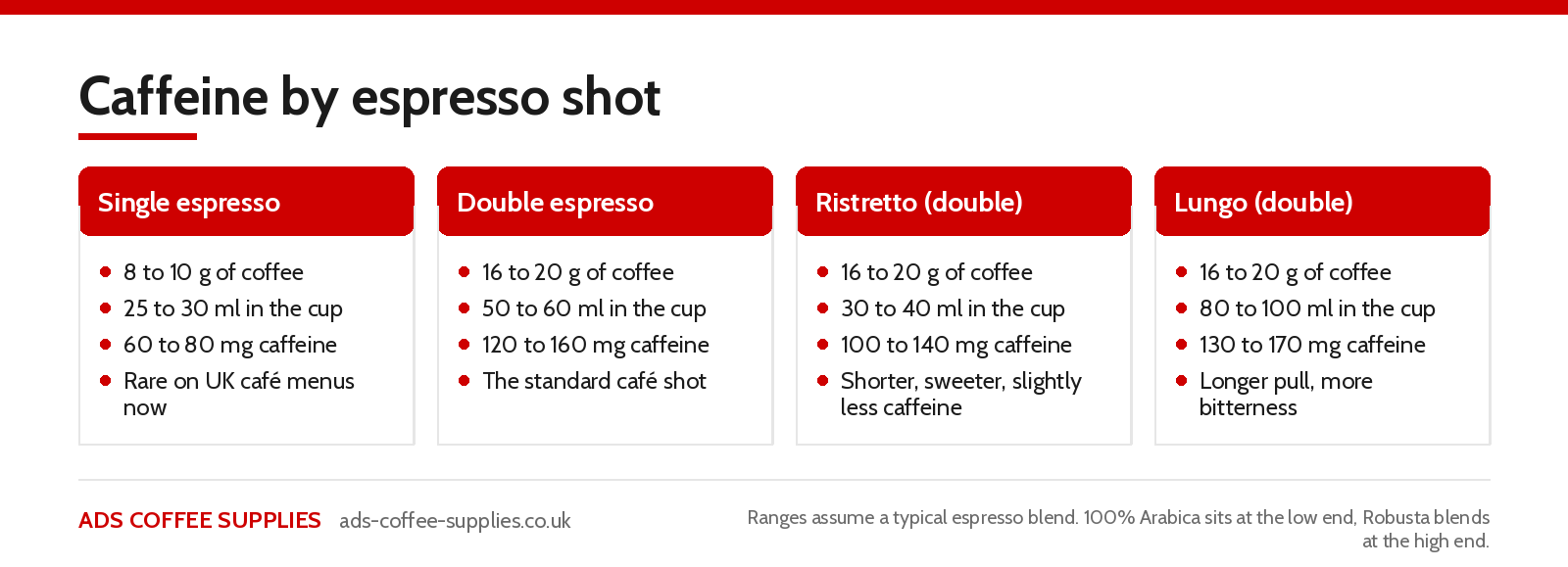
Single vs double espresso: the numbers
Single espresso: 60 to 80 mg
Made with 8 to 10 g of coffee to 25 to 30 ml. Genuinely single baskets are now rare behind UK bars. Most cafés that list a “single” either split a double shot across two cups or pull a double and throw half away, so the caffeine you get is still in the 60 to 80 mg range but the flavour is closer to a double.
Double espresso: 120 to 160 mg
Made with 16 to 20 g to 50 to 60 ml. This is the shot inside a standard latte, flat white, cappuccino and americano, which is why those drinks all contain the same caffeine regardless of size. A 12 oz latte and an 8 oz flat white from the same café usually carry identical caffeine; one just has more milk.
What is a double espresso on a menu?
When you order a “double espresso” or “doppio”, you get the same two shots that go into a milk drink, served neat in a small cup. Some cafés will offer a triple for a large drink, typically 24 to 27 g of coffee and 180 to 240 mg of caffeine, which is close to the 200 mg single-sitting limit recommended by UK and EU food safety bodies.
Ristretto and lungo: same coffee, different caffeine
A ristretto uses the same dose as a double but stops the shot early, at around 30 to 40 ml instead of 50 to 60 ml. Because caffeine dissolves quickly and most of it is out of the grounds in the first half of the extraction, a ristretto loses less caffeine than you might expect: typically 100 to 140 mg against 120 to 160 mg for the full double. It tastes sweeter and heavier because the later, more bitter compounds never make it into the cup.
A lungo runs the shot long, to 80 to 100 ml. The extra water pulls out the last of the caffeine plus the bitter end of the extraction, giving 130 to 170 mg. It is not dramatically stronger in caffeine terms, but it tastes it.
Why two doubles from different cafés can be 40 mg apart
Four things explain most of the variation.
- Blend. Robusta beans carry almost twice the caffeine of Arabica by weight. A traditional Italian-style espresso blend with 20 to 30% Robusta, such as Douwe Egberts Espresso Classic, will sit at the top of the range. A 100% Arabica blend sits at the bottom.
- Dose. Covered above: 16 g versus 20 g is a 25% difference before anything else changes.
- Grind and time. A finer grind and a longer shot extract more. A shot that runs 35 seconds instead of 25 will have slightly more caffeine and noticeably more bitterness.
- Freshness. Stale beans extract less of everything, caffeine included, though the difference is small compared with blend and dose.
For a café, the practical takeaway is that your caffeine level is set by your bean choice and your recipe card, not by the machine. A well-maintained two group machine and a properly dialled-in grinder will produce the same shot all day; the beans you put in the hopper decide where in the range it lands.

Douwe Egberts Espresso Classic Coffee Beans (1kg)
Replacing Douwe Egberts Intense. Introducing the new Douwe Egberts Espresso Classic coffee beans. This expertly crafted blend of Arabica and Robusta beans…
Summit Grande Crema Coffee Beans (1kg)
Smooth and creamy rich cocoa blend balanced with notes of sweet caramel and subtle roasted hazelnuts. Our Grande Crema produces a beautifully thick crema and…
Choosing beans for the caffeine level you want
Most customers never ask about caffeine directly; they ask for “strong” or “smooth”. Strong usually means body and bitterness, which a darker roast or a Robusta component provides, and it happens to bring more caffeine with it. Smooth usually means a medium roast 100% Arabica, which lands at the lower end of the caffeine range.
A few patterns from the blends we supply:
- Dark-roast Italian-style blends with liquorice and cocoa notes, like the Summit Italian Blend, give a punchy double at the higher end of the range and hold up well in milk.
- Medium-roast crema blends give a balanced 120 to 140 mg double that suits most all-day menus.
- Decaffeinated beans, such as the Summit Mocha Brazil decaf, produce a double with 2 to 5 mg, so a decaf flat white is a genuine evening option rather than a compromise.
Summit Italian Blend Coffee Beans (500g)
Our Summit Italian Blend offers a full-bodied dark roasted espresso with notes of deep rich chocolate and powerful liquorice
If you would like help matching a bean to your menu, the team at ADS has been supplying and servicing espresso equipment across the UK since 1993 and can usually tell you from the first sentence of the description which blend your customers are describing. Our guide to making espresso at home covers dose and timing for domestic machines.
Frequently asked questions
How much caffeine is in a double espresso?
A double espresso made with 16 to 20 g of coffee contains about 120 to 160 mg of caffeine. It is the standard shot in UK cafés and the same amount goes into a latte, flat white, cappuccino or americano, so those drinks carry the same caffeine as the double on its own.
Is espresso stronger than regular coffee?
Per millilitre, yes: espresso has around 2 mg of caffeine per ml against roughly 0.4 mg per ml for filter coffee. Per serving, a 240 ml mug of filter coffee (80 to 120 mg) usually contains more caffeine than a single espresso (60 to 80 mg) and about the same as a double.
Does a ristretto have less caffeine than an espresso?
Slightly. A ristretto uses the same coffee dose but stops the shot early, so it ends up with roughly 100 to 140 mg for a double, compared with 120 to 160 mg for a full double espresso. Most of the caffeine is extracted early in the shot, so the difference is smaller than the volume suggests.
How many espresso shots are safe in a day?
UK and EU food safety guidance sets 400 mg of caffeine a day for healthy adults and 200 mg in one sitting. That is about three doubles spread across the day, or one triple at a time. The NHS advises pregnant women to keep to 200 mg a day in total.
Do dark roast espresso beans have more caffeine?
Not meaningfully. Roasting removes very little caffeine. Dark-roasted beans weigh slightly less, so if you dose by volume you get a few more beans and a touch more caffeine, but weighed doses come out the same. The stronger taste of a dark roast is bitterness and body, not caffeine.

