
A cup of coffee in the UK contains somewhere between 60 and 160 mg of caffeine, and the honest answer to “how much caffeine in coffee” is that the drink name tells you less than you would think. A single espresso and a mug of instant land in roughly the same place. A large filter coffee from a jug can carry twice the caffeine of a double espresso, simply because there is more of it. The figures below are what you can expect from a typical serving, followed by the four variables that actually decide the number.
If you are asking because you run a café or an office kitchen, the second half of this post covers the questions customers and staff ask most, and which products on our shelves sit where on the scale.
Key takeaways
- A standard UK cup of coffee contains 60 to 160 mg of caffeine; a double espresso and a mug of filter coffee both sit around 100 to 160 mg.
- Milk drinks carry the same caffeine as the espresso shots inside them, so a latte is not a lighter option than an espresso.
- Bean type and dose move the figure more than the drink name: Robusta blends can carry 30 to 50% more caffeine than 100% Arabica.
- Decaf still contains 2 to 7 mg per cup, and the UK safe daily limit for healthy adults is 400 mg.
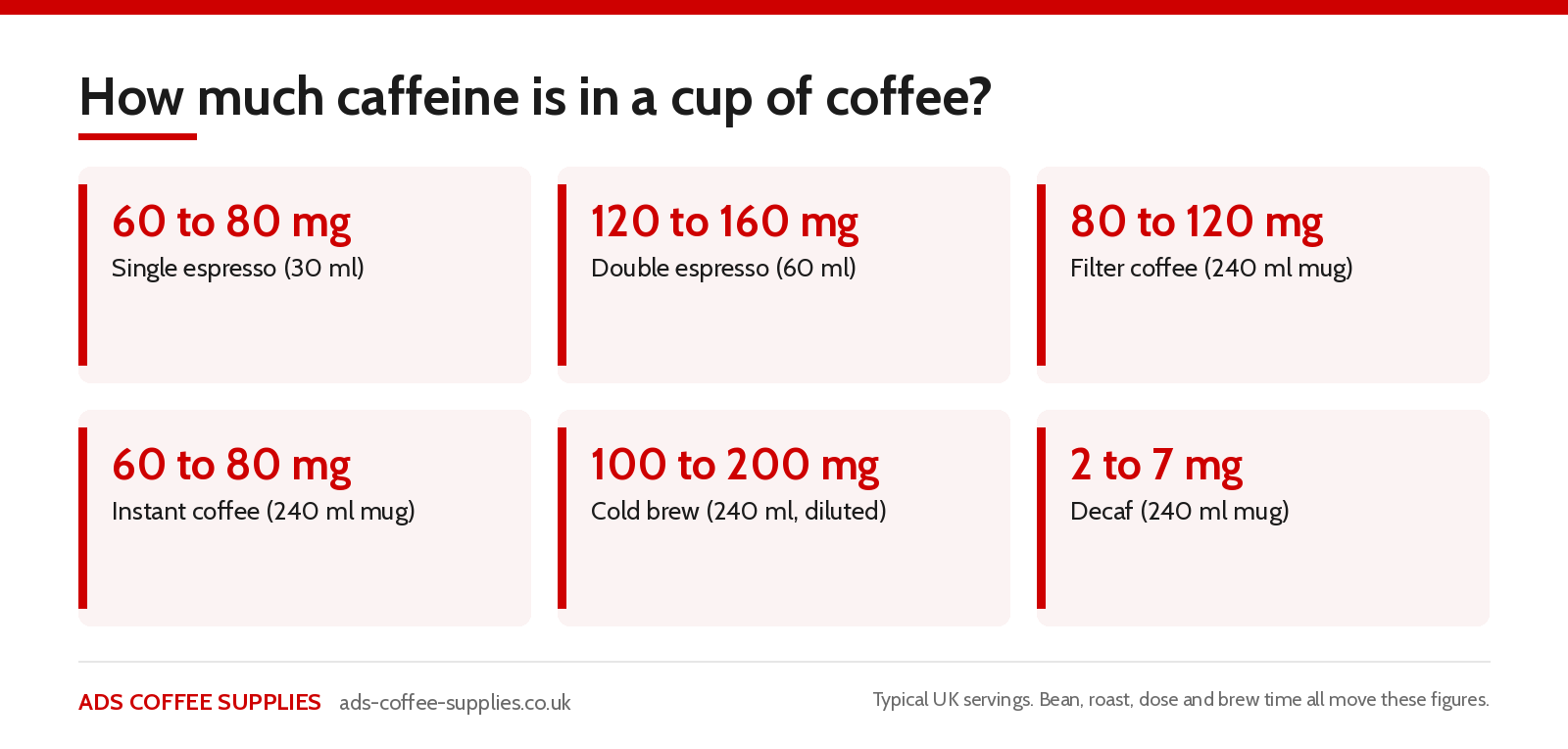
Caffeine in coffee by drink type
These ranges are for the serving sizes most people in the UK actually drink, not the laboratory standard 8 oz cup you see in American tables.
| Drink | Typical serving | Caffeine |
|---|---|---|
| Single espresso | 25 to 30 ml | 60 to 80 mg |
| Double espresso | 50 to 60 ml | 120 to 160 mg |
| Flat white, latte, cappuccino (double shot) | 200 to 350 ml | 120 to 160 mg |
| Americano (double shot) | 250 ml | 120 to 160 mg |
| Filter or cafetière coffee | 240 ml mug | 80 to 120 mg |
| Instant coffee | 240 ml mug, 1 heaped teaspoon | 60 to 80 mg |
| Bean to cup machine coffee | 150 to 200 ml | 70 to 130 mg |
| Cold brew (diluted) | 240 ml | 100 to 200 mg |
| Decaf (any method) | 240 ml | 2 to 7 mg |
The milk drinks are worth a second look. A latte does not have less caffeine than an espresso; it has exactly the same, because the milk adds volume but no caffeine. That surprises a lot of people who switch to a latte thinking it is the gentler option.
The four things that change the number
Two cafés using the same drink names can serve very different amounts of caffeine. These are the levers.
1. The bean: Arabica or Robusta
Arabica beans contain roughly 1.2 to 1.5% caffeine by weight. Robusta is closer to 2.2 to 2.7%, so a blend with a Robusta component can carry 30 to 50% more caffeine than a 100% Arabica coffee at the same dose. Most Italian-style espresso blends include some Robusta for crema and body, which is one reason a commercial espresso often feels stronger than a home one.
2. The dose
Caffeine is pulled from ground coffee, so more coffee in the basket or the filter means more caffeine in the cup. A modern café double shot uses 18 to 20 g of coffee. Ten years ago 14 g was normal. A cafetière made at a ratio of 60 g per litre will out-caffeinate one made at 45 g per litre by a third, with the same beans.
3. Contact time and water temperature
Espresso extracts for 25 to 30 seconds. A filter brew takes 4 to 6 minutes. Cold brew steeps for 12 to 18 hours. Longer contact pulls more caffeine out of the grounds, which is why cold brew concentrate is so strong even though cold water is a less efficient solvent than hot. Espresso compensates with pressure and a very fine grind.
4. Roast level, which matters less than people think
Dark roasts taste stronger but do not contain more caffeine. Roasting burns off almost none of it. A dark-roasted bean loses moisture and weighs less, so if you dose by scoop rather than by weight you get slightly more beans and slightly more caffeine from a dark roast. If you dose on scales, the difference disappears.
Espresso vs filter: which has more caffeine?
Per millilitre, espresso wins easily: around 2 mg of caffeine per ml against 0.4 mg per ml for filter. Per cup, filter usually wins, because a 240 ml mug of filter holds 80 to 120 mg and a single espresso holds 60 to 80 mg. The confusion comes from mixing up concentration and quantity. If your office runs a bean to cup coffee machine, a standard 150 ml cup sits between the two, typically 70 to 130 mg depending on how the machine is programmed.
For a café, this matters when a customer asks for “something strong”. A long black with a double shot gives them 120 to 160 mg in a drink they can sip. A filter coffee from a batch brewer gives a similar amount in a bigger, milder-tasting cup. Both are honest answers; they just taste different.

Summit Grande Crema Coffee Beans (1kg)
Smooth and creamy rich cocoa blend balanced with notes of sweet caramel and subtle roasted hazelnuts. Our Grande Crema produces a beautifully thick crema and…
Instant coffee and caffeine
Instant coffee is made by brewing coffee at scale and then drying it, so a teaspoon of granules is concentrated brewed coffee rather than ground beans. A level teaspoon (about 1.8 g) in a 240 ml mug gives roughly 60 mg of caffeine. A heaped teaspoon pushes that towards 80 mg. Vending machines that run on freeze-dried coffee are usually set to dose between 1.5 and 2 g per cup, so they land in the same band.
Wholebean instant products such as Kenco Millicano include finely milled roasted beans alongside the soluble coffee, which brings the flavour closer to filter without changing the caffeine much. If you want to compare brands precisely, the caffeine content is rarely printed on the jar, so dose by weight and assume 30 to 35 mg per gram of instant coffee as a working figure. We have more detail on how instant is made in our instant coffee range.
Kenco Millicano Americano Wholebean Instant Coffee (300g)
Taste: Bold, Rounded, Heart-warming Aroma: Rich, Welcoming rich, welcoming Finish: Smooth,
Does decaf coffee have caffeine?
Yes, a little. UK and EU rules require decaffeinated coffee to have had at least 99.9% of its caffeine removed from the green bean (the figure for soluble coffee is 99.7%). In the cup that works out at 2 to 7 mg for a 240 ml serving, which is about the same as a cup of hot chocolate. Someone who drinks four decafs over a working day is still taking in less caffeine than one single espresso.
The decaffeination method, whether Swiss Water, CO2 or solvent based, changes the flavour more than it changes the residual caffeine. All three methods have to hit the same legal threshold.
How much caffeine is too much?
The UK Food Standards Agency and the European Food Safety Authority both put the safe daily limit for healthy adults at 400 mg, with no more than 200 mg in a single sitting. For pregnant women the NHS advice is 200 mg a day in total. In coffee terms, 400 mg is roughly:
- Three double-shot lattes or flat whites
- Four mugs of filter coffee
- Five or six mugs of instant
- Two large cold brews
Caffeine takes 30 to 60 minutes to peak in the bloodstream and has a half-life of around five hours in most adults, so a double espresso at 3 pm still has 60 to 80 mg working at 8 pm. That is the practical reason most cafés see decaf orders climb after lunch.
Measuring and managing caffeine in a café or office
You cannot measure caffeine on the bar, but you can control the three things that set it: the beans you buy, the dose you program or weigh, and the drink sizes on the menu. A few practical points from our customers:
- If you switch from a blend with Robusta to a 100% Arabica, expect customers to say the coffee is “weaker” even at the same dose. Warn the regulars.
- Program bean to cup machines by grams, not by “strength” presets, and write the dose down. Service engineers reset these more often than you would expect.
- Offer a proper decaf, not an afterthought. Decaf is now 10 to 15% of orders in many UK cafés and it is the drink customers judge you on in the afternoon.
- For offices, a grinder with a consistent dose, such as the Eureka Mignon Specialita for smaller teams, removes most of the cup-to-cup variation.
Eureka Mignon Specialita Coffee Grinder
55mm flat hardened steel burrs for fast, consistent espresso and brew grinding Silent Technology keeps your kitchen or café impressively quiet Stepless…
ADS has supplied cafés, offices and hospitality sites across the UK since 1993, and we service the machines as well as sell the coffee, so if you want help setting doses on an existing machine or choosing a blend with the right strength for your customers, call the team in Eastbourne or browse the full coffee range.
Frequently asked questions
How much caffeine is in a single shot of espresso?
A single 25 to 30 ml espresso made with 8 to 10 g of coffee contains about 60 to 80 mg of caffeine. Blends with Robusta sit at the top of that range or above it; 100% Arabica blends sit towards the bottom. A double shot is simply twice that, 120 to 160 mg.
Does a latte have less caffeine than an espresso?
No. A latte contains the same espresso shots as the straight espresso it is built on, so a double-shot latte has 120 to 160 mg of caffeine. The milk adds volume and softens the taste but contributes no caffeine at all.
Which has more caffeine, coffee or tea?
Coffee, by a clear margin per cup. A mug of filter coffee has 80 to 120 mg; a mug of black tea brewed for three minutes has 40 to 60 mg, and green tea is lower still at 20 to 40 mg. Cup for cup, coffee typically has two to three times the caffeine of tea.
Is cold brew stronger than espresso?
Per cup, usually yes. Cold brew concentrate steeps for 12 to 18 hours, so even after dilution a 240 ml serving carries 100 to 200 mg of caffeine, compared with 60 to 80 mg in a single espresso. Per millilitre, espresso is the more concentrated drink.
How long does the caffeine in coffee last?
Caffeine peaks in the blood 30 to 60 minutes after drinking and has a half-life of about five hours in a healthy adult. A double espresso at midday still has roughly half its caffeine active at 5 pm, which is why an afternoon switch to decaf makes a real difference to sleep.

