If you're looking at commercial coffee machines for sale, you're probably already feeling the pressure behind the decision. A café owner wants better speed at the morning rush. An office manager needs coffee that staff will enjoy. A restaurant wants something reliable that won't fail halfway through service. The machine matters because it affects drink quality, staffing, workflow, maintenance, and cash flow every day.
A lot of buying guides stop at model lists. That isn't enough. The ultimate decision comes down to how the machine fits your site, your menu, your staff, and your budget over time. If you're still working through the wider setup, this guide on starting a coffee shop is a useful companion because equipment choices only make sense when they match the business model.
Finding the Right Commercial Coffee Machine for Your Business
The first mistake new buyers make is shopping by brand before they've defined the job the machine needs to do. That's how people end up with a machine that looks impressive on a spec sheet but slows service, needs more training than expected, or creates installation problems they didn't budget for.
A better starting point is simple. Ask what kind of drinks you'll serve, who will make them, and how often the busiest periods happen. A coffee shop with trained baristas has very different needs from a hotel breakfast room or a staff kitchen.
Start with the business model, not the machine
For most buyers, the machine should support one of these setups:
- Craft-led service where quality, espresso control and milk texture matter.
- Fast self-service where consistency and ease of use matter more than latte art.
- Batch service where you need volume rather than theatre.
- Low-touch convenience where coffee is an add-on, not the main offer.
That sounds obvious, but it's where expensive mistakes usually start. A manual espresso machine in a site with high staff turnover can become a constant training issue. A fully automatic bean-to-cup unit in a specialty café can make the coffee feel generic.
Practical rule: Buy for your busiest hour and your least experienced operator. That usually gives you a more accurate answer than buying for your ideal day.
Think beyond the purchase price
The machine itself is only one part of the spend. You'll also need to think about:
- Power requirements and whether your site can support the machine.
- Water quality and the filtration needed to protect it.
- Cleaning time and who is responsible for it.
- Downtime risk if the unit fails during service.
- Consumables and support such as grinders, filters, milk systems and servicing.
The strongest buying decisions usually come from treating the machine as part of an operating system, not a one-off purchase. That approach helps you choose something that works on Monday morning, not just something that looked good in a brochure.
Matching the Machine Type to Your Business Needs
A new site can lose money before the coffee is even dialled in. A café can buy a beautiful traditional machine, then discover the team cannot keep up with cleaning, grinder adjustment, and milk consistency. An office can install a cheap bean-to-cup unit, then spend more than expected on maintenance, ingredient costs, and service callouts. Machine type affects labour, downtime, training, and customer expectation as much as drink quality.
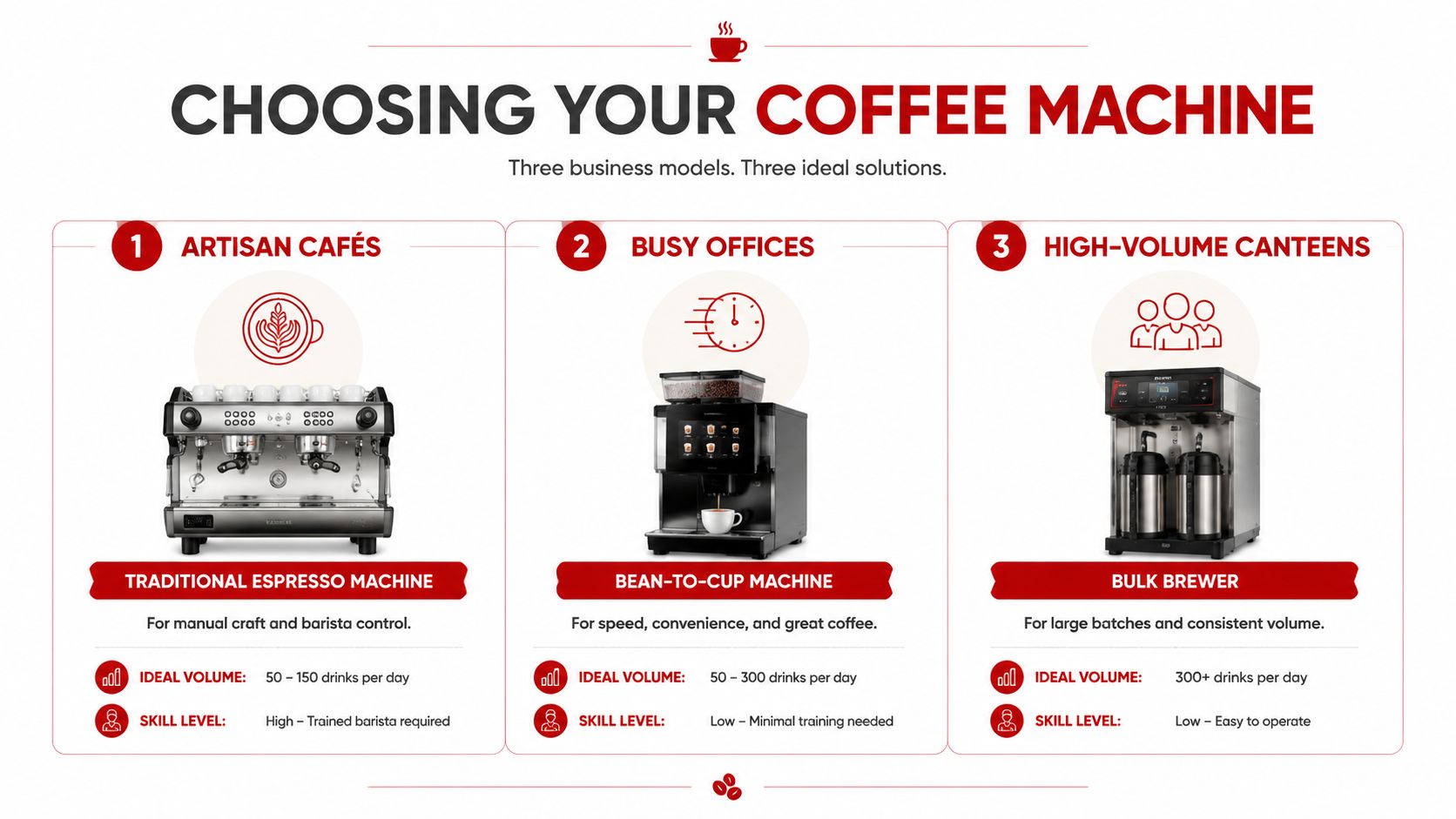
If you want a fuller breakdown of the main formats, ADS covers the core types of commercial coffee machines and where each one tends to fit best.
Traditional espresso machines
Traditional espresso machines suit businesses that sell coffee as part of the experience. Independent cafés, brunch venues, quality-led restaurants, and specialty sites usually fall into that group.
The benefit is control. A good operator can adjust grind, shot time, and milk texture to match the coffee and the menu. The machine also earns its space on the counter because customers can see drinks being prepared properly.
The cost sits in staffing and consistency. These machines need barista training, grinder management, daily cleaning discipline, and time for setup before service. In the UK, they can also bring extra site costs if you need a separate grinder setup, stronger water filtration to manage limescale, or an electrical check before installation. For some businesses, the machine itself is not the expensive part. Labour and upkeep are.
Bean-to-cup machines
Bean-to-cup machines fit sites that need repeatable drinks with less operator input. Offices, hotels, car dealerships, forecourts, garden centres, and self-service areas often get better value from this route than from a manual espresso setup.
They reduce training pressure and help protect output when staffing is inconsistent. That matters if coffee is important commercially but not the main reason a customer visits. In those cases, a machine that produces good drinks quickly can be the better investment than a more skilled setup the team cannot use properly.
There are trade-offs. Drink customisation is narrower, milk texture is less refined, and the coffee offer can feel less distinctive in a brand-led café. Long term costs also need checking closely. Cleaning systems, milk modules, service contracts, and ingredient choices all affect monthly spend, so the cheapest machine on paper is not always the cheapest machine to run.
Bulk-brew filter machines
Bulk-brew filter equipment is built for volume. It works well in conference spaces, canteens, breakfast service, churches, hospitality suites, and events where speed matters more than espresso theatre.
From an operating cost point of view, this category is often underrated. One team member can serve a large number of cups without barista-level training, and service stays quick during peaks. That reduces labour pressure and queue time.
The limitation is obvious. It is a volume solution with a narrow menu. If customers expect cappuccinos, flat whites, and fresh espresso, bulk brew will not cover the full brief on its own.
Instant and pod systems
Instant and pod systems suit low-volume locations where coffee is a supporting service. Staff rooms, waiting areas, treatment rooms, B&Bs, and back-up service points are typical examples.
The practical case for them is simple. Setup is lighter, cleaning is easier, and installation is often less demanding than plumbed commercial equipment. That can matter in smaller UK sites with limited power supply, no easy water connection, or awkward counter space.
The downside is customer perception. If coffee quality influences whether people return, spend more, or rate the experience highly, these systems can hold the business back.
Commercial coffee machine types at a glance
| Machine Type | Best For | Key Advantage | Key Consideration |
|---|---|---|---|
| Traditional Espresso | Independent cafés, specialty coffee shops, restaurants | Full control over espresso and milk quality | Higher training, labour, and setup demands |
| Bean-to-Cup | Offices, hotels, self-service areas, quick-service sites | Fast, consistent drinks with less training | Ongoing service and consumable costs need close review |
| Bulk-Brew Filter | Canteens, conferences, events, breakfast service | High-volume coffee service with simple workflow | Limited menu flexibility |
| Instant or Pod | Staff rooms, B&Bs, waiting areas, low-volume sites | Easy to run with lighter installation demands | Lower perceived quality |
The right machine type should match your staff, service style, and operating costs from day one. That is usually the difference between a machine that earns its keep and one that keeps adding expense after opening.
How to Correctly Size Your Machine's Capacity
Many individuals ask how many cups a machine can produce in a day. That's useful, but it isn't the question that causes trouble. The primary pressure point is peak demand.
If a machine can handle your total daily volume but struggles during the morning rush, you'll still lose orders, slow the queue, and stress the team. Capacity needs to match your busiest trading window, not your quiet afternoon average.
Work from peak hour, not total volume
Start with a simple estimate:
- Identify the busiest hour in your day.
- Estimate how many drinks you'll serve in that period.
- Separate milk-heavy drinks from black coffee, because milk service slows output.
- Check who is operating the machine, since staffing affects realistic throughput.
A café doing a concentrated breakfast rush needs a different setup from an office where drinks are spread across the day. A venue selling mostly flat whites and lattes also puts more strain on steaming capacity than a site serving mostly americano and filter coffee.
Leave room for growth
Undersizing is usually more expensive than buying a little headroom. Replacing a machine too early, or adding equipment after opening, is disruptive and often costs more than making the right call first time.
That matters even more in a market that's growing. The UK commercial coffee machine market is projected to rise from $136.79 million in 2021 to $386.45 million by 2033, with a 9.03% annual growth rate according to Cognitive Market Research. For a new operator, that isn't just industry trivia. It points to a market where coffee demand and customer expectations are likely to keep rising.
A practical way to size safely
Use this approach when comparing machines:
- Match current volume first: The machine must handle today's service without strain.
- Add sensible headroom: Leave enough space for stronger trade, a broader menu, or staff inefficiency during busy periods.
- Avoid buying for fantasy demand: Extra capacity is useful. Excessive overspec usually means higher cost, larger footprint, and more power demand than you need.
For a more detailed planning framework, this guide on choosing a commercial coffee machine by footfall and menu is worth reviewing before you commit.
Buy enough machine that service stays calm when the queue builds. That's the moment your equipment earns its keep.
Decoding Key Features and Technical Specifications
Spec sheets can be misleading if you don't connect the feature to the job. The important question isn't whether a machine has more functions. It's whether those functions improve service, consistency, or running costs in your setting.
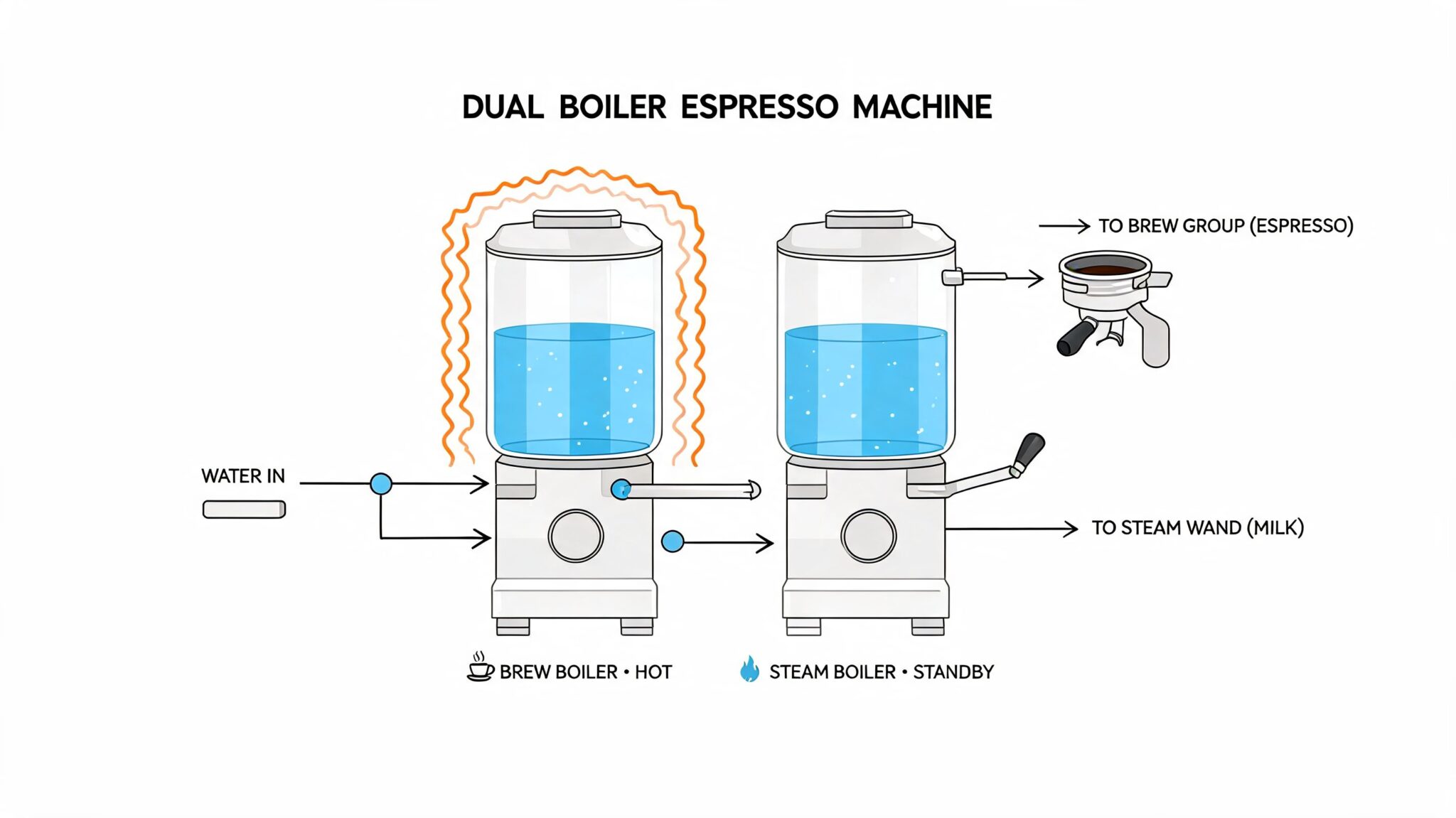
If you're comparing pump systems while reading specs, this guide on rotary pump vs vibration pump helps explain one of the details buyers often overlook.
Boiler setup and service speed
Boiler design changes how the machine behaves under load. In practical terms, the issue is whether the machine can brew espresso and steam milk consistently during busy periods.
A simpler machine can still be the right choice for a lower-volume site. But once milk drinks dominate the menu, stronger thermal stability and steam performance become far more important. That's where better boiler architecture starts to pay for itself in smoother service and fewer compromises.
Integrated grinders versus separate grinders
A built-in grinder can save space and simplify setup, especially in compact locations. It can also be helpful in lower-skill environments where fewer moving parts mean fewer operator errors.
Separate grinders usually give more control. They're easier to adjust, easier to service independently, and better suited to cafés that want to dial in espresso properly. If the grinder goes down, you haven't necessarily lost the whole coffee setup.
Milk systems and staffing reality
Automatic milk systems suit offices, self-service points, and hospitality venues where consistency matters more than handcrafted texture. They reduce training needs and can keep drinks moving when coffee isn't the operator's main skill.
Traditional steam wands offer better control and usually produce stronger results in trained hands. They also demand more attention, more cleaning discipline, and more skill. That's fine in a café. It's often less fine in a site where coffee is one task among many.
Energy use and smart features
Energy efficiency deserves more attention than it usually gets. UK mandates require new commercial coffee equipment to meet less than 0.8 kWh per litre brewed, and smart, IoT-enabled machines can deliver up to 18% labour savings through automation, according to the cited market note at Clive Coffee.
That matters because some features that look minor on paper can reduce daily labour drag:
- Automatic cleaning cycles reduce end-of-day workload.
- Remote monitoring helps staff spot issues before they become a service failure.
- Usage and stock tracking can make ordering and planning easier in multi-user environments.
- Programmable drink settings cut variation between staff members.
A feature is only valuable if your team will use it. Complex menus and advanced controls sound good, but many sites get better results from a simpler machine used properly every day.
What works and what doesn't
Here are the trade-offs that usually matter most:
- Works well: Powerful boilers, clear controls, easy-access cleaning points, and a grinder setup that suits your staff skill.
- Often disappoints: Machines with long feature lists but awkward cleaning routines, poor usability, or settings nobody understands after the handover.
- Worth paying for: Stability, ease of maintenance, and features that cut labour or reduce drink variation.
- Usually not worth paying for: Add-ons chosen for appearance alone.
Buying vs Leasing vs Refurbished A Financial Breakdown
The price on the machine isn't the actual cost. The actual cost is what the machine does to your cash flow, your tax position, your maintenance burden, and your ability to invest elsewhere in the business.
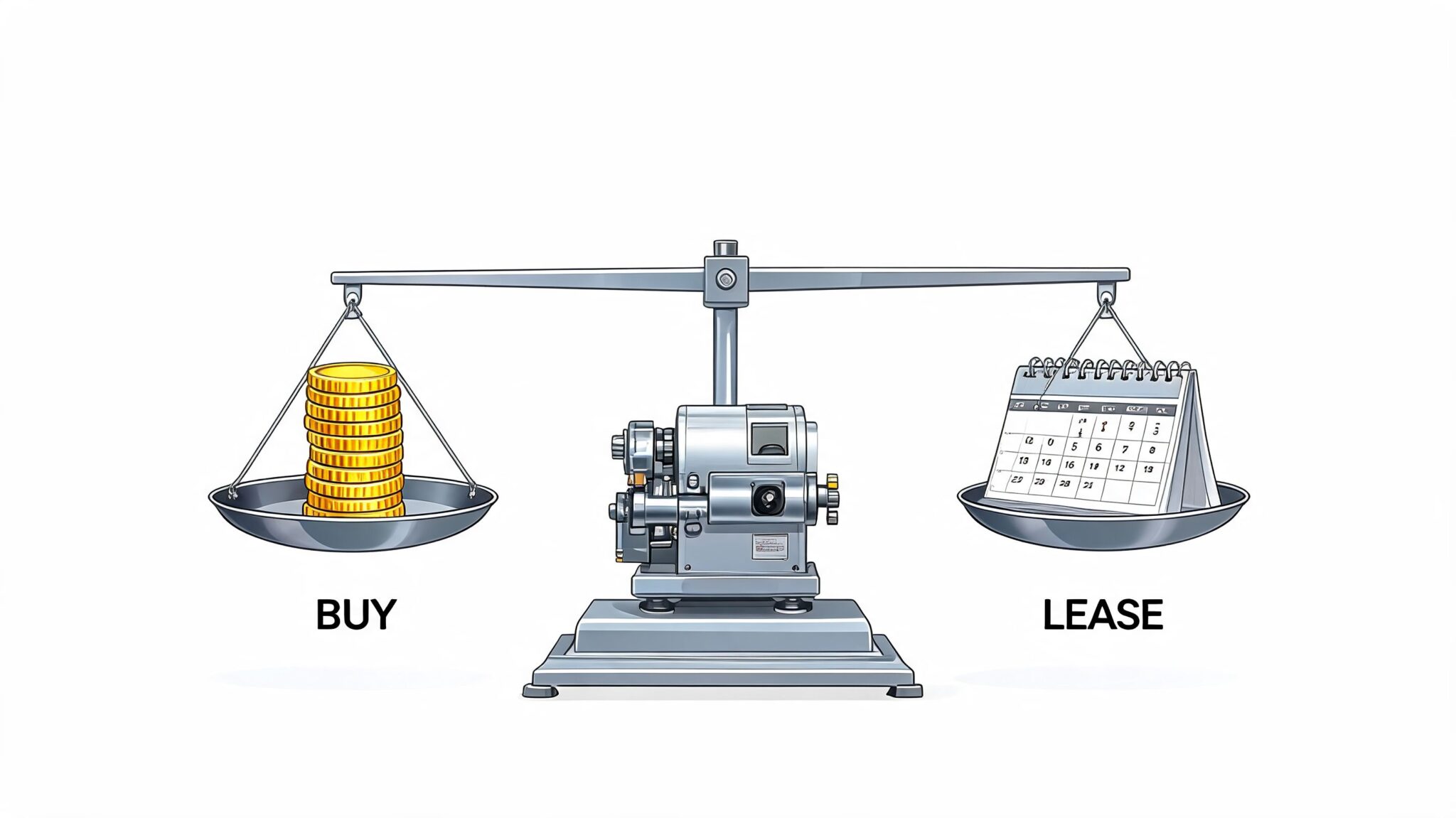
Buying outright
Buying suits businesses that have capital available and want to own the asset from day one. It can make sense if you're confident in the machine choice, your site is established, and you prefer not to commit to monthly finance.
Ownership gives you freedom. You aren't tied into lease terms, and over a long enough period the machine may work out well financially if it's maintained properly.
The weakness is obvious. The upfront spend can remove cash from other parts of the business that may matter more in the early stages, such as fit-out, staffing, stock, or marketing.
Leasing
For many UK operators, leasing is the most practical route because it protects working capital. The key point isn't that leasing is always cheaper. It's that it can make the cost more manageable and predictable.
This is especially relevant because 68% of small UK hospitality businesses cited cashflow as the top barrier to equipment upgrades, and catering equipment leases rose 22% year on year. The same market note also states that rentals are often 100% tax-deductible against profits under the UK treatment described there, as referenced in this piece on commercial coffee machine leasing and the underlying cited data at WebstaurantStore.
Leasing tends to work well when:
- Cash needs protecting: You want to keep funds available for launch costs or seasonal swings.
- The machine supports revenue: The coffee offer brings in enough value that a monthly cost is easier to justify than a lump sum.
- You want clearer budgeting: Fixed payments can be easier to manage than irregular repair and replacement decisions.
Refurbished machines
A good refurbished machine can be a smart middle ground. You reduce the upfront hit while still getting equipment that is suited to commercial use.
This route works best when the supplier has properly assessed, rebuilt, and tested the machine, and can support it after installation. Refurbished only becomes a false economy when buyers chase the lowest ticket price without asking about condition, parts history, or service support.
Which route fits which buyer
| Option | Best Suited To | Main Benefit | Main Risk |
|---|---|---|---|
| Buy Outright | Established sites with available capital | Full ownership from day one | Largest upfront cash impact |
| Lease | New businesses and cash-sensitive operators | Preserves cash flow and spreads cost | Ongoing monthly commitment |
| Refurbished | Value-focused buyers with trusted supplier support | Lower entry cost on commercial-grade equipment | Quality varies if refurbishment is weak |
The wrong finance choice can turn a sensible machine into a strain on the business. The right finance choice often makes a better machine affordable without putting pressure on cash.
There isn't one correct answer for every buyer. A stable business with strong reserves may prefer ownership. A new café, office rollout, or growing hospitality site may be better served by finance or a refurbished unit if that keeps working capital in the business where it's needed most.
Essential Site Prep Water Filtration and Installation
A lot of commercial coffee machine problems start before the first coffee is ever served. Buyers focus on the machine and forget the site. Then the unit arrives, and someone discovers the power supply isn't suitable, the counter space is too tight, or the water quality is poor enough to damage the equipment.
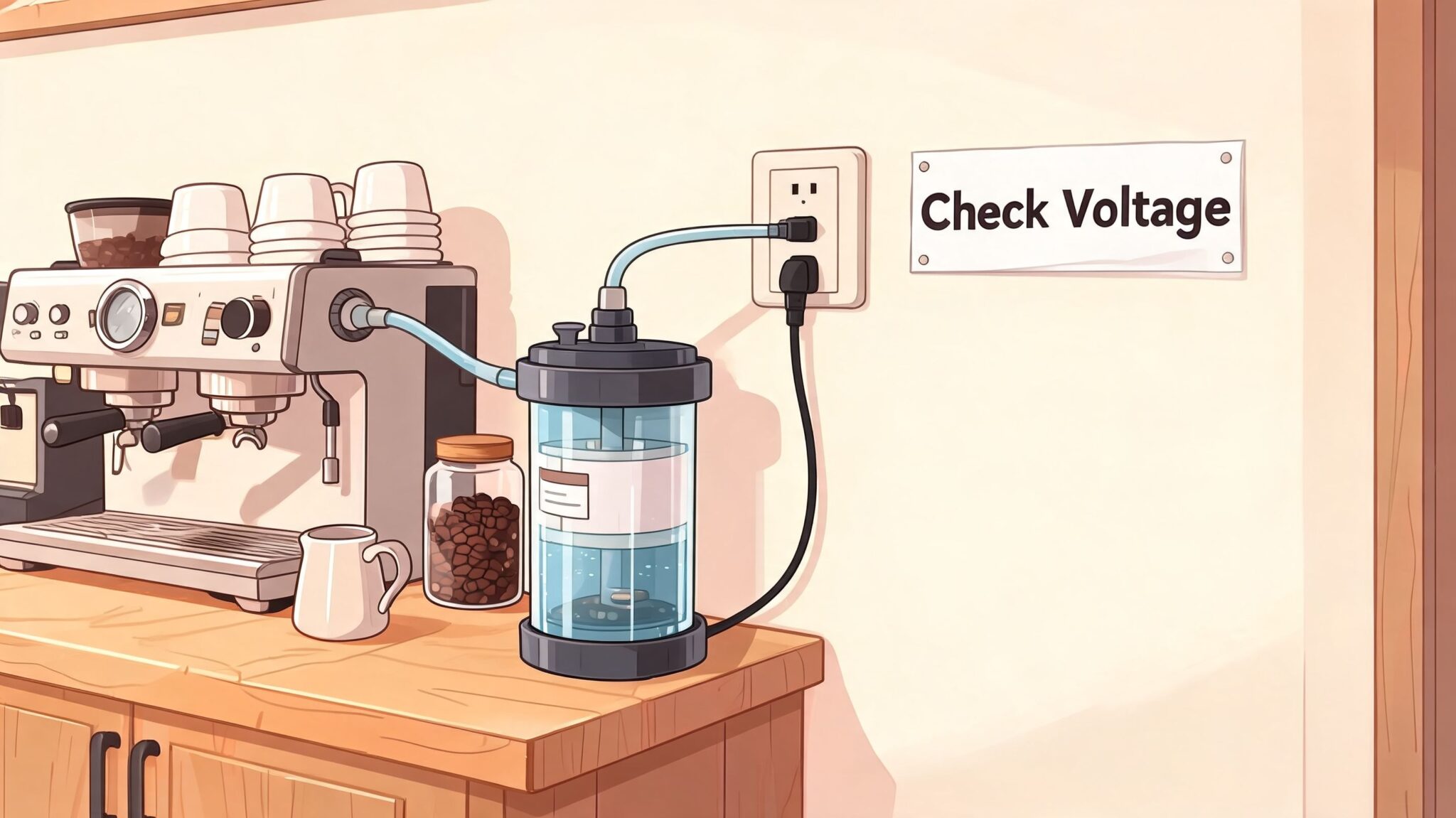
A proper pre-install check avoids most of that. This commercial coffee machine installation guide is a sensible place to start before ordering.
Check the electrical supply first
Power isn't a minor detail. A standard 2-group commercial espresso machine requires a 20-amp, 4.6kW single-phase supply, while a 3-group needs 32-amps. Assessing amperage before purchase is important because retrofit work can cost over £500, based on the cited machine specification note at White Horse Coffee machine specs.
That has practical consequences:
- A machine may physically fit but still be wrong for the site.
- An electrician may need to upgrade the supply before installation.
- A rushed purchase can delay opening or create unplanned cost.
For offices, cafés, and hospitality sites in older buildings, this check is especially important.
Water filtration is not optional
Water affects two things immediately. It affects the taste in the cup, and it affects the condition of the machine.
Hard water can scale up internal parts, reduce performance, and increase the need for service work. Poor water quality can also flatten flavour or add unwanted taste notes. That's why filtration shouldn't be treated as an accessory.
A proper filtration setup helps with:
- Machine protection: Reduces scale and internal wear.
- Cup quality: Supports cleaner, more consistent flavour.
- Service intervals: Helps prevent avoidable maintenance problems.
- Warranty confidence: Many suppliers expect suitable water treatment to be in place.
Good filtration doesn't just protect metal and pipework. It protects the coffee your customer actually tastes.
Installation should follow workflow, not just available space
The machine needs to fit the bar, but it also needs to fit the team. Think about grinder placement, milk fridge location, waste access, cleaning access, and whether staff can move freely during busy service.
This is also the point where a complete supplier can save time. Allied Drinks Systems offers commercial machines, filtration options, and related setup support through its UK equipment range, which is useful for buyers who want to sort machine choice and practical installation considerations through one supplier conversation rather than splitting the process across several vendors.
Partnering for Success Barista Training and Aftercare
A new machine can look right on paper and still cost you money in the first month. Service slows down, milk texture varies between staff, cleaning gets skipped on a late shift, and a small fault turns into a callout during trading hours. The machine is only one part of the investment. The people using it, and the support behind it, decide whether it earns its keep.
Training should cover the jobs your team will do every day. That means dialling in espresso, adjusting for changes in beans or humidity, steaming milk to a repeatable standard, and knowing the cleaning routine well enough to protect both drink quality and the machine itself. In cafés this affects speed and consistency. In hotels, restaurants and offices, it often matters even more because coffee is only one part of the operation and staff attention is split.
Good aftercare lowers total cost of ownership. A team that spots pressure changes, inconsistent shot times, or a steam issue early can report a problem before it becomes a breakdown. That reduces wasted coffee, emergency engineer visits and avoidable downtime. If you're leasing, that matters twice. You are still paying monthly whether the machine is producing or not.
What good aftercare looks like
Look for support encompassing the practical basics:
- A proper handover at install so staff start with the right settings, cleaning routine and shut-down procedure.
- Scheduled servicing based on usage, not just a reactive call when the machine fails.
- Fast technical support for changes in performance, not only full breakdowns.
- Clear responsibility for consumables and maintenance items such as filters, group seals and water treatment replacements.
- Training refreshers for new starters so standards do not slip after the opening period.
Supplier support matters here. Allied Drinks Systems supplies equipment, training and ongoing service support for UK businesses that want one supplier to handle the machine, the setup and the aftercare rather than leaving the operator to coordinate several contractors.
A coffee machine pays back when the team can use it properly, clean it consistently and get help before a minor issue becomes lost sales.
If you're comparing commercial coffee machines for sale, judge the support package as closely as the specification sheet. A lower purchase price can disappear quickly if training is thin, callouts are slow, or routine servicing is left to chance.