You've got a jug of lukewarm filter coffee on the counter, a pod machine humming in the corner, and a cupboard full of gear you're not quite sure you bought for the right reason. That's the usual point where a filter coffee maker UK search starts to make sense, because the question isn't “what looks clever”, it's “what works every morning without fuss, waste or silly running costs”.
If you're brewing for a busy household, a small office, or a café that needs reliable batch coffee, the wrong machine becomes a headache fast. The right one does one job properly, keeps the workflow simple, and stops you paying for convenience you don't need.
Table of Contents
- Why Filter Coffee Makers Still Matter in the UK
- Types of Filter Coffee Machines Available in the UK
- Choosing the Right Capacity for Your Needs
- Water Quality and Machine Maintenance Essentials
- Running Costs and Sustainability Compared to Alternatives
- Brand and Model Recommendations by Use Case
- Your Filter Coffee Maker Buying Checklist
Why Filter Coffee Makers Still Matter in the UK

A lot of UK buyers start with pods because they're everywhere, then realise the need is for more capacity. Breakfast in a family kitchen, a meeting room with four people waiting, or a café wanting coffee ready before the rush all point in the same direction, batch brewing. That's where a filter coffee maker earns its keep.
The market backs that up. World Coffee Portal's Coffee At Home UK Report 2023 says filter machines made up 24.1% of domestic coffee-machine sales, with total UK sales of domestic pod, filter and espresso machines at £162.8 million, up 3.5% over the previous 12 months, and 48% of UK households typically purchase ground coffee, which fits filter brewing well. You can read that in the World Coffee Portal report on the UK at-home coffee market.
Practical rule: if you want several mugs quickly, don't buy a machine designed around single cups and hope it'll behave like a batch brewer.
Who Actually Benefits
Filter machines suit people who want a bigger brew with less intervention. If you're serving two or three mugs at once, a drip brewer beats faffing about with repeated cups every time. In homes, that means less queueing at the kettle. In offices and hospitality, it means fewer interruptions during peak demand.
Grand View Research's UK outlook adds another useful clue. It says the UK coffee machine market generated US$268.6 million in revenue in 2022 and is projected to reach US$425.2 million by 2030, with drip filter the largest product segment in 2022 at 55.51% revenue share. That's a strong sign that filter is not a dead format, it's still a core one in the UK market. See the UK coffee machine market outlook from Grand View Research.
For a straight explanation of how filter coffee works in everyday terms, this guide from Allied Drinks Systems is a good companion read: what is filter coffee.
Types of Filter Coffee Machines Available in the UK
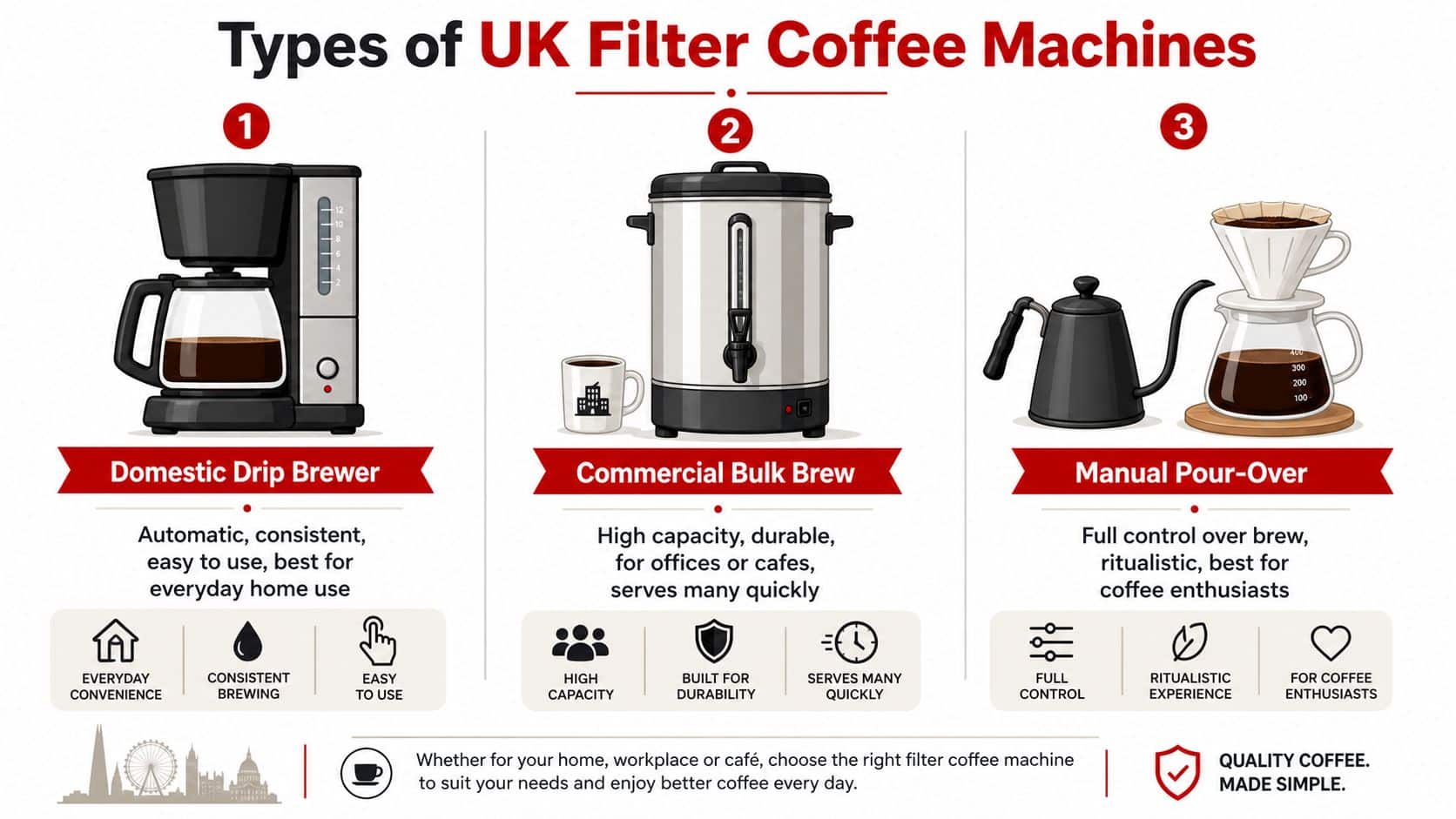
The main mistake buyers make is treating every filter machine as the same. They're not. A compact kitchen brewer, a commercial urn, and a manual pour-over kit all make filter coffee, but they solve very different problems.
Domestic Drip Brewers
Domestic drip brewers are the default choice for homes and small offices. They sit on the counter, fill a jug or thermal carafe, and do the work for you. That's the appeal, automatic brewing with little attention after you load water and grounds.
They work best where people want decent coffee without learning a manual brewing routine. They also fit UK kitchens well because the footprint stays sensible. In real use, that matters more than fancy menus. If the machine is annoying to fill, clean, or store, it gets ignored.
Commercial Bulk Brew Systems
Commercial bulk brew systems are for serious volume. A UK-listed Royal Catering unit brews up to 40 cups at once from a 6 L reservoir, while another UK-listed machine at 1.5 L is rated for 12 cups and includes a keep-warm function. The point isn't just size, it's throughput.
Use these where queue time costs you money. Offices with constant traffic, breakfast service, and self-serve hospitality stations all benefit from larger systems, but only if the output matches demand. If the capacity is too big for the shift, coffee sits too long and quality drops. That's the trade-off.
Manual Pour-Over
Manual pour-over is the hands-on option. You control the water, the pace, and the extraction, so it suits coffee drinkers who want more involvement and more consistency from their own technique. It's the cleanest route for people who already know they like filter style coffee and don't want a machine dictating the process.
Straight answer: if you want convenience, buy an automatic brewer. If you want control, buy a manual dripper. If you want volume, buy a commercial system.
For a broader look at machine categories, this relevant Allied Drinks Systems page is useful: types of commercial coffee machines.
Choosing the Right Capacity for Your Needs
Capacity is where most buyers get it wrong. They either buy too small and keep refilling, or they buy too big and end up holding stale coffee for longer than they should. The right answer is simple, match the brewer to peak demand, not the busiest fantasy you can imagine.
Use Capacity as a Serving Tool
A 750ml machine suits individuals. A 1.25-litre brewer is a better fit for households and small offices. A 1.5 to 1.8 litre machine works for larger households or offices, and 6 L systems are for high-volume venues. That sizing guidance lines up with UK buyer advice from Coffee Gear 360's filter coffee machine guide.
A brewer that's a little too small creates frustration. A brewer that's too large creates waste and dull coffee.
Capacity Guide
| Capacity | Approximate Cups | Best Suited For |
|---|---|---|
| 750ml | Individual use | Solo drinkers, compact kitchens, travel-focused setups |
| 1.2 to 1.25L | About 8 to 10 cups | Households, small offices, light batch service |
| 1.5 to 1.8L | Larger batches | Bigger families, busier workplaces, catering prep |
| 6L | Up to 40 cups | Commercial service, self-serve stations, high-volume demand |
UK retail examples fit that pattern neatly. A 1.25 L Moccamaster unit is sold in the UK for up to 10 cups, and a 1.2 L Philips unit is rated for 2 to 10 large or 15 small cups. That's the sweet spot for everyday use, because it gives you enough volume without turning the machine into a bulky urn.
For higher-volume settings, the operational balance matters. Bigger brewers reduce brew cycles, but once coffee sits on heat too long, flavour starts to fade. That's why a thermal carafe often makes more sense than a hot plate in lower-volume use. Pick the machine that fits your busiest hour, not your average day.
Water Quality and Machine Maintenance Essentials
UK water can make a good machine look bad. If limescale builds up, the brewer struggles, the flavour gets flatter, and cleaning turns into a chore instead of a routine. Water treatment and maintenance are not optional extras, they're part of ownership.
Keep the Water Side Under Control
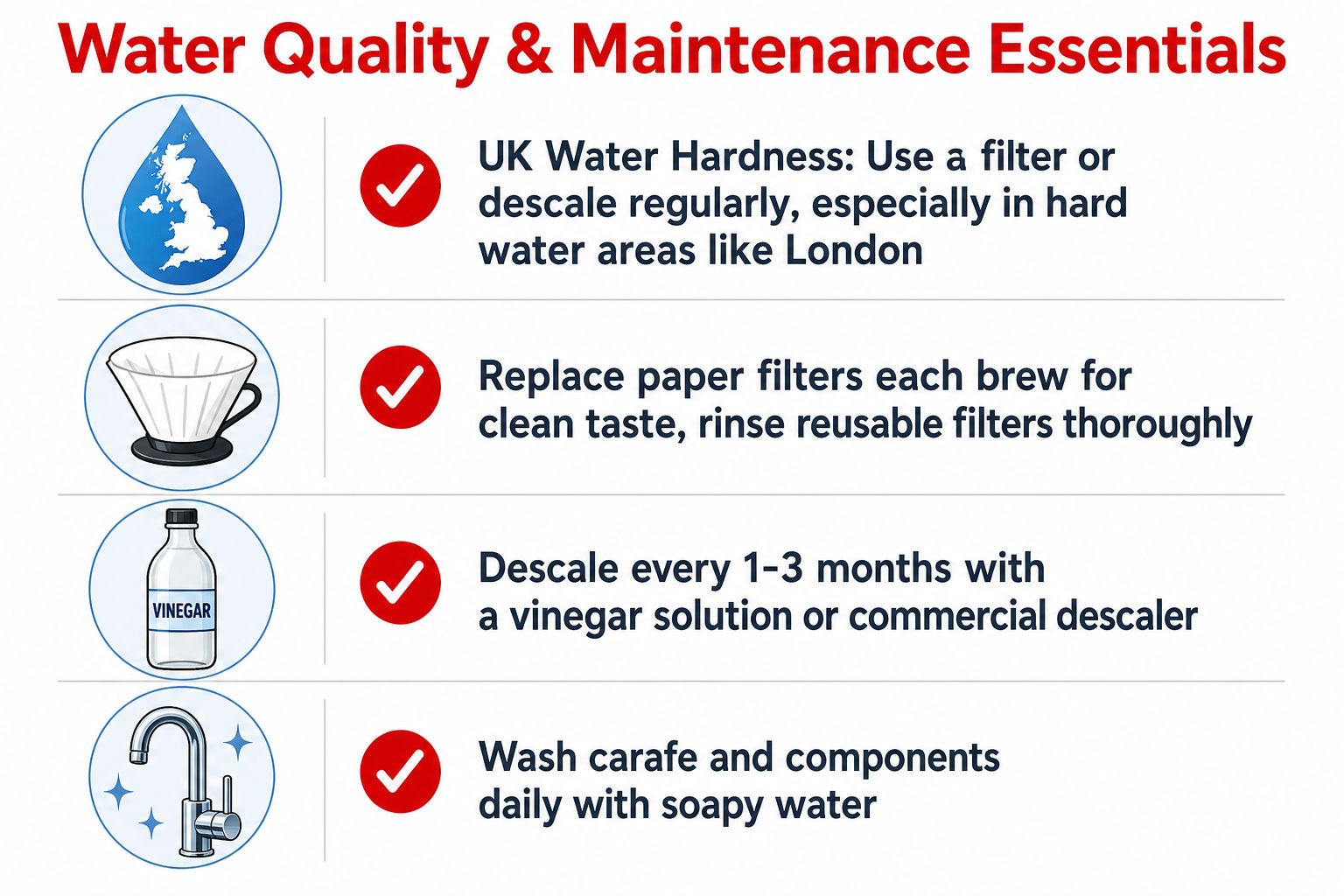
Hard water areas need more attention. If your local supply is chalky, a filter or regular descaling isn't cosmetic, it's protection for the heating system and a basic way to keep taste consistent. For fixed installation or plumbed setups, Allied Drinks Systems' water filtration system page is worth checking alongside the brewer itself.
Paper and reusable filters also affect the cup. Paper filters usually give a cleaner result, while reusable filters are easier on waste but can leave more oils and fine particles in the mug. That's a taste choice as much as a maintenance choice.
Build a Routine You'll Actually Keep
Daily care should be dull and fast. Wash the carafe, brew basket, and removable parts with warm soapy water. Don't let coffee oils dry into the corners. That's how machines start tasting stale even when the brew recipe is fine.
The maintenance infographic below gives the basic rhythm many UK buyers miss:
For plumbed equipment, one relevant accessory is the Brita Purity C IQ 500 Filter Cartridge, which fits into a filtration-led maintenance approach without changing the core brewing process.
Running Costs and Sustainability Compared to Alternatives
A filter machine usually wins on ownership cost when it's used properly. The coffee itself is ground coffee rather than capsules, and the machine doesn't rely on single-dose packaging for every cup. That makes the running model simpler and cleaner, especially where multiple mugs are brewed at once.
The Real Cost Drivers
The big variables are electricity, filter choice, coffee dose, and whether the machine sits on a hot plate too long. A keep-warm plate is convenient, but it's also where many cheap brewers waste energy and overcook the jug. Thermal carafes avoid that problem by holding heat without constant reheating.
This is why a filter brewer can be a sensible option for offices and hospitality. You're not paying per capsule, and you're not filling a bin with plastic and foil after every round. You're also not locked into a machine format that only really makes sense for single cups.
Sustainability Is More Than One Feature
Reusable baskets reduce paper waste, but they don't automatically deliver the best cup. Paper filters add a consumable, yet they can also make cleaning easier and improve clarity in the cup. The right choice depends on whether the site values taste cleanliness, low waste, or both.
For buyers who care about energy use as well as brew quality, Allied Drinks Systems' guide to reducing energy costs with efficient coffee equipment choices is a sensible follow-up. The key point is simple. Filter brewing is often the practical middle ground, lower waste than pods, less faff than a cafetière for volume service, and easier to justify than a machine that burns energy all day to make one mug at a time.
My view: if you're making multiple drinks a day, a well-sized filter machine is usually the cleaner and more economical choice. If you're making one mug at a time, don't pretend it is the same answer.
Brand and Model Recommendations by Use Case
Buy the machine for the job, not for the brochure. That's the rule I use when fitting equipment into homes, offices, and cafés, because the right brewer for a family kitchen can be a terrible fit for a reception desk.
Home Baristas Wanting Better Batch Coffee
For home use, prioritise a 1.2 to 1.25 litre brewer, a thermal carafe if you hate hot plates, and simple controls that don't get in the way. If you like a more hands-on routine, manual pour-over still makes sense, but only if you'll use it before work.
If you want a buying shortlist, start with the machine list on Allied Drinks Systems' drip coffee machine range. It's a practical place to compare formats without getting lost in unrelated equipment.
Office Managers Need Reliability First
Offices need consistency, quick cleaning, and easy replacement parts. That means looking for a brewer with a sensible capacity, easy water filling, and a carafe or jug that staff won't mishandle at 8.30am. A removable water tank helps too, because it cuts the awkward refill routine.
If the office is in a leased unit or shared building, the same logic applies to space planning and service access. Good tenant representation guidance can help people think about practical premises decisions, including whether a machine's footprint and servicing needs suit the site.
Commercial Venues Need Output and Support
Cafés, hospitality counters, and event setups need a brewer that can take volume without constant babysitting. That means stronger support on parts, consumables, and matching accessories, not just a machine in a box. Allied Drinks Systems is useful here because it supplies machines, consumables, disposables, and spare parts in one place, so you're not splitting orders across half the trade directory.
If you want a single rule to remember, make it this. Small volume, compact brewer. Repeated demand, bulk brew. High traffic, commercial system. Once you accept that, the rest of the decision gets much easier.
Your Filter Coffee Maker Buying Checklist
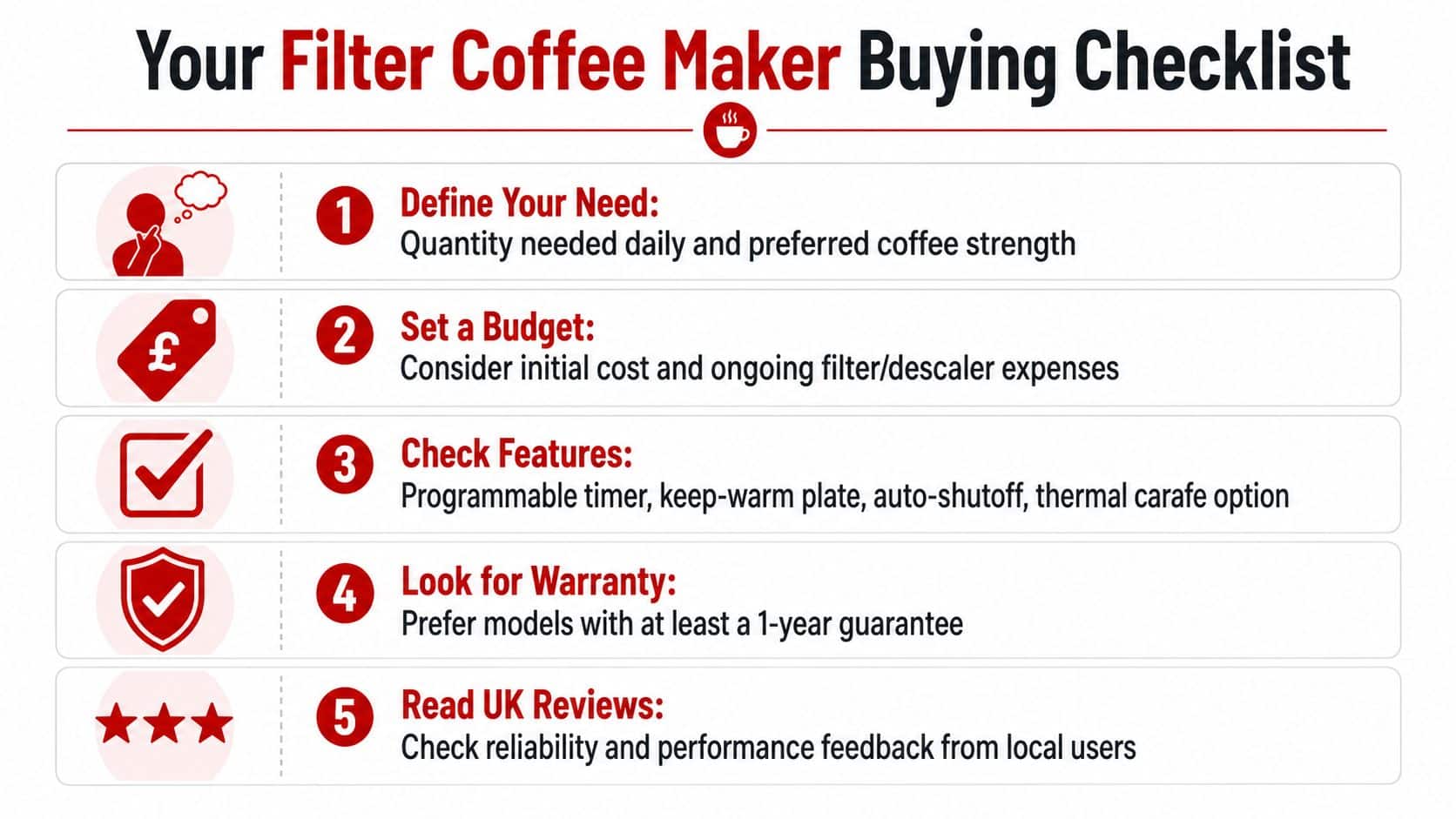
Use this checklist before you buy, especially if you're comparing quotes or trying to decide between a domestic brewer and a commercial one.
Quick Pre-Buy Checks
- Define the daily need. Count how many mugs you serve on a normal day, then size the machine to that figure.
- Set the budget properly. Include filters, descaler, and replacement parts, not just the sticker price.
- Check the feature set. Look for a programmable timer, keep-warm control, auto shut-off, or a thermal carafe if the coffee sits around.
- Confirm warranty and support. A machine is only useful if you can keep it running.
- Read UK user feedback. Local reviews matter because they reflect British kitchens, British water, and British usage patterns.
Final Purchase Filter
- Match the capacity to peak demand. Don't buy a giant brewer for a small kitchen.
- Check water handling. Removable tanks and filtration compatibility save time.
- Look at maintenance habits. If cleaning looks awkward in the product photos, it'll be worse in real life.
- Buy from a supplier with parts and consumables. That saves hassle later.
- Choose the simplest machine that meets the job. Fancy controls don't improve coffee if the machine is wrong for the space.
If you're ready to buy a filter coffee maker UK customers can live with day to day, start with a supplier that understands the job, not just the product. Allied Drinks Systems can help you match the brewer to the venue, source the right consumables, and keep the whole setup practical. Visit Allied Drinks Systems and choose the machine that fits your kitchen, office, or café properly.