The grinder stops just as the morning queue reaches the door. A pump won't run, the espresso machine is out of service, and the only diagnosis anyone can offer is that a replacement part might be available somewhere. For a café, spare parts availability quickly becomes a service, revenue and reputation issue, not a minor maintenance detail.
The difficult question is rarely whether a component exists. It's whether the correct part can be identified, sourced quickly, delivered reliably and fitted without creating another fault. Lead times, compatibility, supplier stock, technician access and sensible on-site storage all influence how long your business remains disrupted.
Table of Contents
- Why Spare Parts Availability Matters for Your Coffee Business
- UK Right to Repair Rules and What They Mean for Coffee Equipment
- How to Identify the Correct Spare Part for Your Machine
- Where to Source Coffee Machine Spare Parts in the UK
- The Ordering Process from Stock Check to Delivery
- Managing Downtime Risk Through Smart Parts Stocking
- Common Coffee Machine Parts and Their Part Codes
- Troubleshooting Before You Order a Replacement Part
- When to Repair and When to Replace Your Coffee Machine
- Keeping Your Equipment Running with Ongoing Support
Why Spare Parts Availability Matters for Your Coffee Business
A failed solenoid valve might mean one group stops dispensing water. A worn grinder burr set can produce inconsistent doses and slow service. A damaged seal may cause a leak that looks harmless until water reaches electrical components or forces the machine out of operation.
During a quiet afternoon, these faults may be manageable. During peak service, they can leave staff explaining delays to customers while drinks orders build up. The cost isn't limited to the component itself. You may also face wasted coffee, cancelled orders, emergency engineering charges and pressure on the rest of the team.
Practical rule: Treat every part that can stop service as a continuity-planning item, not simply a maintenance item.
The useful questions are operational:
- How quickly can the part leave the supplier?
- Is it physically stocked in the UK, or does it need to be ordered in?
- Does the code match your exact machine revision?
- Can a trained technician fit it safely?
- Should you keep one on site because a failure would stop trading?
A documented maintenance routine still matters, and the practical guidance in coffee machine maintenance myths debunked can help prevent avoidable faults. Cleaning, inspection and correct adjustment reduce the chance of ordering a part for a problem caused by scale, coffee residue or user settings.
The strongest approach combines preventive care with realistic procurement. Keep records of model numbers and serial numbers, know which components are common failure points, and maintain a relationship with a supplier that can confirm compatibility. Availability protects uptime only when the part is the right part and reaches you before the disruption becomes a business problem.
UK Right to Repair Rules and What They Mean for Coffee Equipment
The UK's right-to-repair framework reached a significant legal milestone in July 2021. For certain covered household appliances, manufacturers, authorised representatives and importers must make spare parts available to professional repairers and/or end-users for minimum periods ranging from 7 to 10 years after the last unit of a model was placed on the market, as set out in the UK Parliament briefing on right to repair.

That obligation isn't necessarily immediate. Manufacturers can have a grace period of up to 2 years before making parts available, so the practical supply window may begin later than the date on which a product first entered the market. Some components are intended for professional repairers, while simpler and safer items may be available directly to consumers. The BBC's explanation of the UK rules describes this distinction clearly.
Where commercial coffee equipment fits
The public discussion often focuses on household appliances and electronic displays. For electronic displays, the rules require certain parts to be supplied to professional repairers for at least 7 years, with parts lists and ordering processes published on a free public website within 2 years of launch, according to Schedule 19 of the Ecodesign regulations.
Commercial espresso machines, bean-to-cup systems, grinders and drinks dispensers don't automatically receive the same straightforward protection. The current framework mainly addresses specified appliance categories, and there isn't a blanket rule requiring parts for every product for a fixed period, as noted in industry commentary on UK spare-parts law.
That means operators should ask manufacturers and suppliers specific questions rather than assuming that “right to repair” guarantees access. Confirm who can buy the part, how long it will remain obtainable, whether technical information is restricted, and whether the listed component applies to your machine revision. The PSSR coffee machine testing guidance is also relevant where safety, inspection and professional servicing form part of your equipment management.
How to Identify the Correct Spare Part for Your Machine
Ordering by appearance is one of the fastest ways to extend downtime. Two valves can look identical while having different thread sizes, electrical ratings, connectors or flow characteristics. A gasket can appear to fit but still leak because its profile or thickness is wrong.
Start with the machine itself, not a marketplace search.
- Record the model and serial number. Look for the manufacturer plate, service label or documentation. Photograph the plate before removing panels, particularly if you manage several similar machines.
- Find the official parts diagram. Exploded diagrams show where components sit and usually assign an item number to each assembly.
- Match the exact part code. The name “pump” or “steam valve” isn't enough. Record the manufacturer's code, any revision suffix and whether the item is supplied as a complete assembly.
- Confirm the machine revision. Ask the supplier to check compatibility against the model and serial number, especially if the machine has been refurbished or modified.

OEM and compatible alternatives
An OEM part comes from the original equipment manufacturer or its approved supply chain. It may be the safest choice for complex electronics, safety controls and assemblies with tightly specified performance requirements. A compatible aftermarket part can be suitable for standard items such as seals, hoses or certain fittings, but only when its dimensions and specification have been verified.
Send the supplier clear photographs of the old component, its connector and the machine plate. If you're unsure how the hydraulic or electrical systems interact, the explanation in how a commercial coffee machine works provides useful context before you discuss the order with a technician.
Use the video below as a visual aid, but don't substitute a general demonstration for the machine-specific parts diagram.
Where to Source Coffee Machine Spare Parts in the UK
The cheapest listing isn't always the lowest-cost option. A part that arrives quickly but doesn't fit creates a second delay, while a technically correct component held overseas may be unsuitable for an urgent repair.
UK coffee businesses usually choose between specialist distributors, manufacturer channels, general marketplaces and overseas suppliers. Each channel has a different balance of speed, advice and price clarity.
| Sourcing Channel | Typical Lead Time | Compatibility Guarantee | Best For |
|---|---|---|---|
| UK specialist distributor | Same-day dispatch where stocked, then courier delivery | Often supported by product knowledge and model checks | Urgent repairs and mixed equipment fleets |
| Manufacturer or authorised service channel | Dependent on factory and service stock | Strong for exact OEM parts | Safety-critical assemblies and proprietary electronics |
| General marketplace | Varies by seller | Inconsistent, so the buyer must verify codes | Identifiable standard components and price comparisons |
| Overseas supplier | Dependent on export and import handling | Varies by listing and documentation | Obsolete or specialist items when time allows |
| Local technician network | Dependent on technician stock | Strong when the engineer knows the machine | Diagnosis, fitting and complex repairs |
What local stock changes
A UK distributor may be able to combine parts with an existing order for coffee, syrups or disposables. That can reduce administrative work and avoid separate deliveries, although you should still check the supplier's cut-off times, stock status and delivery terms before relying on a promised date.
A specialist supplier can also help distinguish a genuine compatible replacement from a visually similar item. For decisions about the wider equipment relationship, choosing a commercial espresso machine supplier is useful because after-sales support should be assessed alongside the machine's purchase price.
Some unusual components may be produced on demand. For background on serial production parts via 3D printing, consider how material suitability, dimensional accuracy, heat exposure and food-contact requirements apply before using a printed replacement in a coffee system.
The Ordering Process from Stock Check to Delivery
A repeatable order process prevents a simple repair from becoming a chain of avoidable errors.
1. Check stock before dismantling
Look for the exact part code and confirm whether the listing means in stock, available to order, or awaiting manufacturer supply. If the machine is already down, phone the supplier rather than relying on a vague availability label.
2. Prepare the information
Have these details ready:
- Machine identity: Manufacturer, model, serial number and machine revision if known.
- Part specification: Exact code, description, quantity and photographs.
- Delivery details: Site address, access restrictions and whether someone can receive the parcel.
- Urgency: Explain whether the machine is completely unavailable or operating with a limited function.
This information lets the supplier check a substitute without guessing. It also reduces the risk of ordering a component that matches the product family but not your particular version.
3. Confirm dispatch and delivery
Ask about the same-day dispatch cut-off, courier service, expected delivery day and any exclusions for your location. Don't confuse dispatch with arrival. A parcel leaving the warehouse today still needs to travel through the courier network.
4. Consolidate where practical
If the part isn't urgent, add it to a planned order for consumables and disposables. If the machine is down, prioritise the repair and avoid delaying the part while waiting to build a larger basket. Guidance on next-day coffee supplies for UK businesses can help you plan routine replenishment around equipment needs.
On delivery, compare the item with the code on your order before installation. Keep the packaging until the technician confirms fit and operation.
Managing Downtime Risk Through Smart Parts Stocking
Stocking every possible component is expensive and creates a cupboard full of obsolete items. Stocking nothing leaves the business exposed to the first failure that falls outside the supplier's immediate availability.
A practical policy begins with criticality, not price. Ask what happens if the component fails, how quickly the machine can be restored without it, whether a substitute is acceptable and how predictable the supplier's lead time is. BS EN 62550:2017, described by the British Standards Institution as a standard for spare parts provisioning, provides a defensible reference for classifying spares, estimating demand from failure history and setting holding policies.
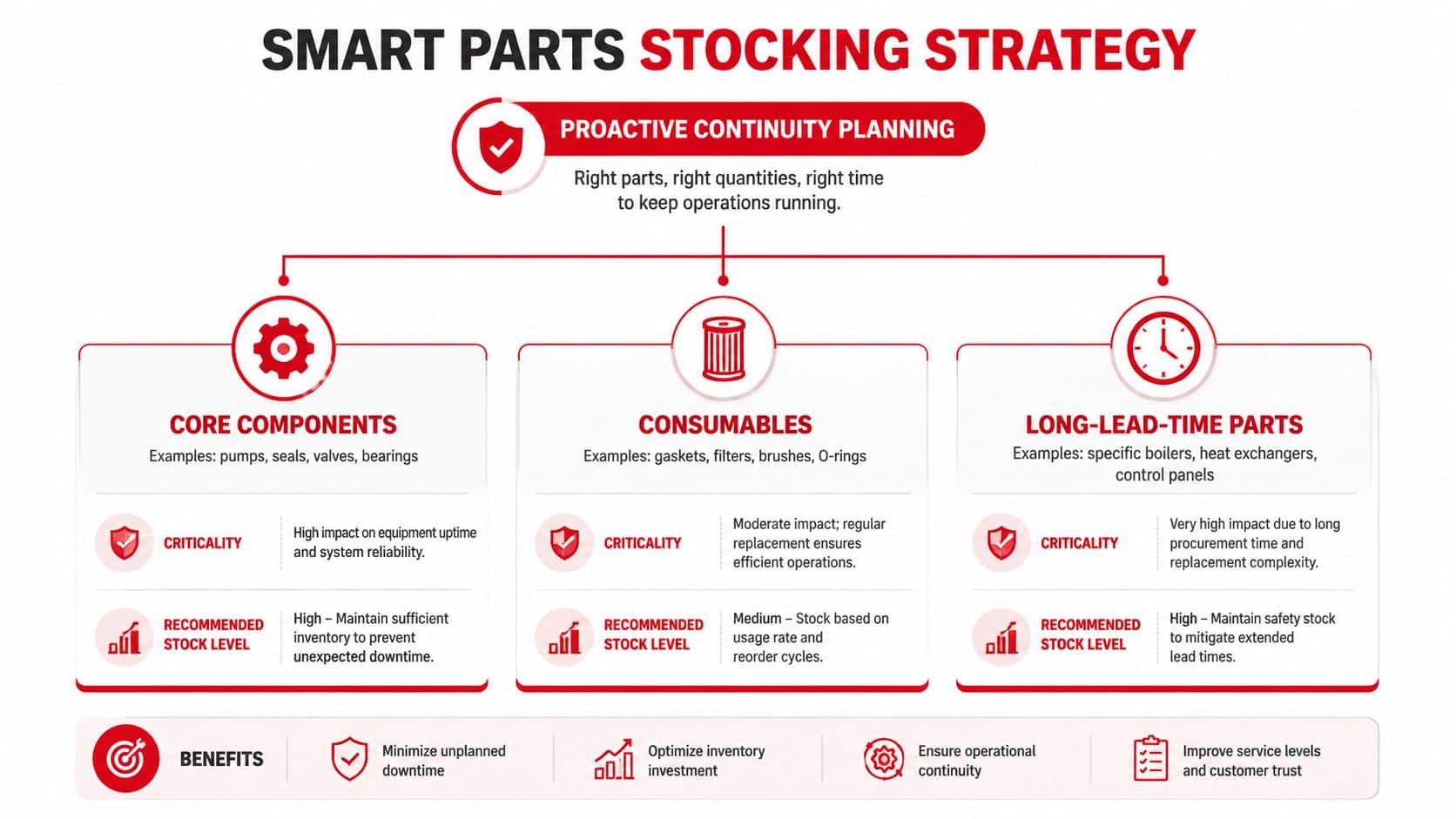
Build three practical groups
- Service-stopping components: Pumps, control boards and key valves may justify on-site coverage when one machine supports the whole service.
- Routine consumable spares: Gaskets, O-rings, brushes and seals are easier to justify because they're small, commonly used and often needed during planned servicing.
- Long-lead or machine-specific parts: A boiler, unusual motor or proprietary board may need supplier-held stock, a confirmed ordering route or a contingency machine.
Busy cafés and lower-volume offices won't need identical policies. A high-throughput site should prioritise parts that stop its busiest machine, while an office may sensibly order more components on demand if an alternative brewing method is available.
Track what you use. Record the machine, fault, part code and date whenever a replacement is fitted. For a structured approach to calculate safety stock for your business, combine consumption history with supplier lead times and the operational consequence of a stockout.
Cross-brand compatibility can reduce risk, but only after technical verification. A standard seal may suit several machines, while a pump with the wrong specification can create poor extraction or damage the system.
Common Coffee Machine Parts and Their Part Codes
Part codes vary by manufacturer, model and revision, so the examples below are code types to look for, not universal order numbers. Always match the supplier's code to the machine plate and parts diagram.
| Component | Function | Replacement warning | Code information to record |
|---|---|---|---|
| Group head gasket | Seals the portafilter against the group | Leaks around the handle, poor lock-in or a flattened profile | Profile, thickness, group type and manufacturer code |
| Shower screen | Distributes brewing water over the coffee bed | Uneven flow, blocked holes or damaged mesh | Diameter, fixing style and machine model |
| Solenoid valve | Controls water or steam flow | Persistent flow, failure to dispense or electrical fault | Valve type, coil specification, ports and code |
| Pump assembly | Creates hydraulic pressure | Weak flow, unusual noise or failure to prime | Pump model, voltage, fittings and assembly code |
| Grinder burrs | Cut beans to the selected grind | Slow grinding, inconsistent particles or poor adjustment range | Burr diameter, carrier type and grinder model |
| O-rings | Seal internal joints and fittings | Drips, pressure loss or visible flattening | Internal diameter, section size and material |
| Steam wand seal | Seals the steam valve or wand connection | Steam or water escaping at the joint | Valve arrangement, seal profile and machine revision |
Tools that prevent installation damage
Use the correct shower-screen tool rather than forcing a screwdriver into the group. For Iberital equipment, the Iberital Expression Shower Removal Tool is designed for that specific removal task.
Cleaning products also influence part life. A blocked screen or valve may need cleaning before replacement, while a worn seal should be renewed rather than repeatedly tightened. Keep removed parts labelled until the repair is complete, especially when several similar machines are serviced together.
Troubleshooting Before You Order a Replacement Part
A café once reported a failed pump because water flow had become weak. The first check found a blocked inlet filter and heavy scale. Replacing the pump would have added cost without addressing the restriction.
Start with the symptom and work backwards.
- No water flow: Check the water supply, inlet hose, filter, reservoir position and visible blockages before assuming a pump or valve has failed.
- Low or unstable pressure: Inspect the grind setting, dose, group screen and scale condition. A hydraulic restriction can resemble a weak pump.
- Leaks: Dry the area, run the machine briefly and identify the first point where water appears. Replacing the lowest seal you can see may miss the actual source above it.
- Unusual noise: Check whether the pump is drawing water correctly and whether a loose panel, fan or mounting bracket is vibrating.
- Temperature changes: Confirm operating settings and allow the machine to stabilise. Electrical testing and internal inspection should be handled by a suitably qualified technician.
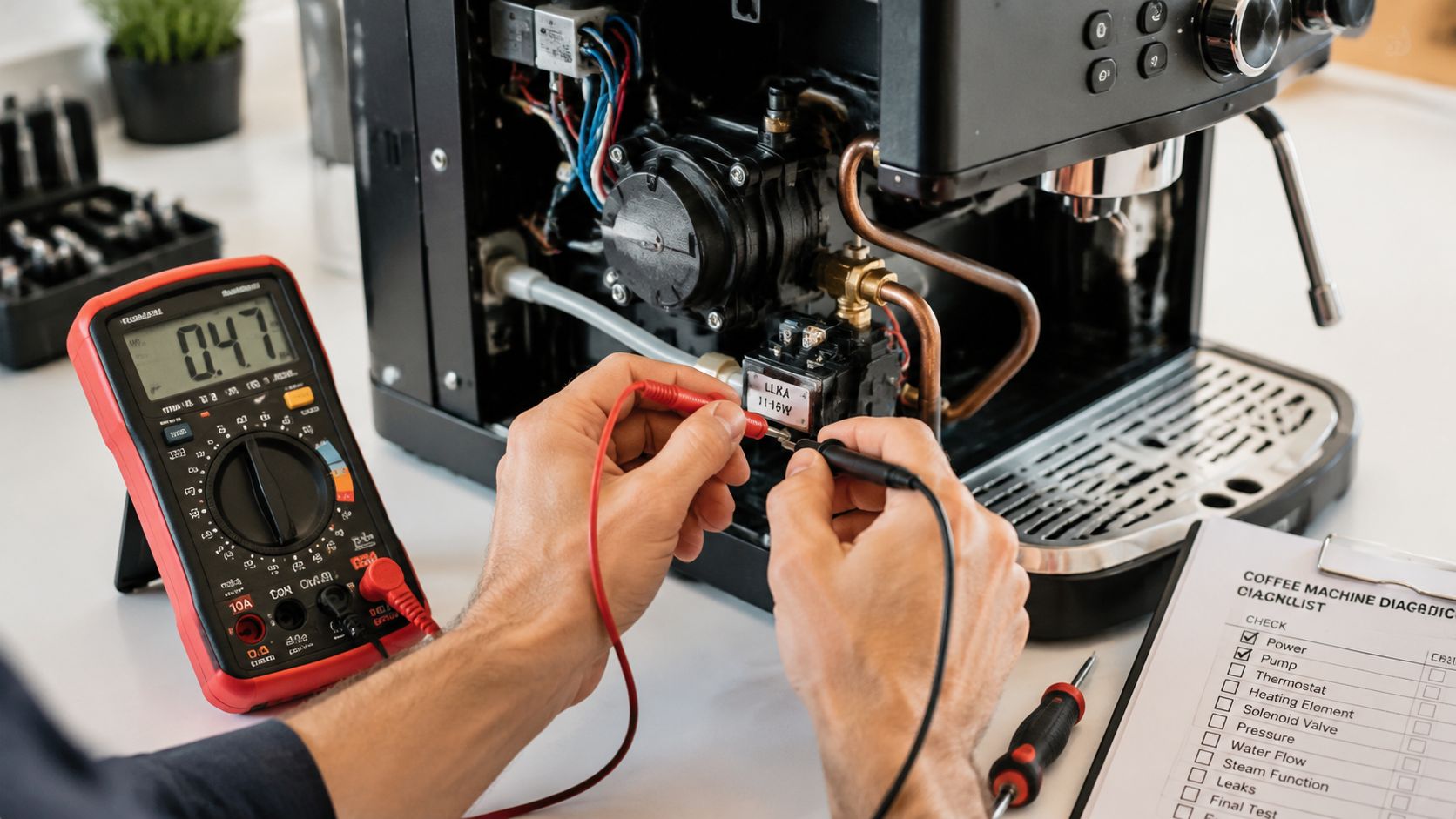
Don't open live electrical equipment as a casual diagnostic step. A multimeter can help a competent technician test continuity, voltage and component resistance, but an incorrect test can create a safety hazard.
Write down what changed immediately before the fault. A new water filter, cleaning cycle, grinder adjustment or machine move can provide more useful evidence than a broad description such as “it stopped working”. Give the supplier or engineer the sequence, fault code, photographs and machine identification.
When to Repair and When to Replace Your Coffee Machine
Repairing a machine makes sense when the fault is isolated, the frame and major systems remain sound, the correct parts are obtainable and the repair restores dependable service. A single pump, valve, gasket or grinder component shouldn't automatically trigger a replacement decision.
Replacement deserves serious consideration when failures are recurring, several major assemblies need attention, the machine no longer suits service volume or future parts access is uncertain. A low purchase price can become poor value if staff lose confidence in the equipment and every repair requires a separate emergency visit.
Use this quick filter:
- Repair: One defined fault, confirmed diagnosis, suitable part and a technician who can complete the work safely.
- Investigate further: Repeated faults, unclear symptoms, missing service history or a suspected control-board problem.
- Replace: Multiple expensive systems are deteriorating, parts are difficult to source, or the machine no longer meets operational needs.
Warranty terms should be checked before ordering. If the equipment was bought for business use, preserve invoices, service records and communication with the trader.
The Consumer Rights Act 2015 gives UK buyers rights to insist on repair or replacement of faulty goods, and the trader must bear the cost of that remedy, according to the official explanatory notes. The Act doesn't remove the need for a technical diagnosis, and it doesn't guarantee that every ageing commercial machine will have a suitable part available.
Make the decision on total operating risk, not the part price alone.
Keeping Your Equipment Running with Ongoing Support
Good spare parts availability starts with accurate machine records and continues through routine cleaning, inspection and supplier communication. Keep model and serial details in one accessible location, record every fitted part and note which components would stop service if they failed.
A UK supplier can simplify procurement when it handles equipment, ingredients, disposables, accessories and parts in one workflow. Allied Drinks Systems operates a multi-brand catalogue from Eastbourne, with spare parts and barista accessories alongside commercial coffee equipment and drinks supplies. Its stated service parameters include same-day dispatch up to 4:30pm Monday to Friday and free next-working-day mainland UK delivery on orders over £69 excluding VAT, as set out in its publisher information.
Review your stocking policy after every meaningful fault. The objective isn't a warehouse full of components. It's a clear route to the correct part, a realistic delivery expectation and a repair plan that protects service.
Allied Drinks Systems supplies coffee equipment, spare parts, accessories, ingredients and disposables for cafés, offices and hospitality venues, with UK delivery options suited to planned and urgent replenishment. Visit Allied Drinks Systems to review compatible equipment supplies and parts, then contact the team with your machine model and serial number before ordering if you need help confirming fit.