
Choosing the right drinks vending machine for an office, café, or hospitality venue is harder than it looks once you start comparing specification sheets, capacities, and payment technology side by side. Dimensions, refrigeration settings, product slots, and contactless payment options all affect whether a machine actually earns its keep in a busy breakroom or reception area. Get the choice wrong and you’re left with a sluggish machine that frustrates staff, wastes stock, or simply doesn’t fit the space you had in mind.
A drinks vending machine is a self-service unit that dispenses hot or cold beverages around the clock without needing anyone behind a counter. I’ve spent years working alongside businesses sourcing coffee equipment and drinks supplies at Allied Drinks Systems, a family-run supplier trading since 1993, and I know how confusing the buying process can feel from the outside. This guide works through machine types, the features worth comparing, which venues suit which setup, running costs, and what proper installation and support should look like. By the end, you’ll know exactly what questions to ask before signing off on a purchase.
Let’s start with what a drinks vending machine actually offers and which businesses get the most out of one.
Key Takeaways
Match machine size and capacity to footfall and the space you actually have available.
Prioritise payment flexibility and remote monitoring to cut admin and reduce stockouts.
Consider hot and cold combinations for year-round appeal across different venues.
Factor in installation, warranty, and ongoing engineer support, not just the machine’s price tag.
Sustainability features such as eco-packaging, solar power, and LED lighting are becoming a genuine point of difference.
Jump to section
- What Is a Drinks Vending Machine and Who Needs One?
- Compact Vending Machines for Space-Conscious Businesses
- How Do Smart Payment and Monitoring Systems Work?
- Hot Drinks vs Cold Drinks Vending: Which Fits Your Venue?
- Sustainability and Running Costs: What to Expect
- Installation, Warranty, and Ongoing Support
- The Takeaway
- Frequently Asked Questions
- How Much Does a Drinks Vending Machine Cost to Lease vs Buy?
- What Electrical Supply Does a Drinks Vending Machine Need?
- How Much Space Do I Need Around a Vending Machine for Servicing?
- Can Drinks Vending Machines Accept Contactless and Mobile Payments?
- How Often Should a Vending Machine Be Restocked and Cleaned?
- Do Vending Machines Work in Outdoor or Unheated Locations?
What Is a Drinks Vending Machine and Who Needs One?
A drinks vending machine is a self-service retail unit that stores, chills, or heats beverages and dispenses them automatically once a customer picks a product and pays, removing the need for a staffed counter. This self-service model delivers round-the-clock availability, which matters for office blocks, hospitals, and transport hubs where demand doesn’t stop at 5pm. Businesses installing a drinks vending machine typically do so for one of two reasons, either to cut the staffing and catering costs tied to manual refreshment service, or to generate extra revenue from footfall that’s already passing through the building. Offices and workplaces make up the largest segment of buyers, often pairing a vending machine with office drinks station setup to widen choice without expanding the breakroom. Hospitality venues, healthcare settings, educational institutions, retail stores, and transport hubs each rely on vending for slightly different reasons, from hygiene-led self-service in hospitals to impulse purchases near a shop till. What ties these sectors together is the expectation that a drinks vending machine should run with minimal supervision while still delivering a product that feels fresh and fairly priced. Picking the right type, size, and feature set for a specific venue is where most buying decisions either succeed or fall short.
Which Venues Benefit Most From Drinks Vending Machines?
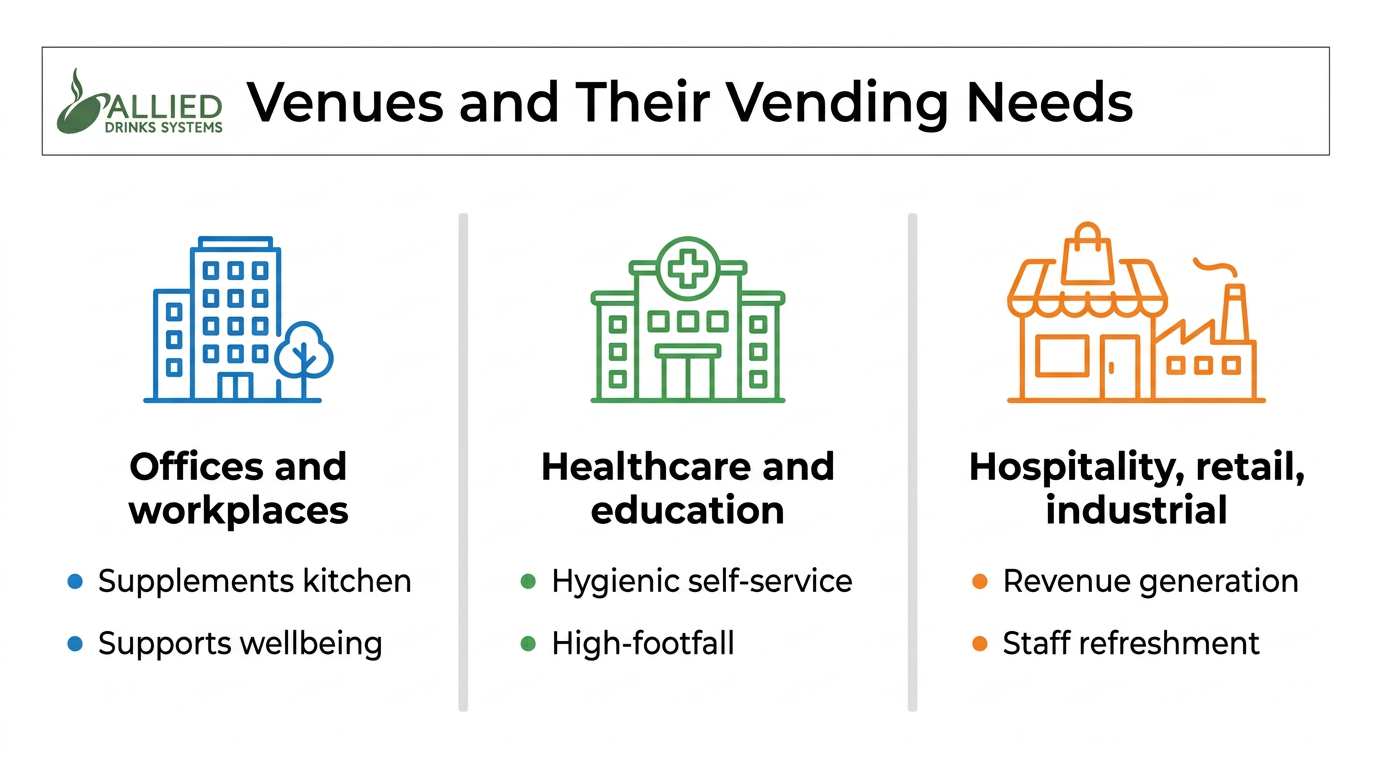
Not every venue needs the same type of drinks vending machine, and matching the unit to the setting makes the biggest difference to how well it pays for itself. Offices supplement existing kitchen facilities and support staff wellbeing without expanding catering budgets, while healthcare, education, hospitality, retail, and industrial sites each lean on vending for slightly different reasons.
Offices and workplaces benefit from a compact machine in the breakroom that supplements existing coffee provision, widens drink choice for staff, and takes pressure off facilities budgets without the cost of a staffed kitchen.
Healthcare and education settings gain from hygienic self-service that reduces shared-surface contact, with sturdy units suited to high-footfall corridors, waiting rooms, and common areas.
Hospitality, retail, and industrial sites use vending to generate extra revenue from passing footfall while giving staff convenient refreshment during long or physically demanding shifts.
Compact Vending Machines for Space-Conscious Businesses
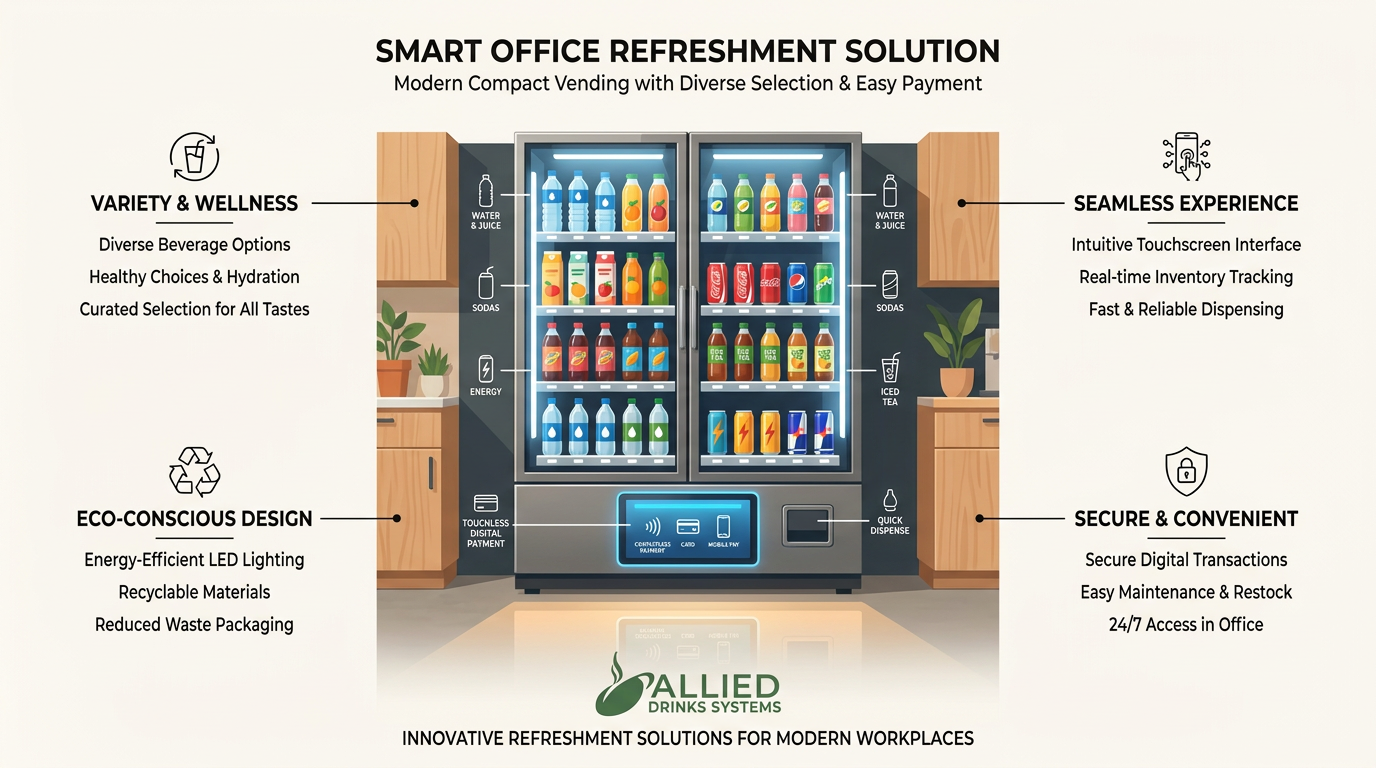
Compact vending machines solve the most common objection to installing a drinks vending machine in the first place, which is a lack of spare floor space. Units built for small offices, reception areas, and tight retail corners typically stand around 1000mm high, 784mm wide, and 746mm deep, weighing in the region of 135kg, figures comparable to machines such as the Absnax Mini. Despite that modest footprint, a well-specified compact unit still holds up to 32 product selections, giving a small office or café counter genuine variety rather than a token handful of drinks. Double-glazed twin viewing windows let customers see what’s inside before they commit to a selection, while bright LED lighting keeps products visible even in a dim corridor or under-lit reception. Because these machines often sit in unattended spots, build quality matters as much as capacity, insulated and refrigerated cabinets keep stock at a safe temperature, and an easy-fill tray system means restocking takes minutes rather than a drawn-out process. For a small coffee shop, office coffee solutions, or hospitality venue that can’t justify a full-size installation, a compact drinks vending machine delivers most of the benefits of a larger unit without demanding the floor space a bigger model would need.
What Features Should I Check Before Buying a Compact Unit?
A compact footprint shouldn’t mean compromising on the features that keep a machine running without constant attention. Automatic defrost and digitally programmable temperature control reduce the manual maintenance a small business would otherwise need to schedule in, keeping drinks at a safe, consistent temperature without staff checking in daily.
Individual product pricing is worth checking too, since it lets you set premium pricing on specialty drinks while keeping everyday options competitive. Triple-locking main doors and an insulated, refrigerated cabinet matter most in unattended placements like a reception area or a corridor, where tampering is a genuine concern rather than a theoretical one.
How Do Smart Payment and Monitoring Systems Work?
Smart payment and monitoring systems turn a drinks vending machine from a simple dispenser into a connected piece of retail equipment that reports back on its own performance. Modern machines accept contactless cards, NFC payments, Apple Pay, and other mobile wallets alongside traditional coins and notes, so a customer’s preferred payment method rarely becomes a barrier to a sale. Cloud connectivity sits behind this payment layer, giving operators a live view of transactions, stock levels, and machine health from a phone or laptop rather than requiring a site visit to check. This remote view matters most when a business runs more than one machine across different buildings or floors, since physically inspecting each unit to check stock would eat into staff time better spent elsewhere. Fault detection works on the same principle, flagging a refrigeration fault, a jammed slot, or a payment reader issue before it turns into a lost sale or a frustrated customer standing in front of an out-of-service sign. For office managers and facilities teams juggling several responsibilities, that early warning is often worth more than any single feature on a spec sheet, because it cuts the number of vending machine maintenance and keeps a drinks vending machine earning its keep day after day.
Why Does Remote Inventory Management Matter for Operators?
Remote inventory management stops the two most common and costly vending mistakes, running out of a popular drink mid-week and sending a member of staff to restock a machine that’s barely been touched. Live stock alerts flag low product levels before customers notice a gap, so restocking visits can be planned around actual need rather than a fixed weekly schedule.
The same data shows which lines sell fastest and which barely move, which matters when shelf space in a vending machine is limited and every slot needs to earn its place. Seasonal shifts, like a jump in cold drink sales during summer or hot chocolate in winter, become obvious in the sales figures rather than something you have to guess at.
Hot Drinks vs Cold Drinks Vending: Which Fits Your Venue?
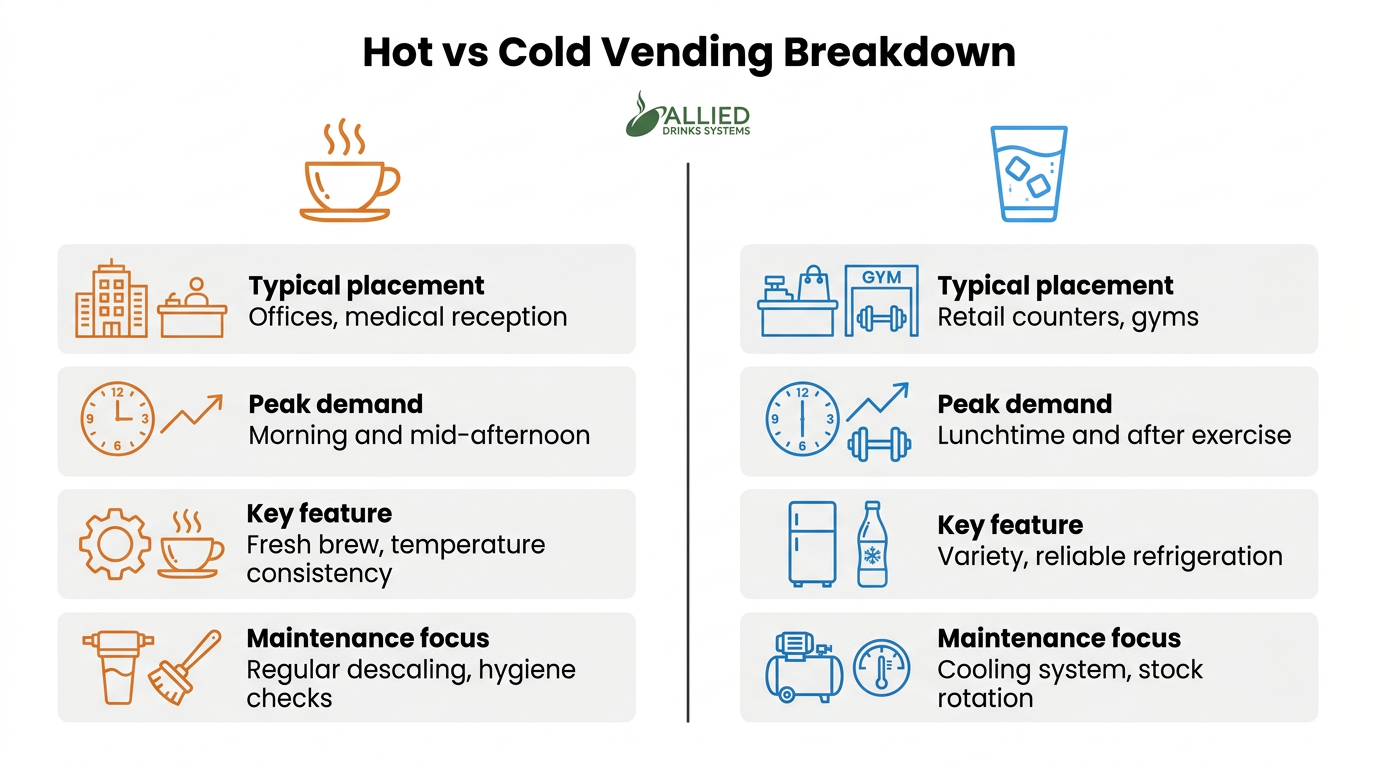
Deciding between hot drinks vending, cold drinks vending, or running both side by side comes down to what your customers actually drink and when they drink it. Hot beverage machines are built for speed and consistency, with high-speed delivery and whipping systems that can turn out up to 240 cups of black coffee an hour, alongside a typical menu of latte, cappuccino, espresso, mocha, hot chocolate, and on-demand hot water. Powdered milk systems remove the spoilage risk and daily top-up that fresh milk would demand, which matters in an office or medical reception running a machine unattended for long stretches. Cold drinks vending leans on different strengths, digitally controlled refrigeration, larger product capacity, and faster throughput during short, sharp demand spikes like a lunch break or a gym session finishing on the hour. A busy retail counter or a gym reception typically favours cold drinks vending for exactly that reason, while an office breakroom or a medical waiting area tends to get more consistent use from a hot beverage machine. Many venues end up running both, splitting demand across the day rather than betting on a single product type.
| Factor | Hot Drinks Vending | Cold Drinks Vending |
|---|---|---|
| Typical placement | Offices, medical reception, waiting areas | Retail counters, gyms, high-footfall corridors |
| Peak demand | Morning and mid-afternoon breaks | Lunchtime and after exercise |
| Key feature | Powdered milk, high-speed brewing | Digital refrigeration, larger capacity |
| Maintenance focus | Flush system hygiene, cup stock | Stock rotation, temperature checks |
Where Does Allied Drinks Systems Fit Into Your Vending Plan?
Allied Drinks Systems supplies compact, ready-to-deploy options including the Cadbury Floor Standing Unit and the SnackBreak Mini Vending Machine, both suited to offices and smaller venues that want vending without a major installation project. The company also holds spare parts and support for slush machine troubleshooting, so businesses running a wider drinks offer aren’t left searching for a second supplier when something needs fixing.
What’s genuinely useful is being able to review vending units, water filtration system, and other drinks system components together before finalising a layout, rather than piecing a setup together from several suppliers. If you want to see the current range, the vending machines for sale is worth a look before you commit to a specific model.
Sustainability and Running Costs: What to Expect
Sustainability has moved from a nice-to-have to a genuine purchasing factor for businesses choosing a drinks vending machine, alongside the harder financial question of what it actually costs to run one. LED lighting and eco-mode standby cut electricity draw during quiet periods, while efficient refrigeration keeps cooling costs down without leaving drinks at the wrong temperature. Solar-powered units extend vending into outdoor or off-grid spots, parks, event sites, or warehouse yards, where running a mains cable would be impractical or expensive. On the financial side, margins on vended drinks typically sit between 40% and 60% depending on product mix and pricing, though the actual figure depends heavily on footfall, product cost, and how well stock rotation limits waste from expired lines. Leasing a machine spreads the upfront cost into a predictable weekly payment, which suits businesses wanting to trial vending before committing to a purchase, while buying outright suits those confident in long-term footfall and willing to own the asset from day one. Either route, the running cost conversation should include energy use and product margin, not just the headline price of the machine itself.
How Can I Reduce Energy and Maintenance Costs Long-Term?
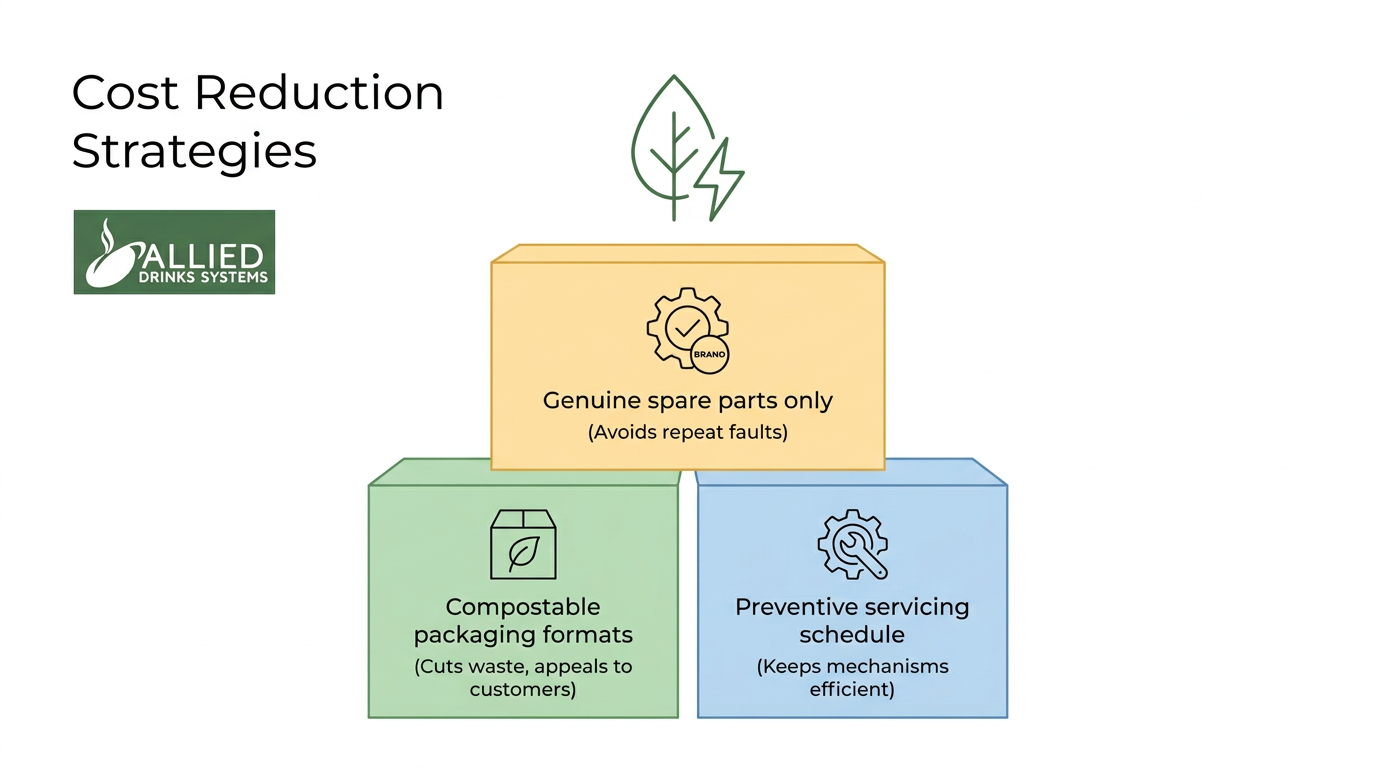
Switching to compostable or sustainable single-serve formats cuts packaging waste and often appeals to the same customers who notice a business’s wider environmental choices. It’s a simple swap that doesn’t require new equipment, just a different supply order.
Scheduling preventive servicing rather than waiting for a breakdown keeps refrigeration and dispensing mechanisms running efficiently for longer, and using genuine spare parts avoids the repeat faults that cheaper substitutes can cause. The company supports this approach through spare parts availability and servicing guidance for both vending and slush equipment.
Installation, Warranty, and Ongoing Support
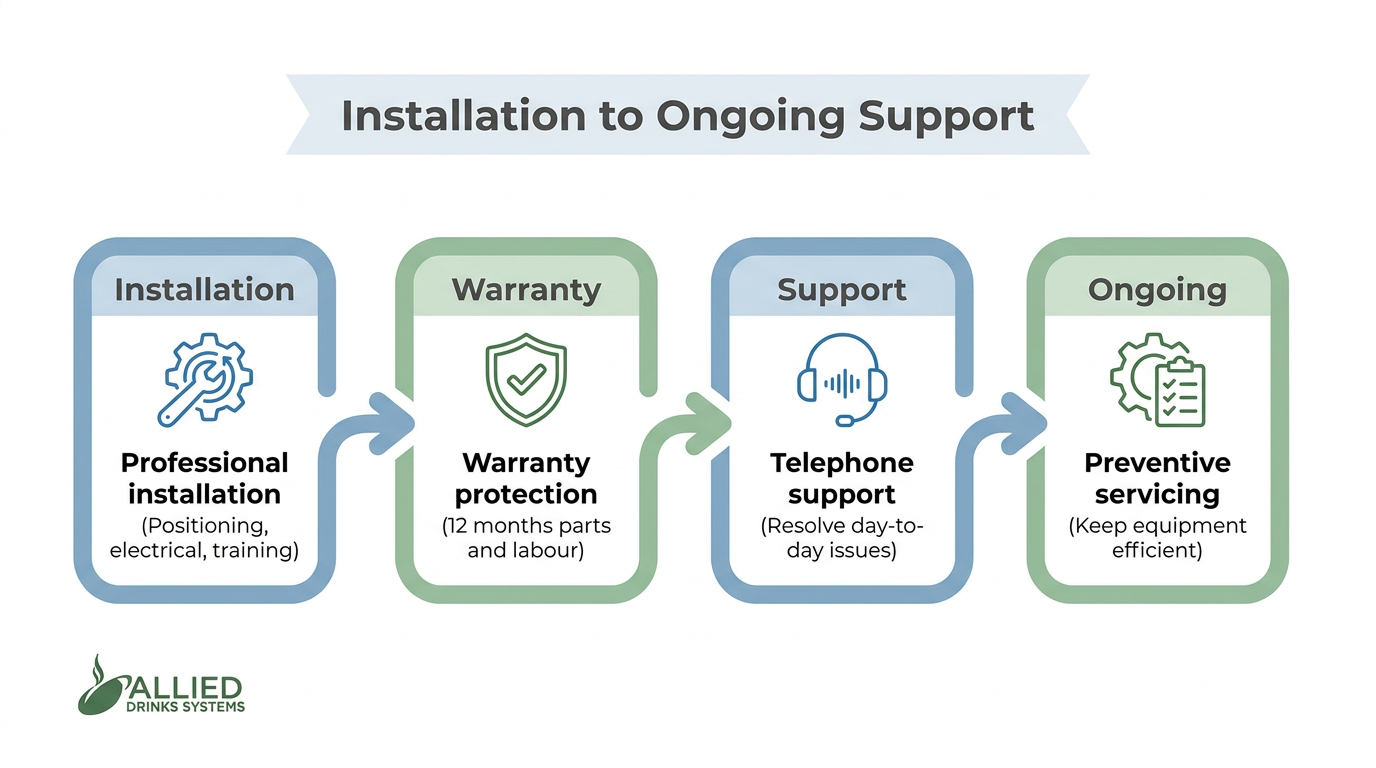
Professional installation makes the difference between a drinks vending machine that runs reliably from day one and one that causes problems within its first few weeks of service. A proper installation covers correct positioning for customer access and security, electrical connection to the right supply, initial stocking so the machine is ready to sell immediately, and basic staff training on restocking and simple fault checks. Warranty cover matters just as much as the installation itself, with 12 months of parts and labour cover giving genuine protection against the refrigeration faults, electrical issues, or mechanical failures that can crop up in the early months of use. Telephone support matters more than buyers often expect, because most day-to-day issues, a jammed coin mechanism or a display error, can be talked through and resolved without waiting for an engineer visit. Businesses that treat installation and support as part of the purchase decision, rather than an afterthought, tend to get far more reliable service from their machine over its working life, and spend less time and money firefighting avoidable problems.
Why Does Staff Training Matter After Installation?
Staff who understand how to restock, clean, and carry out basic fault checks on a drinks vending machine prevent small issues from turning into call-out visits. A short training session at installation pays for itself the first time a member of staff resolves a minor jam without waiting on an engineer.
Allied Drinks Systems has supplied coffee equipment and drinks supplies to UK businesses since 1993, and that depth of experience shapes how its technical support team trains staff around real usage patterns rather than generic manuals. That kind of grounded, practical training is what keeps a machine running smoothly long after the installation team has left.
The Takeaway
Matching machine type, capacity, and payment technology to your venue’s actual footfall remains the biggest factor in whether a drinks vending machine earns its keep. A compact unit crammed into a quiet corridor wastes capacity, just as an undersized machine in a busy reception leaves customers facing empty slots by mid-afternoon.
Sustainability features and supplier support matter just as much as the upfront price tag, since energy use, warranty cover, and engineer response times shape what a machine actually costs over its working life. If you’re ready to compare options, take a look at the vending machines range at Allied Drinks Systems on ads-coffee-supplies.co.uk or call the sales team on 0800 442299 for advice suited to your venue.
Frequently Asked Questions
How Much Does a Drinks Vending Machine Cost to Lease vs Buy?
Leasing a drinks vending machine typically starts at around £35 per week plus VAT, commercial coffee machine leasing and suiting businesses wanting to trial vending before committing. Buying outright demands more upfront cash but removes ongoing lease payments. Cash flow, how long you plan to keep the machine, and whether you want to test demand first should guide the choice.
What Electrical Supply Does a Drinks Vending Machine Need?
Most drinks vending machines run on a standard UK 220-240V supply, the same as most domestic sockets. High-capacity or hot beverage machines drawing around 3kW may need a dedicated circuit to avoid overloading existing wiring, so it’s worth checking this with an installer before delivery.
How Much Space Do I Need Around a Vending Machine for Servicing?
Most suppliers recommend around 30cm of clearance at the sides and 60cm at the rear, giving engineers room to access panels, restock trays, and carry out routine servicing without moving the whole unit. Checking this before installation avoids awkward repositioning later.
Can Drinks Vending Machines Accept Contactless and Mobile Payments?
Yes, most modern drinks vending machines accept card payments, NFC contactless, and mobile wallets such as Apple Pay alongside traditional coins and notes. This payment flexibility reduces lost sales from customers who don’t carry cash and suits workplaces moving toward cashless operations generally.
How Often Should a Vending Machine Be Restocked and Cleaned?
Restocking should follow a first-in-first-out approach so older stock sells before newer deliveries, preventing waste from expired products. Cleaning frequency depends on footfall, but wiping external surfaces weekly and sanitising internal product-contact areas regularly keeps hygiene standards up and maintains customer confidence.
Do Vending Machines Work in Outdoor or Unheated Locations?
Most machines operate reliably within an ambient range of roughly 10°C to 30°C, so unheated or exposed locations can affect performance. Solar-powered vending machines offer a practical option for outdoor, off-grid sites like parks or event spaces, combining renewable power with weatherproof construction.

