
Ask for a cup of tea in almost any UK café and you will be handed English breakfast, whether the menu calls it that or not. So what is English breakfast tea, exactly? It is not a single variety, and it does not come from one place. It is a blend of black teas, chosen to brew strong, dark and malty, and to hold its own under a splash of milk.
That last quality explains most of its success. We have been supplying tea and coffee to UK businesses from our base in Eastbourne since 1993, and breakfast tea is still the line that empties fastest from most of our customers’ shelves. Below we cover what goes into the blend, how it compares with Earl Grey, and how to serve it properly when you are pouring hundreds of cups a week.
Key takeaways
- English breakfast tea is a blend of black teas, typically Assam, Ceylon and Kenyan, built to brew strong and take milk.
- Breakfast tea should be brewed with water close to 100°C for 3 to 5 minutes, with milk added after the bag is removed.
- A mug of English breakfast tea contains around 40 to 60mg of caffeine, roughly half a mug of filter coffee.
- Earl Grey differs from English breakfast because it is black tea flavoured with bergamot oil and is usually lighter and taken without milk.
What Is English Breakfast Tea Made Of?
Every English breakfast tea is a blend of fully oxidised black teas. There is no legal recipe, so each blender sets its own. Most draw on some combination of the following:
- Assam from north east India, which brings the malty depth and body.
- Ceylon from Sri Lanka, for a brighter, brisker edge.
- Kenyan and wider East African teas, prized for strong colour and a quick, punchy infusion.
Older blends sometimes used Chinese Keemun, but modern catering blends lean heavily on African and Indian leaf because it delivers colour and strength fast. Some blenders now source almost entirely from East Africa.
Where the name comes from
Nobody fully agrees. One popular account credits a 19th century Edinburgh tea merchant with selling a “breakfast tea” blend, while others place the name’s early use in America. What matters for a café is the meaning it has today: a strong, everyday black tea designed for the first cup of the morning and every cup after it.
Why it usually comes in bags
Most breakfast tea sold to cafés is processed by the CTC method (crush, tear, curl), which produces small, even granules rather than whole leaves. Those granules infuse quickly, giving a dark brew inside three minutes, which is exactly what you want from a tea bag at a busy counter.
Why Breakfast Tea Became the Café Standard
The short answer is milk. Around three quarters of tea drunk in the UK is taken with milk, and a delicate tea simply disappears once milk goes in. A good breakfast blend keeps its colour and flavour, so the customer still tastes tea rather than warm milk.
It is also forgiving. If a busy barista leaves the bag in for an extra minute, breakfast tea gets stronger but rarely becomes unpleasant. Greens and lighter blacks turn bitter far more quickly.
Then there is familiarity. Customers who never look at the tea menu still expect their “normal” cup to taste the way it does at home, and breakfast tea is the closest match to the supermarket blends most people grew up with. For the operator, it keeps stock simple: one strong blend covers the majority of tea orders, with a small range of speciality teas alongside it.
Caffeine sits comfortably in the middle too. A mug of breakfast tea typically contains around 40 to 60mg, depending on bag weight and brewing time, against roughly 80 to 120mg in a mug of filter coffee. Our guide to how much caffeine is in tea breaks those figures down further if customers ask.
English Breakfast Tea vs Earl Grey
These are the two black teas almost every café stocks, and customers do mix them up. The difference is simple: English breakfast is a straight blend of black teas, while Earl Grey is black tea flavoured with oil of bergamot, a citrus fruit.
| English breakfast | Earl Grey | |
|---|---|---|
| Base tea | Blend of Assam, Ceylon, African teas | Usually China or Ceylon black tea |
| Flavour | Malty, full bodied, brisk | Lighter, floral, citrus aroma |
| Milk | Designed for it | Often taken black or with lemon |
| Brew time | 3 to 5 minutes | 3 to 4 minutes |
| Typical caffeine per mug | 40 to 60mg | 30 to 50mg |
| Best served with | Breakfasts, bacon rolls, cake | Afternoon tea, scones, light lunches |
Earl Grey tends to sell later in the day and alongside afternoon tea, while breakfast tea moves steadily from opening to close. If you are deciding how many of each to carry, our article on choosing a tea selection for your café menu covers that balance in more detail.
Brewing Breakfast Tea Properly Behind the Counter
Most complaints about café tea come down to two things: water that is not hot enough, and bags pulled out too early.
Black tea needs water at or very close to boiling, around 100°C. Be careful with the hot water tap on an espresso machine. On many machines the water is mixed with cold to stop it spitting, so it can come out well below boiling. A dedicated water boiler gives you a hotter, more consistent result.
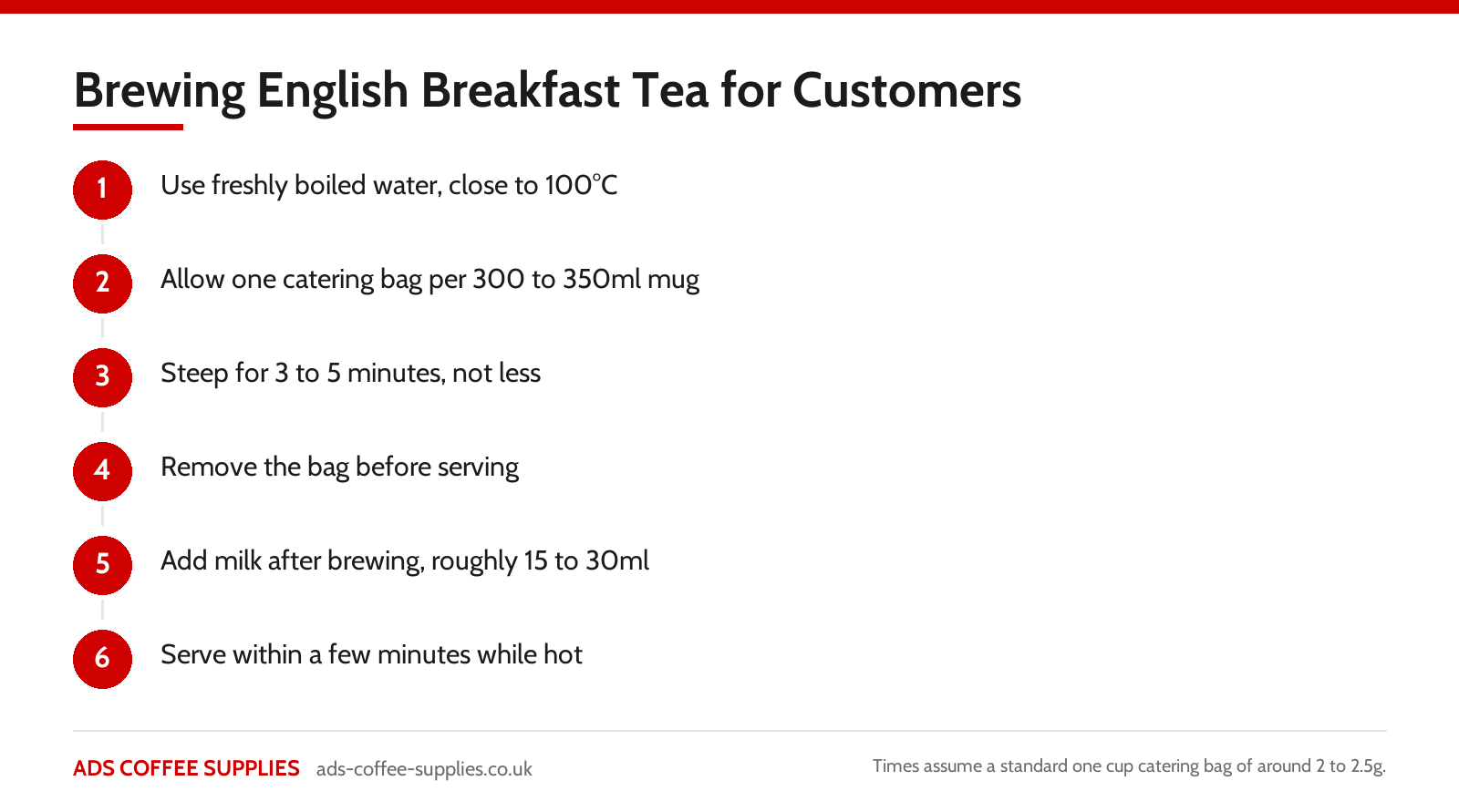
Allow one standard catering bag per mug of 300 to 350ml (10 to 12oz). For a pot, the old “one per person” rule still works: a two cup pot of around 600ml takes two bags. Leave the bag in for at least three minutes; five gives a stronger builder’s style cup. Pressing the bag against the side of the mug squeezes out bitterness, so lift it out cleanly instead.
Milk goes in after the bag comes out. Adding it first cools the water and slows extraction, which is why tea made that way often tastes thin.
Choosing a Breakfast Tea Blend for Your Business
The right format depends on how and where the tea is served, more than on the blend itself.
High volume counters
For cafés, canteens and event caterers, unwrapped catering bags are the most practical option. The Birchall English Breakfast 1100 One Cup Tea Bags come 1,100 to a 2.5kg pack, which works out at roughly 2.3g of tea per bag, a sensible weight for a 12oz mug. The blend is sourced from East African estates, from Rwanda to Kenya’s Rift Valley, so it brews dark and quickly. You can compare other options in our catering tea bags range.

Birchall English Breakfast 1100 One Cup Tea Bags (2.5kg)
Birchall English Breakfast Tea is a unique, masterful blend, closely guarded by the fifth generation of Birchall Graham’s family. Our teas are sourced entirely…
Hotel rooms, meeting trays and table service
Where tea is left out for guests, individually wrapped bags keep it fresh and look tidier. The Birchall English Breakfast Plant-Based Enveloped Tea Bags use the same full flavoured blend in sealed envelopes, which suits hospitality trays and boardroom setups.

Birchall English Breakfast Plant-Based Enveloped Tea Bags (25)
Birchall English Breakfast tea is a strong, unique, masterful blend, bursting with full flavour. Sourced from estates across East Africa, from Rwanda through…
When customers want it stronger
If your regulars complain that tea is never strong enough, try a heavier blend rather than asking staff to use two bags. Birchall Great Rift Breakfast Blend is a punchier breakfast tea that has won Great Taste Awards for ten years running, and it holds up well to plenty of milk.
Birchall Great Rift Breakfast Blend Plant-Based Tea Bags (80)
Birchall Great Rift Breakfast Blend is delicious, strong and bursting with full flavour. Presented in plant-based everyday tea bags, it’s been voted a winner…
Self-serve and capsule machines
Offices and small sites running a capsule system can offer breakfast tea without a separate boiler. K-fee Espresto English Breakfast Tea Capsules deliver a full bodied black tea rated 10 out of 12 for intensity, so staff get a proper cup from the same machine as their coffee.
K-fee Espresto English Breakfast Tea Capsules
Delivery Time: 1-3 Working Days A harmonious, powerful and full-bodied black tea. Intensity: 10/12 Ingredients: Black Tea Quantity: 1 Box – 16 Capsules 6 Boxes…
If you would like help matching tea to your setup, or want to taste a few blends at our Eastbourne showroom, give the team a call. We deliver UK-wide, free on orders over £69 ex VAT.
Frequently asked questions
What is English breakfast tea?
English breakfast tea is a blend of black teas, usually combining Assam, Ceylon and Kenyan or other East African leaf. There is no fixed recipe, so each brand creates its own mix. The aim is a strong, malty, full bodied cup with good colour that tastes balanced when milk is added, which is why it is the standard tea in UK cafés and homes.
What is the difference between English breakfast tea and Earl Grey?
English breakfast is a plain blend of black teas with a malty, full flavour designed to take milk. Earl Grey is black tea, often from China or Ceylon, flavoured with oil of bergamot, giving it a citrus and floral aroma. Earl Grey is lighter and is often drunk black or with lemon, while breakfast tea is usually served with milk.
How long should you brew English breakfast tea?
Brew English breakfast tea for 3 to 5 minutes using freshly boiled water at around 100°C. Three minutes gives a medium cup, while five produces a stronger, darker brew that suits plenty of milk. Remove the bag cleanly rather than squeezing it, then add milk afterwards so the water stays hot enough to extract full flavour from the leaf.
How much caffeine is in English breakfast tea?
A typical mug of English breakfast tea contains around 40 to 60mg of caffeine. The exact amount depends on how much tea is in the bag, the blend used and how long it steeps. A longer brew extracts more caffeine. For comparison, a mug of filter coffee usually contains roughly 80 to 120mg, so breakfast tea sits at about half.
Do you put milk in English breakfast tea?
Most people in the UK do, and the blend is designed for it. The strong Assam and African teas keep their colour and flavour when milk is added, typically 15 to 30ml per mug. It can also be drunk black, though some find it brisk without milk. For best results, add milk after brewing rather than before.

