
Earl Grey tea is black tea flavoured with oil of bergamot, a fragrant citrus fruit grown mostly along the coast of Calabria in southern Italy. If you have ever wondered what is Earl Grey tea beyond the posh reputation, that single ingredient is the answer. It gives the cup a perfumed, slightly floral lift that a standard breakfast brew simply does not have.
Below we cover what goes into it, what it tastes like, how much caffeine it carries and how to brew it well, at home or behind a busy counter.
Key takeaways
- Earl Grey tea is black tea flavoured with oil of bergamot, a citrus fruit grown mainly in Calabria, southern Italy.
- A 250ml cup of Earl Grey contains roughly 40 to 70 mg of caffeine, about the same as other black teas and less than filter coffee.
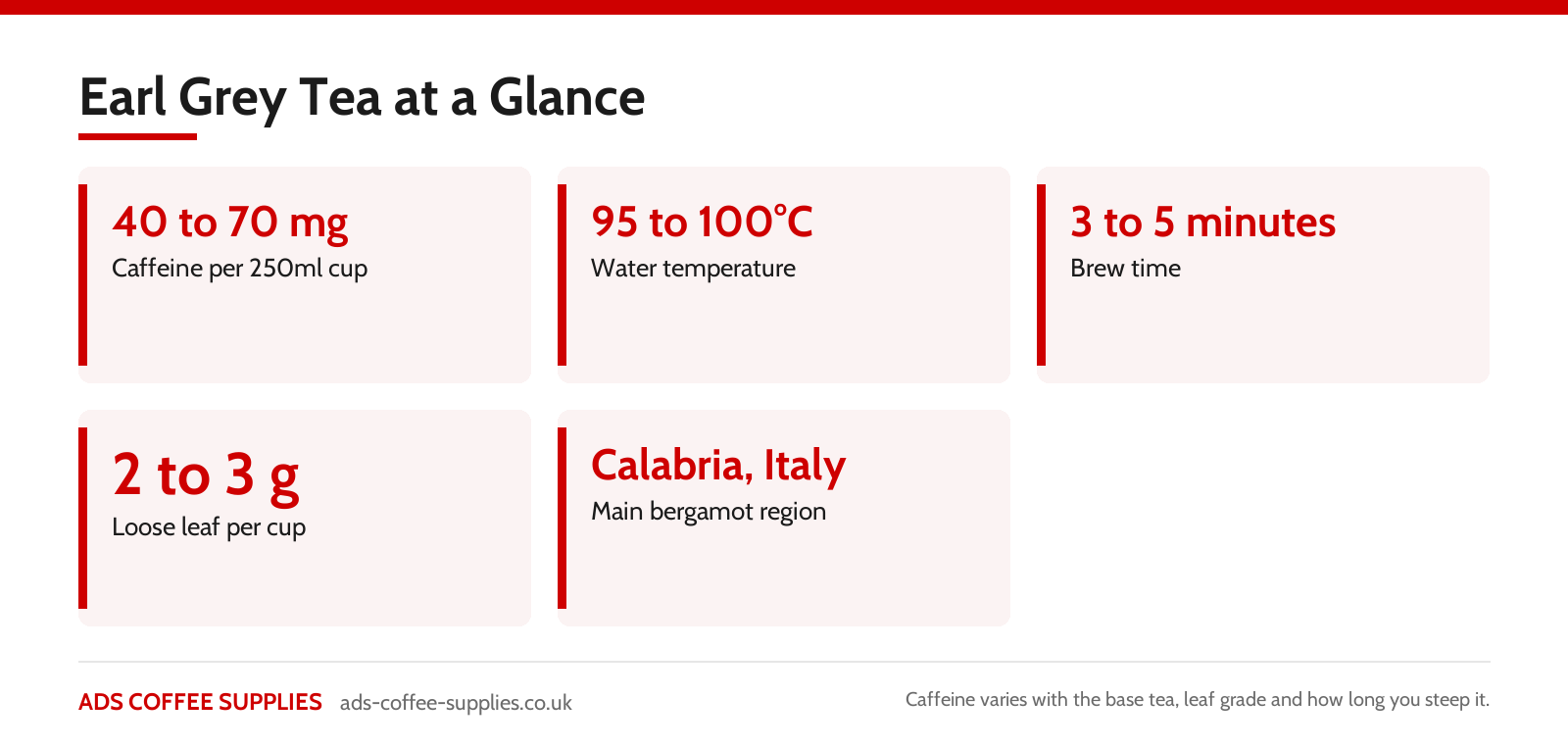
- Brew Earl Grey with water at 95 to 100°C for 3 minutes black or 4 to 5 minutes with milk, using one bag or 2 to 3 g of leaf per cup.
- Bergamot oil is volatile, so Earl Grey should be stored separately from other teas to stop its aroma tainting them.
What Is Earl Grey Tea Made From?
Two things: a black tea base and bergamot. Everything else is a variation on that theme.
The base tea
Early versions were made with Chinese black teas such as Keemun, which have a gentle, slightly smoky character. Today most blends use teas from India, Sri Lanka, China or East Africa, chosen to stand up to the citrus without fighting it. A brisk African base gives a brighter, punchier cup, while a China base tends to be softer and rounder.
The bergamot
Bergamot (Citrus bergamia) looks like a small, knobbly lemon that is turning orange. You would not want to eat one: the flesh is sour and bitter. The value is in the rind, which is cold pressed to release an aromatic oil. That oil is sprayed onto or blended through the dried leaf. Some brands use natural bergamot oil, others use a flavouring that copies it, and the difference shows in how clean and long lasting the aroma is.
Birchall Earl Grey Plant-Based Enveloped Tea Bags (250) are a good example of the classic style: tea from estates across East Africa blended with traditional bergamot oil, giving a bright citrus note with a hint of spice.

Birchall Earl Grey Plant-Based Enveloped Tea Bags (250)
Birchall Earl Grey tea is fragrant, famously bright and perfect anytime. Blended with a traditional Bergamot oil, to give a distinctive flavour of citrus, with…
Where the name comes from
The tea is named after Charles Grey, the 2nd Earl Grey, who was Prime Minister from 1830 to 1834 and pushed through the Great Reform Act of 1832. The popular story involves a grateful Chinese mandarin sending a gift of scented tea, but there is no good evidence for it. A likelier explanation is that bergamot was added to cheaper black tea to imitate the fragrance of expensive Chinese teas, and the Grey name was attached later as a selling point. Several tea companies have claimed to be the original blender, and none can prove it.
What Does Earl Grey Taste Like?
Imagine a regular cup of black tea with a squeeze of orange zest and a faint floral perfume floating over it. The first thing you notice is the aroma, which hits before the cup reaches your mouth. On the palate the citrus is lighter than you might expect, more fragrant than sour, sitting on top of the malty or slightly smoky body of the base tea.
How strong the bergamot comes across depends on the blend. Some are delicate and almost lavender-like. Others are bold enough to taste like a citrus sweet. A heavy hand with the flavouring can tip into soapy, which is usually a sign of cheap flavouring or a bag that has sat open for months.
Milk, lemon or neither?
Traditionalists drink it black or with a thin slice of lemon, which picks up the citrus. Plenty of people take milk, and that works best with blends built on a stronger base. Teapigs Earl Grey Strong Tea Temples (50) are made with exactly that in mind: a blend of strong English breakfast, Darjeeling and bergamot designed to be drunk with milk. If your customers find standard Earl Grey a bit thin, this style usually wins them over.
Teapigs Earl Grey Strong Tea Temples (50)
Teapigs earl grey with attitude. A blend of strong English breakfast, Darjeeling and bergamot – to be drunk with
One thing to avoid is lemon and milk together. The acid curdles the milk almost immediately.
Does Earl Grey Have Caffeine?
Yes. Because it is made from black tea, Earl Grey contains roughly the same caffeine as any other black tea: around 40 to 70 mg in a 250ml (8.5oz) cup. The bergamot adds none. Where your cup lands in that range depends on the leaf, the size of the particles and how long you leave the bag in.
| Drink (250ml unless stated) | Typical caffeine |
|---|---|
| Earl Grey, 3 minute brew | 40 to 55 mg |
| Earl Grey, 5 minute brew | 55 to 70 mg |
| Decaffeinated Earl Grey | 2 to 5 mg |
| Filter coffee | 80 to 120 mg |
| Single espresso (25 to 30ml) | 60 to 75 mg |
So Earl Grey sits comfortably below a mug of filter coffee, and a little above most green teas. For a wider comparison across tea types, our guide to how much caffeine is in tea breaks it down further. If you want the bergamot flavour without the caffeine, look for a rooibos-based version, which is naturally caffeine free.
How to Brew Earl Grey Properly
Earl Grey is forgiving, but a few details make the difference between fragrant and flat.
- Use freshly drawn water. Reboiled water has less oxygen and makes the cup taste dull. In hard water areas, filtered water gives a clearer, brighter result.
- Let it come off the boil. Black tea needs water at 95 to 100°C. Pouring a few seconds after the kettle clicks off keeps the bergamot from tasting harsh.
- Get the quantity right. One bag or 2 to 3 g of loose leaf per 250ml cup. In a teapot, one bag per person is plenty.
- Time it. Three minutes for drinking black, four to five if you plan to add milk. Beyond five minutes the tannins take over and the citrus disappears behind bitterness.
- Remove the bag without squeezing. Squeezing pushes out the most astringent compounds.
- Add milk last, once the tea has brewed, so you can judge the colour and strength.
Pyramid bags and tea temples give larger leaves room to open, which tends to produce a fuller cup than tightly packed fannings. For high-volume urns the same principles apply: get the temperature right and do not let tea stew on a hot plate for an hour.
Earl Grey Variations Worth Knowing
Once you know the basic formula, the variations make sense.
- Lady Grey style blends add extra citrus peel, such as orange or lemon, and sometimes cornflower petals for a lighter, more fruity cup.
- Cream Earl Grey adds vanilla for a softer, rounder finish that suits milk well.
- Green Earl Grey swaps the black base for green tea. Brew it cooler, at around 80°C, for two to three minutes.
- Rooibos Earl Grey uses South African redbush and contains no caffeine, which makes it popular as an evening drink.
- London Fog is an Earl Grey latte: strongly brewed Earl Grey topped with steamed milk and a splash of vanilla syrup. It is an easy addition to a café menu if you already have a steam wand and syrups.
Earl Grey also makes a good iced tea. Brew it at double strength, let it cool, then pour over ice with a slice of orange.
Serving Earl Grey in a Café, Hotel or Office
On most menus Earl Grey is the second tea people ask for after a breakfast blend, so it earns its place even in a small range. It is a fixture of any afternoon tea service and a common request in hotel rooms and meeting spaces.
A few practical points from our years supplying cafés and hotels since 1993:
- Store it separately. Bergamot oil is volatile and travels. Keep Earl Grey in the same caddy as other teas and within a week your breakfast tea will smell of citrus.
- Enveloped bags keep the aroma in. For hotel trays, meeting rooms and self-service stations, individually wrapped bags hold onto that fragrance far longer than loose bags in a jar, and they look tidier too.
- Pair it with a strong everyday tea. Earl Grey works best as the fragrant alternative to a robust builder’s brew rather than a replacement for it. A breakfast blend such as Birchall English Breakfast Tagged Tea Bags (100) covers the classic cup, with Earl Grey sitting next to it for guests who want something lighter.
Birchall English Breakfast Tagged Tea Bags (100)
Birchall English Breakfast Tea is a unique, masterful blend, closely guarded by the fifth generation of Birchall Graham’s family. Our teas are sourced entirely…
- Offer lemon as well as milk. It costs very little and makes Earl Grey drinkers feel looked after.
If you are building or refreshing a tea selection, browse our full range in the ADS tea section, with free next working day delivery on orders over £69 ex VAT to mainland UK.
Frequently asked questions
Is Earl Grey a black tea or a green tea?
Traditional Earl Grey is a black tea flavoured with bergamot oil. That is why it has a similar caffeine level and brewing method to English breakfast tea. Green Earl Grey and rooibos Earl Grey also exist, using the same bergamot flavouring on a different base, but if a menu simply says Earl Grey you can expect black tea.
Should you put milk in Earl Grey tea?
It is personal preference. Many people drink Earl Grey black or with a slice of lemon to keep the citrus aroma clear. Milk works well too, particularly with stronger blends built on a breakfast tea base. Brew for four to five minutes if adding milk, and never combine milk with lemon, as the acid will curdle it.
Can you drink Earl Grey at night?
Standard Earl Grey contains around 40 to 70 mg of caffeine per 250ml cup, so it can affect sleep if you are sensitive to caffeine. That is less than a mug of filter coffee but still significant. For an evening cup, choose a decaffeinated Earl Grey, which has around 2 to 5 mg, or a rooibos version with no caffeine at all.
What is the difference between Earl Grey and Lady Grey?
Lady Grey style teas start with the same bergamot-scented black tea and add extra citrus, usually orange and lemon peel, and sometimes cornflower petals. The result is lighter, fruitier and less perfumed than classic Earl Grey. Lady Grey itself is a trademarked name, so other brands sell similar blends under different names.

