
Matcha has moved out of specialist tea houses and onto the back bar of ordinary UK cafés, and suppliers have answered with a confusing ladder of grades. Ceremonial grade matcha sits at the top of that ladder and is priced accordingly. The useful question for a café owner is not which grade is best in the abstract. It is which grade makes sense for the drinks you actually sell.
For most sites, the answer is not the one with the grandest label. Below we cover how the grades differ, what milk and syrup do to each, and how to decide what goes on your shelf.
Key takeaways
- For a café selling mostly matcha lattes, a good latte or premium culinary grade is usually the better buy than ceremonial grade matcha.
- Ceremonial grade is an unregulated term, but it usually means first-harvest leaves shaded for three to four weeks and stone ground for drinking with water.
- A café matcha latte typically uses 2 to 3 g of powder per 12 oz cup, giving roughly 50 to 70 mg of caffeine per 2 g.
- Matcha should be prepared with water at 70 to 80°C and used within about a month of opening to keep its colour and flavour.
What is ceremonial grade matcha?
There is no official definition. Japan does not regulate the word “ceremonial”. The term was largely coined by Western sellers, so two tins with the same label can be very different products. In practice, a genuine ceremonial matcha usually shares a few traits.
- First harvest. Leaves are picked in late April or May, when the young shoots are at their sweetest.
- Shade growing. The bushes are covered for roughly three to four weeks before picking. Less sunlight pushes up chlorophyll and L-theanine, the amino acid behind matcha’s savoury, rounded flavour.
- Careful processing. Leaves are steamed and dried, then stripped of stems and veins to make tencha. Slow granite stone mills grind the tencha, and each mill produces only around 30 to 40 g an hour.
The result is a vivid jade powder with a very fine particle size. It tastes sweet and grassy with a long umami finish and very little bitterness. It is made to be whisked with water and nothing else. If you want the wider background on how matcha is grown and why it differs from loose green tea, our guide to what matcha is and where it comes from covers the basics.
Culinary grade matcha: what you are actually getting
Culinary grade matcha usually comes from later harvests, often the second flush in June or July and sometimes an autumn picking. Those leaves have had more sun, so they carry more catechins. That gives a stronger, more astringent taste and a duller, olive-leaning colour. The powder may be ball milled rather than stone ground, which is faster and leaves a slightly coarser texture.
None of that makes it bad tea. It is built to stand up to milk, sugar and ice, where a delicate first-flush powder would simply disappear. The problem is that “culinary” covers a huge range. At the good end, suppliers call it latte grade or premium culinary. At the bottom you will find brownish, hay-scented powder that turns a latte the colour of army fatigues.
| Feature | Ceremonial | Latte / premium culinary | Ingredient grade |
|---|---|---|---|
| Harvest | First flush, spring | First or second flush | Later flushes |
| Colour | Bright jade | Mid green | Olive to yellow green |
| Flavour | Sweet, umami, low bitterness | Grassy, some astringency | Bold, bitter, earthy |
| Best use | Straight with water | Lattes, iced lattes | Baking, smoothies, frappés |
| Typical dose | 2 g in 70 ml water | 2 to 3 g per 12 oz drink | To taste in recipes |
What milk, ice and syrup do to each grade
Milk changes everything. Milk proteins bind to some of the catechins and soften the bitterness, and the natural sweetness of dairy or oat milk covers much of what is left. Unfortunately, milk also mutes the subtle umami you paid a premium for. Put ceremonial matcha into a 12 oz (340 ml) latte with a pump of vanilla and very few customers could tell it apart from a good latte grade.
Where a cheaper grade has to earn its place is colour. Weak matcha goes khaki once milk hits it, and customers notice that before they taste anything. The grade you buy for lattes needs to stay properly green in your house milk.
Dose and the false economy
A typical café latte uses 2 to 3 g of matcha per 12 oz cup. A very cheap powder often needs 4 g or more to taste of anything, which quietly eats the saving. Work out cost per serve at the dose that tastes right, not cost per kilo.
Caffeine
Matcha contains roughly 25 to 35 mg of caffeine per gram, so a 2 g serve lands at about 50 to 70 mg. That is broadly similar to a single espresso. Shaded first-flush leaves sit towards the top of that range, which is worth knowing if staff get asked.
Iced drinks dull flavour further, because cold numbs the palate. A bolder latte grade usually performs better over ice than an expensive ceremonial powder.
Which grade should a café buy?
Start with your menu, not the price list. Look at how matcha will actually be served and buy for that.
- Lattes and iced lattes only. This covers most cafés. A good latte or premium culinary grade gives you the colour and flavour you need without paying for nuance the milk will hide.
- Lattes plus a straight matcha. Keep latte grade for milk drinks and a small tin of ceremonial for the straight serve. Price the straight cup as the premium drink it is.
- Frappés, smoothies and bakes. Ingredient grade is fine here. If speed at the counter matters more than control, a pre-sweetened matcha latte powder may suit you better than pure matcha.
- Tea-led specialist sites. Ceremonial earns its keep where customers come for the tea itself and drink it with water.
Freshness matters as much as grade. Matcha starts to lose colour and aroma within weeks of opening, so a lower-volume café is better off buying smaller packs and turning them over quickly than sitting on a kilo bag.
If you are adding matcha for the first time, Summit Matcha Green Tea Powder (100g Packet) is a sensible starting point. It is a pure organic powder with nothing added, so you control the sweetness yourself. At 2 to 3 g a serve, 100 g gives roughly 35 to 50 lattes. That is small enough to use while it is still fresh. Taste it in water and in your house milk before deciding where it sits on your menu.

Summit Matcha Green Tea Powder (100g Packet)
Experience the purest green tea boost with Summit Pure Organic Matcha Powder. Made from specially grown and processed green tea, it offers a fresh, grassy…
Testing samples and serving matcha well
Labels will not tell you much, so run every sample through the same quick test before you commit.
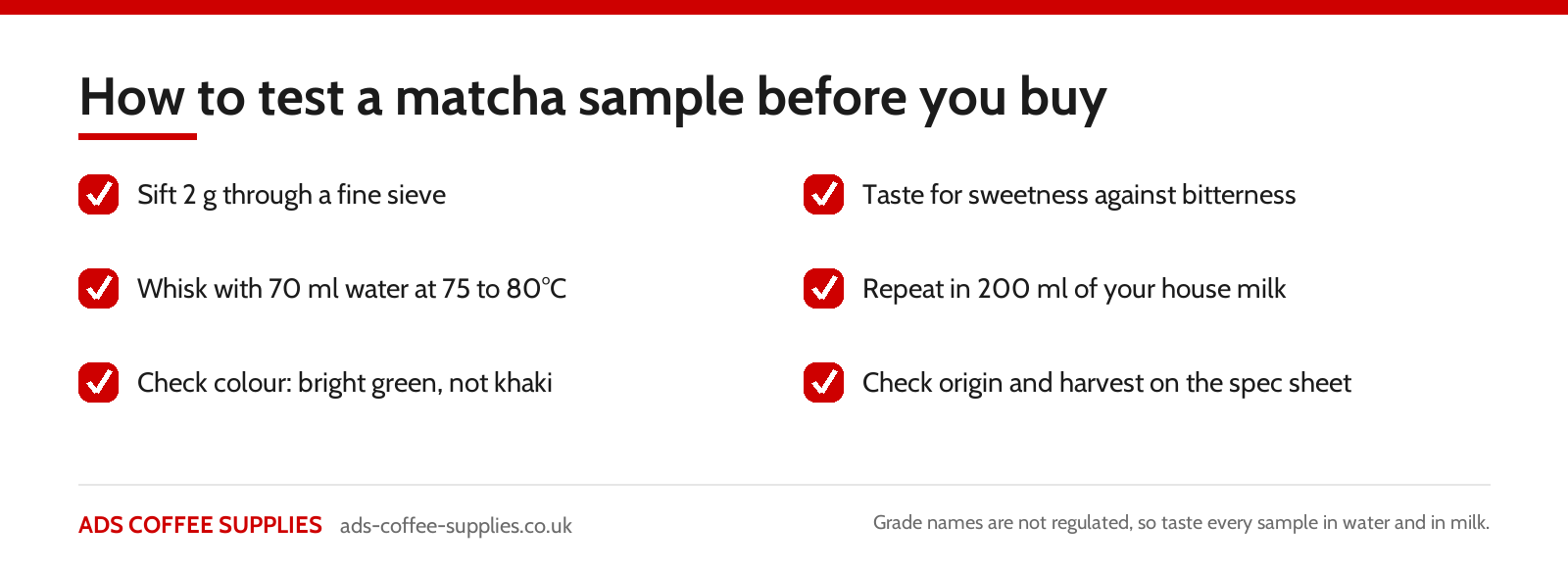
Water temperature catches a lot of cafés out. Boiling water scorches matcha and brings out bitterness, whatever the grade. Aim for 70 to 80°C. Most commercial boilers deliver water well above 90°C, so either let it rest for a minute or decant it into a jug first.
Getting a smooth cup
Clumps are the most common complaint. Sift the powder, then mix it into a paste with around 30 ml of warm water before adding steamed milk. For a straight ceremonial serve, whisk briskly in a zigzag motion with a bamboo whisk until a fine foam forms. Do not stir in circles.
A traditional set behind the counter is also the best way to train staff. Tasting matcha with water teaches them what good powder should be like. The Manual Matcha Bundle brings the handcrafted tools for traditional-style preparation together in one box. That makes it handy for a straight-serve station or for side-by-side tasting when you are comparing samples.

The Manual Matcha Bundle
Create smooth, traditional-style matcha at home with this simple setup, featuring handcrafted tools designed to make preparation easier and more enjoyable.…
Storage
Matcha is damaged by oxygen, light, heat and moisture. Keep it sealed in an airtight tin, away from the espresso machine and the steam wand, and use an opened pack within about a month. Unopened stock keeps longer in a cool, dark cupboard.
We have been supplying cafés from our Eastbourne base since 1993, and we are always happy to talk through which matcha fits your menu. Orders over £69 ex VAT ship free next working day across mainland UK.
Frequently asked questions
What is ceremonial grade matcha?
Ceremonial grade matcha is a marketing term for top-quality matcha, usually made from first-harvest leaves that have been shade grown for three to four weeks, destemmed and stone ground. It is bright green, sweet and low in bitterness, and is meant to be whisked with water rather than milk. The term is not regulated, so quality varies between brands.
Can you use ceremonial grade matcha in a latte?
You can, but it is rarely worth it commercially. Milk and syrup mask the delicate sweetness and umami that make ceremonial matcha expensive, and most customers cannot tell it apart from a good latte grade in a 12 oz drink. Save ceremonial for straight serves with water and use a quality latte grade for milk drinks.
Is culinary grade matcha lower quality?
Culinary grade matcha is made for a different job rather than simply being worse. It comes from later harvests with more catechins, giving a bolder, more astringent flavour that holds up to milk, sugar and ice. Quality ranges widely, though. Good latte grade stays green in milk, while poor ingredient grade turns khaki and tastes of hay.
How much matcha goes in a café latte?
Most cafés use 2 to 3 g of matcha in a 12 oz (340 ml) latte. Sift the powder, mix it into a smooth paste with about 30 ml of water at 70 to 80°C, then add steamed or cold milk. If a powder needs 4 g or more to taste of anything, it may not be the bargain it seems.
How long does matcha last once opened?
Use opened matcha within about four weeks for the best colour and flavour. Oxygen, light, heat and moisture all degrade it, so keep it in a sealed airtight tin away from the espresso machine and steam. It will not become unsafe after that, but it fades to a duller green and tastes flatter and more bitter.

