
Most people in Britain reckon they know how to make a cup of tea, and most of them are nearly right. The difference between a fine mug and a really good one comes down to water temperature and timing, with the milk question a distant third.
We have been supplying cafés, hotels and offices from Eastbourne since 1993, and the same small errors turn up behind counters again and again. Below is the method we use at home, followed by the places where commercial tea service tends to slip.
Key takeaways
- To make a good cup of black tea, pour water at 98 to 100°C onto one bag and brew for 3 to 5 minutes before removing it.
- Green tea should be brewed at 70 to 80°C for 2 to 3 minutes, as boiling water makes it bitter.
- With a bag in a mug, add milk only after the bag is removed, because cold milk first stops the tea brewing properly.
- Cafés should serve tea from a dedicated, filtered water boiler held near boiling rather than from an espresso machine's hot water tap.
How to make a cup of tea at home, step by step
None of this is complicated. It just rewards doing each step on purpose rather than on autopilot.
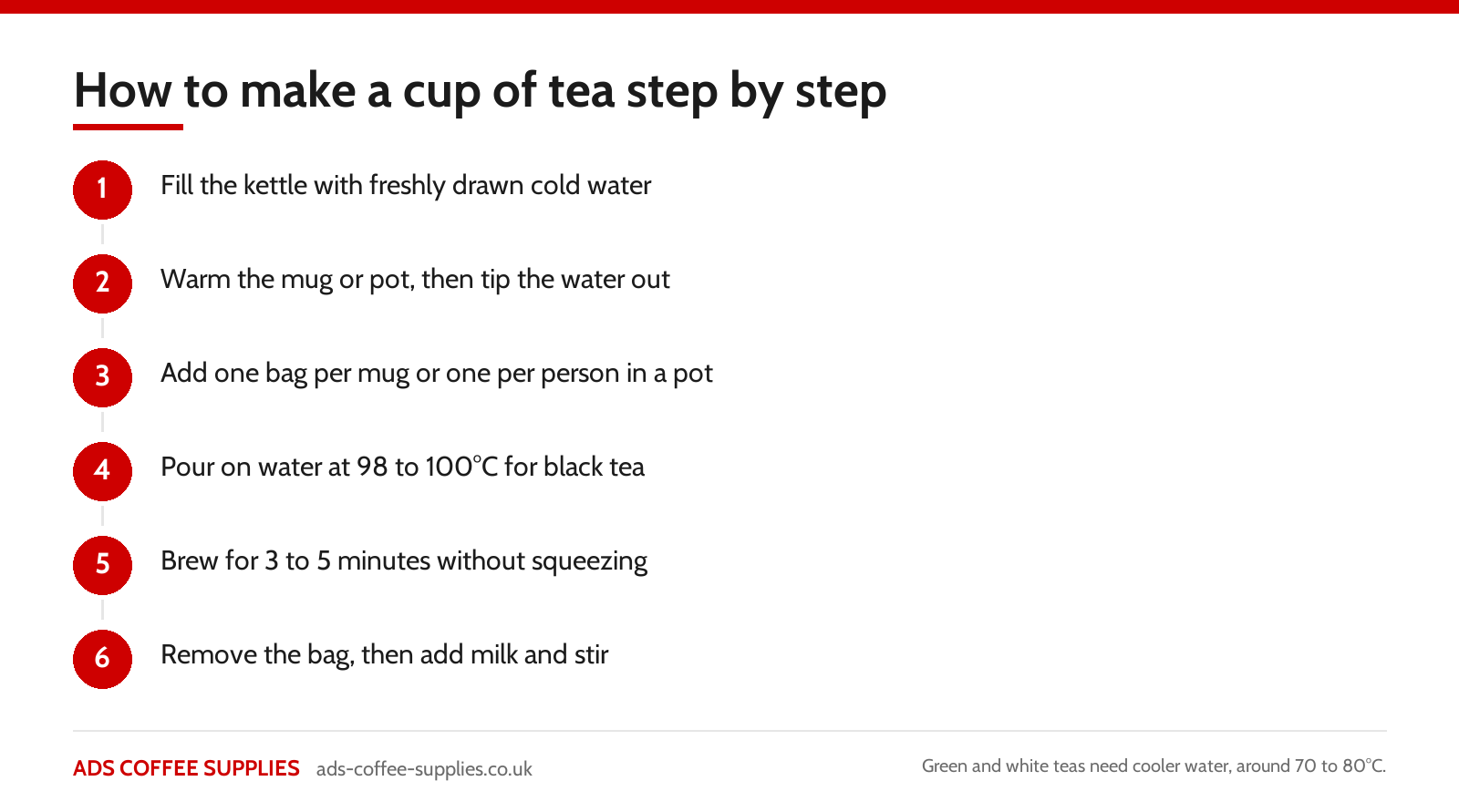
- Use fresh cold water. Run the tap for a few seconds and boil only what you need. Water that has sat in the kettle and been boiled several times tends to taste flat.
- Warm the mug or pot. A splash of hot water, swirled and tipped out, stops a cold ceramic mug pulling 5°C or more out of your brew.
- One bag per mug. In a pot, allow one bag per person. A standard bag holds around 2 to 3 g of tea, which suits roughly 250 to 350 ml (9 to 12 oz) of water.
- Pour as soon as the kettle clicks off. For black tea you want 98 to 100°C hitting the leaf.
- Leave it alone. Three to five minutes, no stirring, no squeezing. Squeezing the bag forces out bitter tannins.
- Bag out, then milk. Add milk to taste, stir and drink.
For a mug, a tagged bag is the easiest thing to handle, because you can lift it out cleanly when the time is up. Birchall English Breakfast Tagged Tea Bags are a good benchmark: an East African blend that gives a bright, brisk cup at four minutes and holds up well to milk.

Birchall English Breakfast Tagged Tea Bags (100)
Birchall English Breakfast Tea is a unique, masterful blend, closely guarded by the fifth generation of Birchall Graham’s family. Our teas are sourced entirely…
How long to brew tea, and at what temperature
This is where most cups go wrong. Black tea is forgiving, but pull the bag at 60 seconds and you get coloured water with very little flavour. Leave it for ten minutes and it turns harsh and drying.
| Tea type | Water temperature | Brew time | What happens if you overdo it |
|---|---|---|---|
| Black / breakfast | 98 to 100°C | 3 to 5 min | Stewed, bitter, mouth-drying |
| Earl Grey | 95 to 100°C | 3 to 4 min | Bergamot turns soapy |
| Green | 70 to 80°C | 2 to 3 min | Grassy bitterness, astringent finish |
| Peppermint and herbal | 100°C | 5 to 7 min | Very little; herbals are forgiving |
Brew time also changes caffeine. A mug of black tea usually lands somewhere between 40 and 70 mg, depending on the blend, the bag size and how long it steeps. The lab standard for tasting tea, ISO 3103, uses a full six minutes so that tasters see every flaw, which is why professional cuppings often taste stronger than a normal mug.
If you like your tea strong enough to stand a spoon in, a longer brew is not the answer. Use a stronger blend instead. Birchall Great Rift Breakfast Blend is built for exactly that: a full, malty cup at four minutes without needing to be left to stew.
Birchall Great Rift Breakfast Blend Plant-Based Tea Bags (80)
Birchall Great Rift Breakfast Blend is delicious, strong and bursting with full flavour. Presented in plant-based everyday tea bags, it’s been voted a winner…
Green tea is the one people ruin most often, because they pour straight from a boiling kettle. Let the kettle stand for three or four minutes with the lid open, or top up the mug with a little cold water first. Birchall Green Tea is smooth and clean at 75 to 80°C for two minutes, and noticeably harsher if it gets boiling water for five.
Birchall Green Tea Plant-Based Enveloped Tea Bags (25)
Birchall Green Tea is a purifying and restorative traditional green tea, rich in anti-oxidants. A delicious full flavoured pure green that is smooth, light and…
Water: the ingredient nobody thinks about
A cup of tea is around 99% water, so what comes out of the tap matters. Much of south and east England has hard water, Eastbourne very much included. The calcium in hard water reacts with the polyphenols in tea and leaves that oily-looking scum on the surface, along with a duller, flatter flavour. Soft water gives a brighter, more coloured cup.
At home, a jug filter makes a visible difference. In a café, the bigger problem is scale. A water boiler working in hard water builds up limescale on its element quickly, which slows recovery, wastes energy and eventually leads to a callout. A plumbed-in filter of the kind fitted to espresso machines protects the boiler and improves the taste at the same time. The Brita Purity C Quell ST C300 suits a typical counter setup, reducing carbonate hardness and the chlorine notes that can make tea taste faintly of swimming pool.
Brita Purity C Quell ST C300 Water Filter
Brita Purity C Quell ST C300 Water Filter Trusted Systematic Filter Technology decarbonises water in four steps Effectively reduces unwanted substances that…
Change the cartridge on schedule. An exhausted filter does nothing, and staff rarely notice the change in taste until the scale is already there.
Milk first or milk last?
The argument is older than any of us. George Orwell insisted on tea first in his 1946 essay on the subject, while the Royal Society of Chemistry argued in 2003 that milk first stops the milk proteins being scalded by boiling tea.
The practical answer depends on how you brew:
- Bag in a mug: milk last, every time. Adding cold milk first drops the water temperature well below what black tea needs, so the bag under-extracts and you get a weak, milky drink.
- Tea from a pot: it matters far less. The tea has already brewed at the right temperature, so pouring it onto milk is fine and gives a slightly smoother, rounder cup.
A splash of 20 to 30 ml of milk suits most mugs. Semi-skimmed is the British default, and full-fat gives a softer, creamier finish that suits stronger blends.
The tea mistakes cafés make
Plenty of cafés put serious thought into their espresso and then treat tea as an afterthought, even though a large share of customers order it. These are the problems we see most often on site visits.
Using the espresso machine’s hot water tap
Many espresso machine hot water outlets deliver water below a full boil, and some blend in cold water to make them safer to handle. That is fine for an Americano and poor for black tea. Draining the machine for tea at the same time also drags down steam pressure during a rush.
Bag on the saucer, water in the pot
Serving a pot of hot water with the bag on the side means the customer brews in water that has already cooled for a minute or two. Put the bag in the pot, pour the water on behind the counter, and let the customer remove it when they are ready.
Takeaway tea left to stew
A bag sealed under a lid keeps brewing for ten minutes or more on the walk back to the office. Ask whether the customer wants the bag removed, or brew for three minutes and take it out before handing it over.
Milk in the takeaway cup first
Some baristas add milk first to save time. With a bag in a cup, this produces a weak, grey drink every single time.
No dedicated boiler
The fix for most of the above is a countertop water boiler, ideally an autofill model plumbed to the mains with a filter, holding water close to boiling all day. Size it by how many cups you serve in your busiest hour rather than across the day, because recovery time is what customers notice. A good boiler also lets you set a lower draw for green tea service.
Once the method is sorted, the range is the next question. Our guide to choosing the right tea selection for your café menu covers that, and you can browse the full Birchall tea range we stock. If your boiler or machine needs servicing, our engineers cover the whole UK, so get in touch.
Frequently asked questions
How long should you brew a cup of tea?
For black or breakfast tea, brew for 3 to 5 minutes in water at 98 to 100°C. Three minutes gives a lighter cup, five gives a stronger one. Going past five minutes mainly adds bitterness rather than strength, so if you want a stronger mug, choose a more robust blend instead of leaving the bag in longer. Green tea needs only 2 to 3 minutes at a cooler 70 to 80°C.
Should milk go in before or after the water?
If you are brewing with a bag in a mug, add milk after you remove the bag. Cold milk added first lowers the water temperature and stops the tea extracting properly. If you are pouring from a teapot where the tea has already brewed, milk first is perfectly fine and gives a slightly smoother cup. The debate only really matters for mug brewing.
Why does my tea have a film or scum on top?
That film forms when calcium in hard water reacts with the natural compounds in tea. It is harmless but makes the tea look unappealing and taste duller. Using filtered or softer water reduces it noticeably. In cafés, a plumbed-in water filter on the boiler solves the problem and protects the element from limescale at the same time.
Can you use boiling water for green tea?
You can, but it usually makes green tea taste bitter and grassy. Boiling water extracts the harsher compounds too quickly. Aim for 70 to 80°C, which you can get by letting a boiled kettle stand with the lid open for three or four minutes, or by adding a little cold water to the mug first. Brew for 2 to 3 minutes.

