
You've bought a coffee machine for the spare room, office kitchen or café counter. The first cup is quick and tidy. Then the practical problems appear. The pods don't have an obvious recycling route, the water leaves scale around the outlet, the tank needs filling during the busiest part of the morning, and the machine occupies more worktop than the product page suggested.
That's why coffee single cup brewers should be judged by total operational friction, not just the ticket price. The right choice depends on brewing technology, water quality, throughput, consumable lock-in, waste handling and the cost of every drink. This guide applies that test to UK homes, workplaces and small cafés, with clear recommendations rather than a generic list of features.
Table of Contents
- Why Choosing the Right Single Cup Brewer Matters
- Understanding the Main Single Cup Brewing Technologies
- Comparing Pod, Capsule, Filter and Espresso Formats
- A Practical Buying Checklist for UK Buyers
- Installation, Water Quality and Real Cost per Cup
- Sustainability, Pod Recycling and the Compostable Question
- Matching the Right Brewer to Your Setting
- Common Questions About Coffee Single Cup Brewers
Why Choosing the Right Single Cup Brewer Matters
A single cup brewer solves a simple problem. It makes one drink when someone wants one, without brewing a whole carafe that may sit and cool. That makes it attractive in a Manchester home office, a shared reception area or a small café where customers want different drinks at different times.
The machine itself is only part of the decision. A pod brewer may be wonderfully consistent, but the owner still needs a realistic plan for used capsules. A filter machine may accept ordinary ground coffee and avoid proprietary servings, yet it can be slower and less suitable for milk drinks. An espresso machine may offer the highest skill ceiling, but it brings grinder choice, dosing, tamping and cleaning into the daily routine.
The UK waste problem remains relevant
The UK produced about 30,000 tonnes of coffee cup waste each year, according to House of Commons Environmental Audit Committee evidence. That represented 0.1% of total UK waste and 0.7% of UK packaging waste, while fewer than 1 in 400 cups, or 0.25%, were estimated to be recycled because specialist facilities were limited.
That historical evidence concerned takeaway cups rather than every pod format, but it explains the scrutiny now surrounding single-serve coffee. Convenience has to be matched by collection, separation and end-of-life arrangements. The same parliamentary evidence noted that only three UK facilities could recycle coffee cups at the time, so disposal infrastructure was as important as product design.
Practical rule: If you can't explain what happens to the used pod, filter or coffee grounds, you haven't finished choosing the brewer.
Four questions prevent most buying mistakes
Before comparing brands, answer these questions:
- How many drinks are needed at the busiest time? A home machine and a workplace machine face very different recovery demands.
- What water will it use? Hard water can shorten maintenance intervals and affect flavour.
- What consumables are acceptable? Proprietary capsules offer simplicity, while ground coffee offers wider sourcing and usually more control.
- Who will maintain it? A machine that looks simple may still need rinsing, descaling, waste-emptying and filter changes.
The buying checklist, sustainability guidance and setting-specific recommendations below use those questions to turn a convenient appliance into a workable coffee system.
Understanding the Main Single Cup Brewing Technologies
A single cup brewer makes one portion at a time instead of filling a shared pot or carafe. The phrase covers several very different machines, so comparing them only by cup size or brand name is a mistake.
The first category is the pod or capsule machine. Nespresso Original, Nespresso Vertuo, Dolce Gusto and Tassimo use pre-portioned servings. The capsule controls much of the dose and preparation, while the machine handles piercing, water delivery and extraction. Bar-coded systems can also use the code to control volume or brewing parameters.
If you're unsure how these systems differ, this guide to what a capsule coffee machine is gives the basic mechanism in plain terms.

Filter systems favour flexibility
A single-serve filter brewer sends water through ground coffee held in a small paper or mesh basket. Examples include the Melitta AromaFresh Solo and Keurig K-Mini. These machines suit drinkers who want a mug of brewed coffee rather than a concentrated espresso, and they can offer much broader coffee choice than a closed capsule ecosystem.
A paper filter gives a clean cup and straightforward disposal. A mesh basket reduces paper use but requires rinsing and emptying. Either way, the result depends heavily on grind size, dose and water temperature.
Portable brewers remove the electrical constraint
The AeroPress and similar portable brewers use immersion followed by manual pressure. They don't need a mains socket, heat water themselves or depend on a pod supply. That makes them excellent for travel, tasting sessions and careful home brewing.
They also require a person to weigh coffee, heat water, steep, press and clean the brewer. The method gives control, but it isn't a push-button workplace solution.
Espresso machines demand more from the user
A single-cup espresso machine, such as the Sage Bambino or De'Longhi Dedica, uses a portafilter and thermoblock to produce a concentrated shot. The plan notes for this category specify a 15–19 g portafilter and a typical 25–40 ml shot, but those figures vary by basket and recipe.
Espresso is the format with the greatest control and the greatest chance of inconsistency. You'll need a suitable grinder, an accurate dose, a controlled tamp and milk-frothing technique if you want cappuccinos or lattes. In return, you can use fresh specialty beans and adjust the recipe rather than accepting a fixed capsule.
Comparing Pod, Capsule, Filter and Espresso Formats
There isn't one universally superior format. A capsule wins when the priority is fast, repeatable preparation. A filter brewer wins when coffee cost and bean choice matter most. AeroPress is a strong manual option, while espresso is the right route for café-style shots and milk drinks.
| Format | Typical Brew Size | Pressure / Method | Brew Time | UK Cost per Cup | Skill Needed | Best-Fit Setting |
|---|---|---|---|---|---|---|
| Pod or capsule | Single serving, from short coffee to mug formats | Sealed serving and machine-controlled extraction | Fast | Varies by capsule and supplier | Low | Home, reception, small office |
| Single-serve filter | About 150–250 ml | Water through paper or mesh filter | Moderate | 12–18 pence for suitable ground coffee | Low to moderate | Home and low-volume office |
| AeroPress or portable | User-controlled | Immersion and manual pressure | Manual | Varies by coffee used | Moderate | Home, travel and tasting |
| Single-cup espresso | About 25–40 ml shot | Portafilter and thermoblock | Fast once prepared | £15–25 per cup operational cost in the stated comparison | High | Café counter and skilled home use |
The filter cost range and espresso operational range come from the specified comparison framework, not a universal tariff. Your actual figure will change with bean, capsule, milk, electricity, wastage and cleaning products.
For a fuller explanation of pods, see what a coffee pod machine is.
The quick verdict
- Two-person household: Choose a capsule machine if speed and low effort matter most. Choose single-serve filter if you drink larger mugs and want better control over beans.
- Twenty-five-staff office: Choose a commercial pod, filter or bean-to-cup system based on queue length, water access and who will manage waste. A domestic machine will usually become the bottleneck.
- Small café counter: Choose single-cup espresso for espresso drinks, then add AeroPress only if manual filter service is part of the offer. Don't make a portable brewer carry a commercial queue.
A Practical Buying Checklist for UK Buyers
A machine can look excellent on a specification sheet and still fail in daily use. Assess these criteria against your setting before you compare colours, touchscreens or promotional bundles.
Essential checks
Brew size flexibility matters if one person wants a short coffee and another wants a mug. Look for a useful range, from a 60 ml ristretto to a 350 ml mug, rather than assuming every single-serve machine handles both well.
Water capacity should match expected use. A small tank may suit occasional home brewing, but it creates interruptions in a shared workplace. Plumbed-in operation removes refilling, though it adds installation requirements.
Filtration is essential in hard-water areas. A Brita system or built-in cartridge can reduce scale exposure, but you must check replacement availability and the recommended change procedure.
Compatibility determines your long-term freedom. Confirm whether the machine accepts only one capsule family, several compatible pods, paper filters, reusable holders or ordinary ground coffee.
Desirable checks
- Throughput: Check time to first cup, recovery between drinks and the manufacturer's intended daily workload. A machine designed for occasional use shouldn't be treated as a café workhorse.
- True cost per cup: Include coffee or pod cost, electricity, filters, descaler, water filters, milk and likely waste. The cheapest machine is not automatically the cheapest system.
- Waste handling: Confirm whether your council or workplace can use Podback, a manufacturer take-back scheme or another specialist route. Don't assume a kerbside bin accepts every pod.
- Service and spares: Check warranty terms, UK support, seals, baskets, tanks and waste containers before purchase. A common model with accessible parts is usually safer than an obscure machine with no local support.
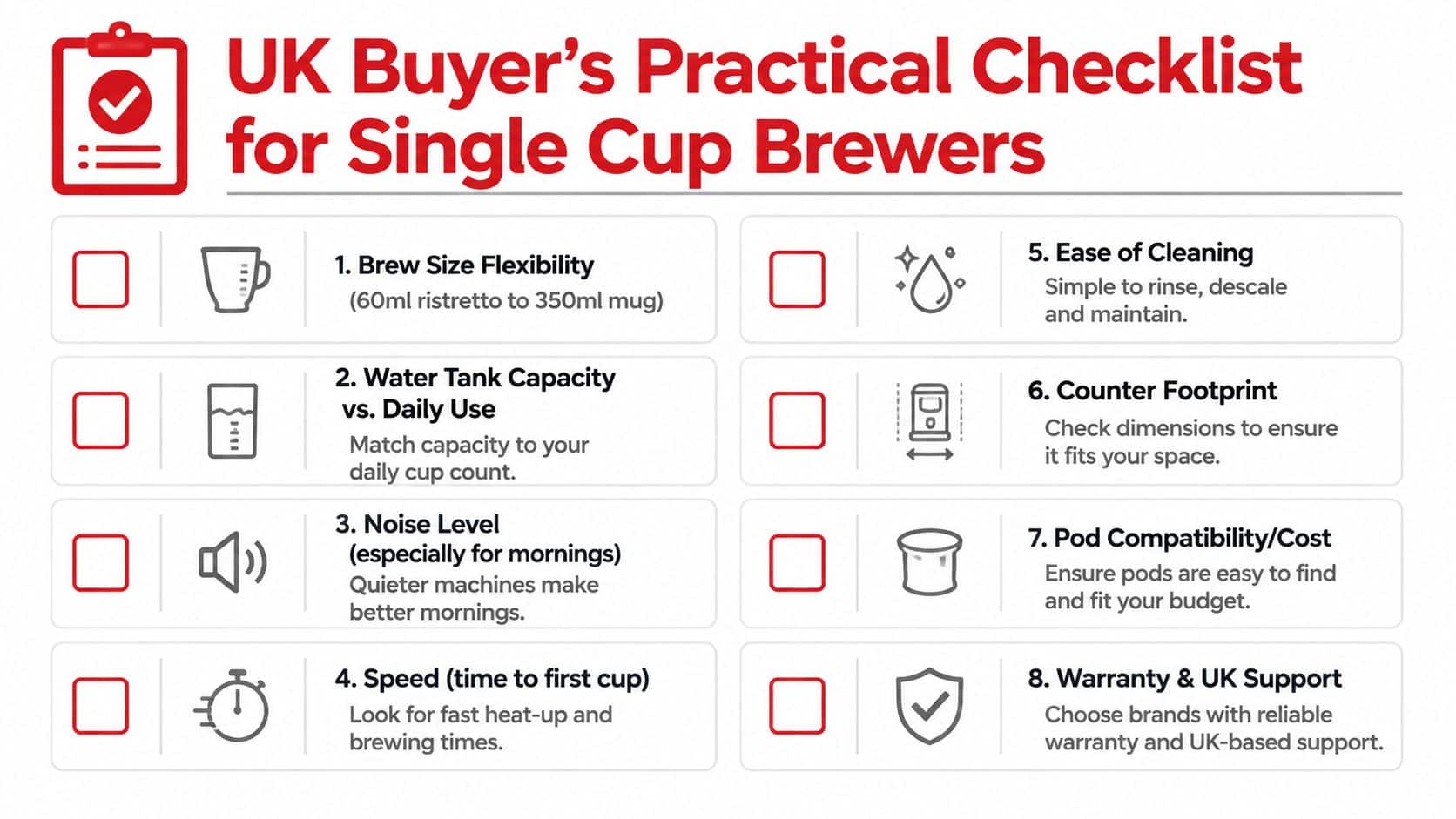
Take this summary card when you buy
Write down the following before opening a product page:
- Setting: home, office, hospitality or café.
- Peak demand: occasional, steady or queue-driven.
- Drink style: mug coffee, espresso, milk drinks or mixed menu.
- Water source: pour-over tank or mains connection.
- Water treatment: jug, inline cartridge or none.
- Consumables: capsule family, ground coffee or whole beans.
- Waste route: Podback, manufacturer scheme or local alternative.
- Support: warranty, service contact and spare-part access.
If a listing doesn't answer several of these points, treat that omission as a buying risk.
Installation, Water Quality and Real Cost per Cup
Installation problems often begin with dimensions rather than coffee. Measure the machine's width, depth and height with the lid open, then check rear clearance, ventilation and access to the socket. Keep the brewer away from splash zones and make sure the electrical arrangement is suitable for the site.
Plumbed-in machines need a cold potable water supply. One UK commercial brewer specifies a mains drinking-water connection through a WRAS-approved or equivalent isolation valve positioned no more than 1 metre away, as shown in its UK Flavia 200 brochure. Another platform accepts either plumbed or pour-over use, but specifies cold potable sodium-free water and filtration.
Wattage affects workflow
UK single-cup brewers commonly sit in the 1.1–2.0 kW band. The Moccamaster Cup-One is specified at 1520 W and an output of 10 cups every 6 minutes, while the Bravilor Sprso is rated at 1978 W, designed for up to 45 cups per day, with preparation taking roughly 11–50 seconds depending on the beverage. These specifications are listed by Simply Great Coffee for the Bravilor Sprso.
Higher input can support faster heating and recovery, but it doesn't make a machine suitable for every socket or queue. Check the circuit, avoid unsuitable extension arrangements and let a qualified installer handle fixed water connections.
Cost comparison needs honest inputs
The requested worked example uses a 1.3 kW pod machine, four cups a day and £0.34 per pod. The coffee alone is therefore £1.36 for that day's four drinks. Electricity adds a smaller variable amount, but an exact pence-per-cup figure needs the machine's actual heating time and the applicable tariff, and those values aren't supplied here.
| Brewer format | Typical wattage | Pod/filter cost | p/kWh used | Cost per cup including electricity |
|---|---|---|---|---|
| Pod machine example | 1.3 kW | £0.34 per pod | Enter your tariff | £0.34 plus measured electricity |
| Moccamaster Cup-One | 1520 W | Enter coffee and filter cost | Enter your tariff | Calculate from actual brew time |
| Bravilor Sprso | 1978 W | Enter beverage cost | Enter your tariff | Calculate from actual preparation |
| Refillable filter holder | Varies | Ground coffee and filter cost | Enter your tariff | Often lower than proprietary pods, depending on coffee |
Use the supplied water filtration system options to plan scale control. Descale according to the manufacturer's instructions and local water hardness. Don't wait for a blocked outlet or bitter cup to tell you maintenance is overdue.
Sustainability, Pod Recycling and the Compostable Question
A pod's material matters less than the disposal route available after brewing. Compostable does not automatically mean suitable for a UK home compost bin or kerbside collection. A 2025 ASA ruling found compostable-pod marketing misleading because the pods were not compostable at home. Check the exact collection and treatment method before buying.
Treat the pod and collection system as one purchase decision. A potentially recoverable pod creates little benefit if no practical scheme accepts it where you live or work.

Recycling access is expanding, but coverage still varies
In 2024, Podback and local authorities added 64 household waste recycling centre sites, bringing access through local authority areas to over 2.7 million households, according to LARAC's coverage of the Podback rollout. By October 2024, Podback reported access through local authority waste and recycling arrangements for 5.7 million households.
Separate UK coverage reported dedicated coffee pod collection points in more than 350 Morrisons stores, created with Podback. Retail drop-off helps when doorstep or civic-site collection is inconvenient, but confirm accepted pod types and preparation instructions before travelling.
A publicly available UK-wide recycling rate for coffee pods is still unavailable. West London Waste Authority's guidance reports that around 800 million drinks pods are used each year in the UK and that 20% of households own a coffee machine. Those figures show the scale of the disposal problem, not the proportion successfully recovered.
Use a simple waste hierarchy
- Reduce: Match the pod format and size to the drink, avoiding unnecessary packaging for oversized servings.
- Reuse: Choose a refillable holder only if staff or household users will fill, clean and maintain it consistently.
- Recycle: Use Podback or the manufacturer's designated scheme where available. Keep specialist pods out of ordinary household recycling unless your council explicitly accepts them.
- Verify claims: Establish whether “compostable” means home compostable, industrially compostable, or made with a compostable material.
Apply the same scrutiny to cups, lids and service items. Review sustainable coffee packaging alongside the pod system, then choose the option that creates the fewest collection steps in your setting.
Matching the Right Brewer to Your Setting
The right machine changes with the workflow. A home user can tolerate a manual step that would frustrate an office. A café can justify a grinder and portafilter, while a reception area usually needs predictable preparation with minimal training.
Home
For a home making fewer than two cups a day, choose a compact capsule machine if convenience and footprint dominate. Nespresso Original or Vertuo formats offer a broad branded ecosystem, while compatible third-party capsules may widen choice. Use a recognised collection route rather than treating the capsule as ordinary kerbside waste.
If you drink filter coffee every day, a single-serve pour-over system such as a Melitta or Wilfa server is the more sensible choice. It gives you better control over beans, grind and dose, and it avoids making every drink dependent on a proprietary capsule.
Workplace
For an office with fewer than 25 staff, a plumbed-in bean-to-cup or larger capsule machine can balance variety and reduced refilling. A 2–3 litre tank may be suitable for a smaller shared station, but confirm the manufacturer's workload and the site's water access before ordering.
Use the best office coffee system guidance to compare the station as a complete service, including consumables, drainage, cleaning and support. A domestic brewer rarely makes sense once several people depend on it throughout the day.
Small café
A café counter should default to a single-cup espresso machine with a 58 mm group head if espresso and milk drinks are central to the menu. Pair it with a hand AeroPress only when manual filter service adds a clear customer or tasting benefit.
Every setting needs a waste owner. Decide who empties the capsule container, changes filters, records descaling and orders consumables before the machine arrives.
Common Questions About Coffee Single Cup Brewers
Are compostable pods suitable for household composting?
Usually, no. The 2025 ASA ruling identified misleading marketing around pods that weren't compostable in a home setting. PLA and similar materials may require industrial composting, so follow the pod maker's instructions and your council's guidance. If neither provides a route, don't place the pod in garden compost or assume it belongs in the food-waste caddy.
Is plumbed-in better than pour-over?
Plumbed-in is better when the machine faces sustained demand and you want to remove manual refilling. Pour-over is simpler and cheaper to install for lower-volume use. The correct choice depends on access to a compliant cold potable supply, filtration, drainage and an installer, not just the number of people in the building.
Do I need a grinder?
Not for a sealed capsule machine. You do need one for espresso made from fresh beans, and a stepless conical burr grinder under £300 is the sensible starting point for controlled home espresso in the comparison framework. A filter brewer can use pre-ground coffee, although grinding shortly before brewing gives you more control over freshness and recipe adjustment.
How hard can my water be?
If hardness exceeds 200 ppm, use a Brita filter jug or in-line cartridge to protect boilers and seals, as specified in the buying guidance. The filter doesn't remove the need for descaling. Follow the brewer's maintenance schedule and check the local water supplier's hardness information.
What warranty should I expect?
The supplied guidance refers to six months of manufacturer-backed cover under UK consumer rights, but warranty terms vary by machine and seller. Register the brewer online when available, keep the purchase record and check what the warranty excludes, especially scale damage, misuse and consumables.
A final point matters more than most feature lists. The cheapest coffee single cup brewer is only a good purchase when it fits your water, workload, waste route and staff habits. Allied Drinks Systems supplies pod and capsule machines, coffee equipment, consumables, filtration products and supporting disposables for homes, offices and hospitality venues, so visit Allied Drinks Systems to compare a complete setup before you buy.


