Welcome to your complete guide on choosing the right commercial coffee machines for your UK business. Whether you’re running a bustling café, a busy office, or a high-end hotel, the right machine is the engine of your success. This guide walks you through everything that matters, helping you make a confident, profitable choice.
Why Your Choice of Commercial Coffee Machine Matters
Picking a commercial coffee machine is one of the most important decisions you'll make. It’s not just another piece of kitchen equipment; it's the heart of your operation, a massive factor in customer satisfaction, and a significant investment.
The perfect machine can boost staff morale, streamline your workflow, and drive revenue. The wrong one can lead to frustrating queues, inconsistent drinks, and unexpected maintenance costs. The goal is simple: match the machine to your specific operational needs.
Aligning Your Machine with Your Business Goals
Before browsing, think about your business objectives. Are you serving high volumes of coffee quickly in an office canteen or crafting artisanal espressos in a speciality café? Your answer will point you toward very different types of machines.
Here are a few key points to consider:
- Speed and Volume: How many cups do you need to serve during your busiest hour?
- Quality and Consistency: Is your priority barista-level perfection or push-button convenience?
- Staff Skill Level: Do you have trained baristas, or will staff with minimal training operate the machine?
- Your Menu: Will you serve simple black coffees or a full range of lattes and cappuccinos?
The UK coffee market is growing fast, highlighting the huge opportunity for businesses to capitalise on the nation's love for quality coffee. Before getting into technical details, check out our guide on choosing a machine by footfall and menu.
Comparing the Main Types of Commercial Coffee Machines
Picking the right commercial coffee machine isn’t about finding the single “best” machine. It’s about matching the equipment to your business, whether you’re crafting artisanal lattes or serving hundreds of people a simple black coffee in a hurry.
Let's dive into the main contenders to see which one is the right fit. This quick guide maps out the ideal machine for different business types.
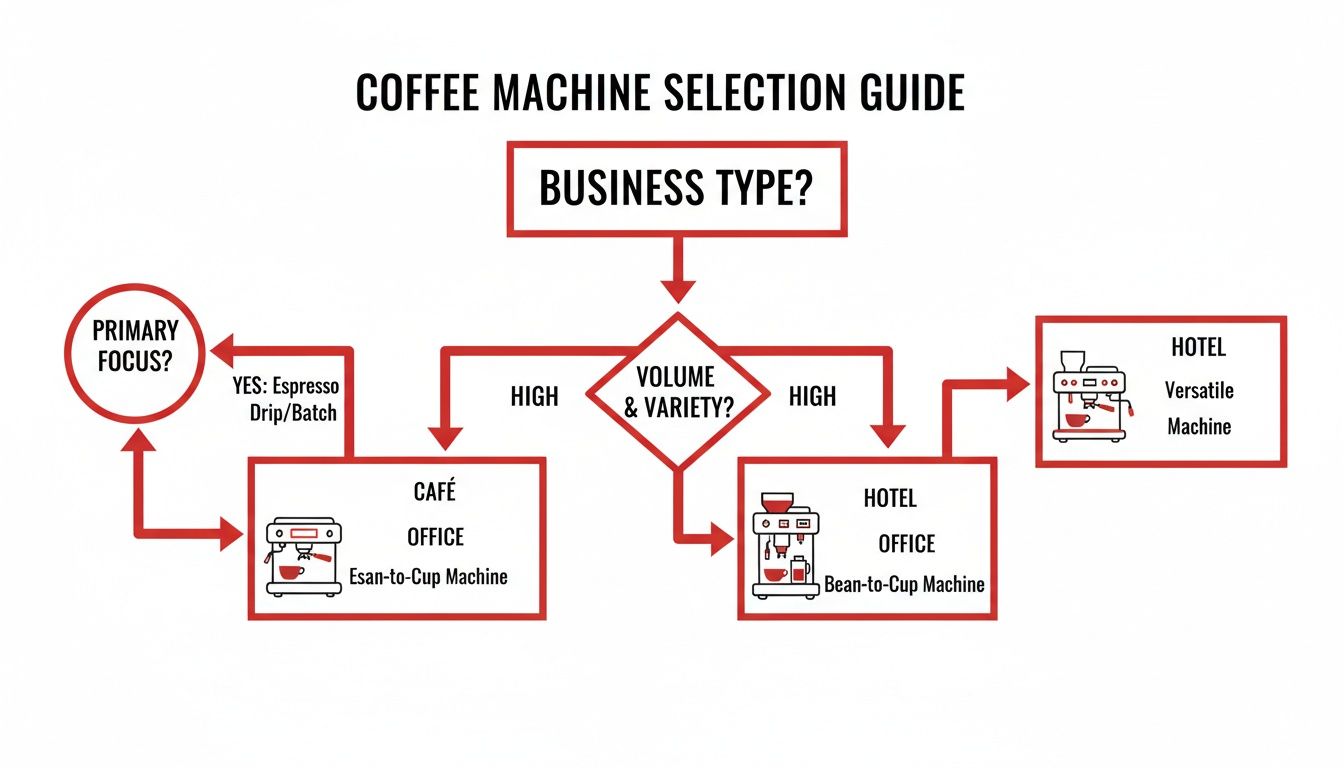
As the flowchart shows, a café’s focus on quality points towards a traditional machine, while an office's need for convenience makes a bean-to-cup the obvious choice.
To make things clearer, let's look at how the four main types of commercial coffee machines stack up. This table gives you a snapshot of where each machine shines.
Commercial Coffee Machine Comparison
| Machine Type | Ideal For | Typical Output (Cups/Hour) | Ease of Use | Upfront Cost |
|---|---|---|---|---|
| Traditional Espresso | Artisan Cafés, High-End Restaurants | 40-100+ | Low (Requires Barista) | ££££ |
| Bean-to-Cup | Offices, Hotels, Self-Service Areas | 20-80 | High (Push-Button) | £££ |
| Bulk-Brew Filter | Conferences, Canteens, Events | 100+ | Very High | ££ |
| Instant | Staff Rooms, Waiting Rooms | 150+ | Very High | £ |
This table provides a high-level view, but understanding the nuances of each machine is key to making a confident investment.
Traditional Espresso Machines: The Barista's Choice
A traditional espresso machine is the heart of any speciality coffee shop. It offers a skilled operator complete control over every variable, from the grind coarseness to the extraction time. This hands-on approach is unbeatable for top-tier espresso and perfectly textured milk for lattes.
These machines are built for performance and a bit of theatre, becoming a focal point where customers and baristas interact. They’re the perfect fit for cafés, restaurants, and bars where coffee quality is a core part of your brand and you have trained baristas.
Bean-to-Cup Machines: The Automated All-Rounder
Bean-to-cup machines offer convenience and consistency. At the press of a button, they grind fresh beans, brew an espresso, and even froth and dispense milk for a perfect cappuccino. This makes them incredibly easy for staff with minimal training to use, guaranteeing every drink is the same high quality.
Their speed and simplicity make them perfect for busy environments that need great coffee without a dedicated barista.
Bean-to-cup models are ideal for:
- Busy Offices: Giving staff a genuine coffee perk without any fuss.
- Hotel Breakfast Buffets: Letting guests serve themselves quickly and easily.
- Convenience Stores: Offering a reliable coffee-to-go service with minimal staff input.
For a detailed breakdown, read our guide comparing bean-to-cup machines vs traditional espresso.
Bulk-Brew Filter Machines: The Volume Powerhouse
When you need to serve large volumes of quality black coffee quickly, bulk-brew filter machines are the champions. These workhorses can brew several litres of coffee at a time, holding it at the perfect serving temperature in insulated flasks.
They are incredibly simple to operate and maintain, ensuring you can serve hundreds of people without a queue forming.
- Best for Conferences and Events: Keep attendees caffeinated during breaks.
- Ideal for Canteens and Buffets: Provide a constant, reliable supply of fresh coffee.
- Perfect for Meeting Rooms: Offer a simple, self-service option that just works.
Instant Coffee Machines: The High-Speed Solution
For environments where speed and sheer volume are the top priorities, instant coffee machines provide a practical and cost-effective solution. Using soluble coffee granules, these machines deliver a hot drink in seconds. They require minimal cleaning and are incredibly reliable.
While they don’t use fresh beans, modern instant machines can produce a surprisingly good cup, often with options for hot chocolate and hot water. They are the go-to choice for high-traffic areas like waiting rooms, construction sites, and large staff rooms.
How to Work Out Your Required Capacity
Choosing a commercial coffee machine with the wrong capacity is an expensive mistake. Go too small, and you’ll create queues and burn out the machine. Go too big, and you waste capital that could be better spent elsewhere.
The key is to focus on your peak demand. What’s your busiest hour of the day? Your machine has to handle that period without compromising on quality or speed.
Estimate Your Peak Hour Output
A straightforward approach will give you a solid estimate. Just follow these steps:
- Find Your Busiest Hour: For one week, track your sales or count the drinks you serve to find the 60-minute window when you're busiest.
- Count the Cups: During that peak hour, tally up every hot drink made.
- Add a Buffer for Growth: Take your peak hour number and add a 25% buffer. This future-proofs your investment. If your busiest hour sees 80 drinks, your target capacity should be 100 cups per hour.
This simple calculation gives you a performance benchmark to match against machine specifications.
Understanding Group Heads and Workflow
With traditional espresso machines, capacity is tied to the number of group heads—the part where hot water is forced through the coffee. Each group head can pull one or two espressos at a time.
- 1-Group Machines: Best for low-volume sites, like a small restaurant, handling up to 40-50 cups per hour.
- 2-Group Machines: The industry workhorse, perfect for most small to medium-sized cafés. It improves workflow and pushes output to around 80-100+ cups per hour.
- 3-Group Machines: Built for high-volume environments like busy city-centre coffee shops, serving well over 150 cups per hour.
More group heads create a smoother workflow. A 2-group machine lets a barista pull shots on one side while steaming milk for another order, halving customer waiting times.
Why Boiler Technology is Critical
The boiler is the engine of your espresso machine, supplying all the hot water and steam. Its design impacts the machine's ability to hold a consistent temperature and pressure under stress, which is vital for quality.
There are three main types of boiler systems:
- Single Boiler: A single tank heats water for both brewing and steaming. Found in lower-end machines, it can struggle with back-to-back drinks.
- Heat Exchanger (HX): A smarter design with one large boiler for steam and a separate pipe heating fresh water for brewing. It allows for brewing and steaming at the same time and is a reliable choice for most cafés.
- Dual Boiler (DB): Two separate boilers—one for brewing and one for steam. This delivers the ultimate in temperature stability, making it the top choice for high-end speciality coffee shops.
Understanding Essential Features and Tech Specs
Diving into the technical specifications of commercial coffee machines can feel overwhelming. You only need to understand a few key features to know what really matters for your business. These components separate a machine that just makes coffee from one that produces consistently brilliant drinks.
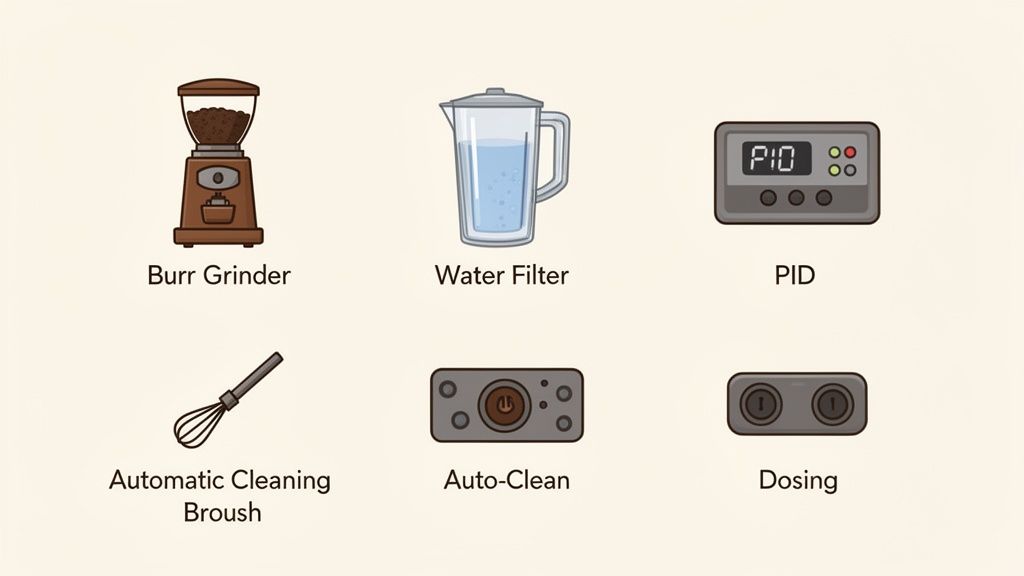
Some features are non-negotiable for quality coffee, while others are designed to make your workflow smoother. Let's break down the essential tech you need to know about.
Why a Burr Grinder is Non-Negotiable
The grinder is just as important as the coffee machine. For great espresso, a burr grinder is essential. Burr grinders use two revolving surfaces to crush coffee beans into a uniform size. This consistency is the secret to an even extraction and a balanced, flavourful espresso.
Blade grinders smash beans unevenly, creating a mix of dust and chunks that result in bitter coffee. To see how these two pieces of kit work together, find more information about our espresso machine and grinder packages.
The Crucial Role of Water Filtration
Most of the UK has hard water, packed with minerals. While fine to drink, it’s the number one enemy of a commercial coffee machine. Without a filter, these minerals build up inside the machine’s boiler and pipework as limescale.
This limescale causes serious problems:
- Reduced Efficiency: Limescale forces the machine to work harder and use more electricity to heat the water.
- Inconsistent Temperature: It can clog sensors, leading to water that’s too hot or too cold.
- Costly Breakdowns: Severe build-up can block pipes and cause catastrophic failure.
A professional-grade water filter is a must. Most manufacturer warranties are voided if an approved filter isn't installed and changed regularly. It’s a small cost that will save you thousands in potential repairs.
Features That Save Time and Guarantee Consistency
Modern machines come with smart features designed to make life easier and ensure every drink is perfect. These additions automate key steps and reduce the chance of human error.
Programmable Dosing: This feature lets you pre-set the exact volume of water for single and double shots. The barista just presses a button, and the machine delivers the perfect amount every time, freeing them up for other tasks.
PID Temperature Controllers: A PID (Proportional-Integral-Derivative) controller is a high-tech thermostat for your machine’s boiler. It makes constant adjustments to keep the water temperature incredibly stable, vital for extracting the best flavour from your coffee.
Automatic Cleaning Cycles: Cleaning an espresso machine is crucial but time-consuming. Many modern machines have automated cleaning cycles. At the end of a shift, staff can pop in a cleaning tablet and start a cycle that backflushes the group heads, removing built-up coffee oils with minimal effort.
Buying Versus Leasing Your Coffee Machine
Once you know what type of machine you need, the next step is financial. Do you buy it outright or is leasing a smarter move? The best choice depends on your cash flow, long-term plans, and how you feel about owning assets.
Buying means the machine is yours, a tangible asset. Leasing keeps initial spending low and often includes extras like servicing. Let's unpack both options.
The Case for Buying Your Machine Outright
Purchasing your coffee machine means you own it from day one. This is a solid strategy if you have the capital, as you'll be free of ongoing monthly payments. Over the machine's lifespan, the total cost is often cheaper than leasing, and you have complete freedom to sell it or upgrade whenever you wish.
Another benefit is potential tax relief, as the machine's cost can usually be offset against your profits. For businesses seeking maximum value, buying a professionally refurbished machine is an excellent option.
Our Top Tip
Refurbished commercial coffee machines from a trusted supplier like ADS Coffee Supplies offer the best of both worlds. You get a fully serviced, high-performance machine with a warranty, often saving up to 50% on the cost compared to buying new.
The Benefits of Leasing a Commercial Coffee Machine
Leasing is a popular choice, especially for new businesses keen to protect their cash flow. Instead of a large upfront payment, you pay a fixed monthly fee over a set term. This makes budgeting easy and frees up capital for other areas like marketing or staff.
A major draw is that lease agreements often include a full service and maintenance package. This means regular servicing and repairs are taken care of, giving you peace of mind. It’s a smart way to get top-tier equipment without the financial headache. Explore our guide to commercial coffee machine leasing for more details.
Key Questions to Ask Your Supplier
Before signing any agreement, be clear on what you’re getting. Here are the must-ask questions:
- What is included in the monthly fee? Does it cover installation, training, and a water filter?
- What does the service package cover? Are both parts and labour included for call-outs?
- What is the call-out response time? How quickly can an engineer get to you if the machine breaks down?
- What happens when the lease term ends? Can you upgrade, buy the current machine, or start a new contract?
The UK's commercial coffee scene is thriving, with significant growth ahead. The right financing model can directly fuel your success. You can read more about commercial espresso machine market trends to get the full picture.
Installation, Maintenance, and Ongoing Support
Your investment in a commercial coffee machine doesn’t end with delivery. Professional installation and diligent maintenance are the bedrock of great coffee and reliability.
A professional installation involves a site survey to ensure you have the right power and water connections. The engineer will also correctly install and calibrate your water filter, protecting your new machine from limescale from day one.
Creating a Simple Maintenance Routine
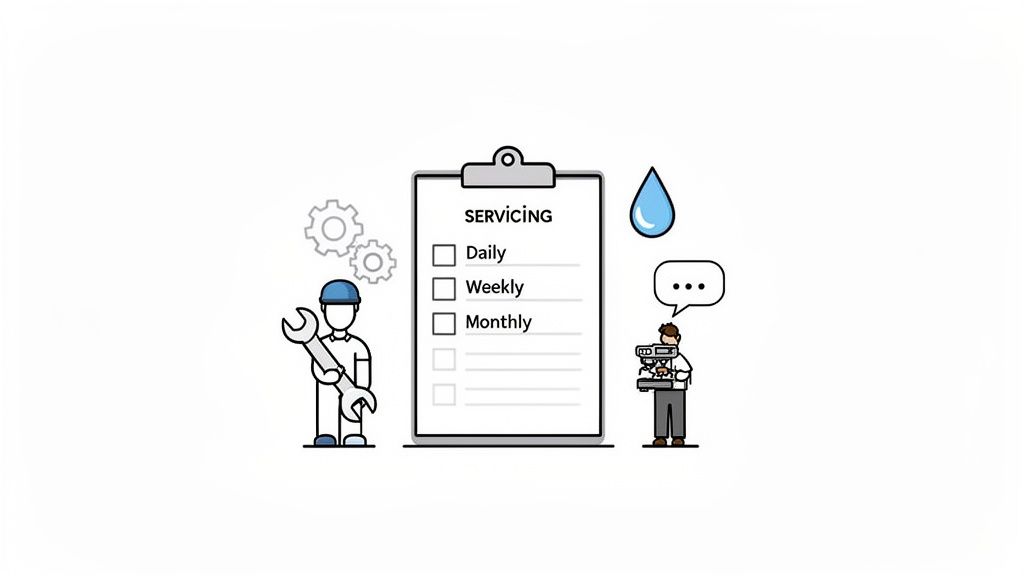
Preventative maintenance is the secret to avoiding costly downtime. By integrating simple cleaning jobs into your team's daily and weekly routines, you can stop small problems from becoming major breakdowns.
This simple checklist covers the essentials:
-
Daily Tasks (End of Day):
- Backflush the group heads: This vital process purges stale coffee oils and grounds.
- Clean the steam wands: Wipe them after every use, purge them, and soak them in hot water at the end of the day.
- Wipe down all surfaces: Keep the drip tray, portafilters, and machine exterior clean.
-
Weekly Tasks:
- Deep clean the group heads: Use a specialised cleaner to dissolve stubborn build-up.
- Empty and clean the coffee grinder: Brush out old grounds from the hopper and burrs.
Regular cleaning is critical for hygiene and a long machine life. The principles for cleaning commercial beverage equipment like water dispensers are very similar.
The Value of a Reliable Support Partner
Even with perfect maintenance, parts wear out and issues can arise. A machine breaking down during the morning rush is a disaster, which is why having a reliable support partner is essential.
Choosing a supplier is about more than just the machine; it's about a long-term partnership. You need a team that provides fast, effective support when you need it most.
A complete support package should always include several key services.
Key Support Services to Look For:
- Emergency Repairs: Look for a supplier that guarantees a fast call-out response from a qualified engineer.
- Barista Training: A good partner will provide initial and ongoing training for your staff.
- Spare Parts Access: Ensure your supplier stocks common spare parts like gaskets and filters to avoid long waits.
At ADS Coffee Supplies, we pride ourselves on offering the whole package. Learn more about our commitment to nationwide installation, support, and training and see how we protect your investment.
Your Questions Answered
It’s normal to have questions when navigating the world of commercial coffee machines. We’ve put together straightforward answers to some of the most common queries we hear.
How Often Does a Commercial Coffee Machine Need Servicing?
Think of professional servicing like an MOT for your machine—it's vital for keeping it running smoothly. We recommend a full service at least once a year for most businesses.
For high-volume cafés, bumping that up to every six months is a wise move. It’s about preventative maintenance; catching minor wear and tear before it leads to a costly breakdown. A good service plan, often included with leasing agreements from suppliers like ADS Coffee Supplies, is the simplest way to stay on top of it.
What's the Single Biggest Mistake to Avoid When Buying a Machine?
The most common and costly mistake is underestimating your capacity needs. A business buys a machine that can handle its quietest day, not its busiest morning. This is a recipe for disaster.
An undersized machine is a bottleneck. It leads to slow service, frustrated customers, and immense stress on its components, causing frequent breakdowns. Always calculate your required cups-per-hour for your peak periods and choose a machine that can handle that volume with room to spare.
Is a Water Filter Really Necessary for My Machine in the UK?
Yes, one hundred percent. A commercial-grade water filter is a non-negotiable part of your setup in most of the UK. The reason is simple: hard water is packed with minerals that create limescale inside your machine.
Limescale build-up is the number one enemy of coffee machines. It chokes water flow, affects brewing temperature, and causes expensive breakdowns. Crucially, most manufacturer warranties are void if an appropriate water filter is not installed and regularly changed.
Ready to find the perfect coffee machine to drive your business forward? The expert team at ADS Coffee Supplies is here to help. We offer a fantastic range of new and refurbished commercial machines to buy or lease, complete with installation, training, and ongoing support.
Book a free site survey or arrange a demo today to get started.