
Becoming a barista is a journey that blends technical skill with genuine hospitality. It’s about mastering the perfect espresso shot, steaming silky milk, and delivering first-class customer service—often all at once. This guide explains how to become a barista, moving beyond just pouring coffee to becoming a true craftsperson and the friendly face of a café.
What a Barista in the UK Really Does
Before we get into the details, let's be clear about what being a barista involves in the UK's buzzing coffee scene. The job is a whirlwind of art, science, and people skills. A typical day means dialling in grinders, pulling hundreds of espresso shots, steaming endless jugs of milk, and keeping your workspace spotless, all while chatting with regulars.
This guide gives you a realistic picture of the road ahead. Forget romantic notions of slowly pouring latte art in a quiet corner; the reality is a high-energy environment where precision and speed are essential. You are the final, crucial line of quality control between a carefully sourced coffee bean and a paying customer.
A Growing Industry Full of Opportunity
There has never been a better time to get started. The UK coffee shop market is booming, which means thousands of new jobs for aspiring baristas are always appearing.
In fact, UK coffee shops and cafés recently generated around £6.1 billion in turnover from roughly 12,229 outlets. This isn't just a number; it means more training opportunities, entry-level jobs, and clearer career paths than ever before. You can dive deeper into these trends in this UK coffee market growth report.
More Than Just Making Coffee
While making great coffee is the core of the job, a truly excellent barista shines in other areas too. Think of these as the four pillars that separate a good coffee maker from a real professional. They are the foundation of everything you will do behind the bar.
Here’s what separates a competent barista from a truly great one.
The Four Pillars of a Professional Barista
| Pillar | What It Means for You | Key Skills to Develop |
|---|---|---|
| Technical Precision | It's all about consistency. Your job is to understand the variables—grind size, dose, water temperature—that make every coffee taste amazing. | Grinder calibration, tamping technique, mastering espresso extraction, consistent milk steaming. |
| Speed and Workflow | A busy café is like a dance. You need to move efficiently, handle multiple orders at once, and keep your station clean without dropping quality. | Time management, multitasking, bar ergonomics, keeping an organised workspace. |
| Customer Connection | You're a key part of someone's daily routine. Being warm, welcoming, and knowledgeable builds loyalty and creates a fantastic atmosphere. | Active listening, making recommendations, remembering regulars, handling feedback gracefully. |
| Product Knowledge | Knowing your coffee is crucial. You need to be able to explain the difference between a single-origin and a blend or what makes a particular coffee special. | Understanding coffee origins, processing methods, and tasting notes. Learn more in our guide on what makes speciality coffee different. |
Mastering these four areas will make you an indispensable part of any coffee shop team. It’s the difference between simply serving coffee and creating a genuine experience.
How to Become a Barista: Mastering Core Skills
To truly understand how to become a barista, you first need to get comfortable with the hands-on actions that are the heart of the job. Mastering these foundational skills is what separates an enthusiast from a professional who can produce quality drinks with speed and consistency, even during a chaotic Saturday morning rush.
Think of these skills as your toolkit. Some are technical ‘hard skills’, like dialling in a grinder, while others are interpersonal ‘soft skills’, like communicating with your team. Understanding the distinction between soft skills vs. hard skills will help you see your value more clearly, both behind the machine and on your CV.
Grasping Essential Coffee Knowledge
Before you even touch an espresso machine, you need to know the basics, starting with the beans.
The two main coffee species are Arabica and Robusta. Arabica is known for its complex, aromatic, and often fruity or floral notes. Robusta, on the other hand, packs more punch with higher caffeine and a bolder, more traditional 'coffee' flavour.
Where a coffee comes from—the country, region, and even the specific farm—massively impacts its taste. You don't need to be an expert overnight, but knowing these basics means you can describe what you're serving to customers with confidence.
The Art of Pulling a Perfect Espresso Shot
The espresso shot is the foundation for most drinks on the menu, so nailing it every time is non-negotiable. This process, known as 'dialling in', is a daily ritual for every barista. It's a balancing act between three key variables to get a delicious, well-extracted shot.
Here’s the breakdown:
- Dosing: This is weighing the exact amount of ground coffee for a shot. A typical dose for a double espresso is between 16–19 grams, but this depends on your café's recipe.
- Tamping: Once the coffee is in the portafilter (the handle with the basket), you apply firm, even pressure to create a flat 'puck' of coffee. This ensures water flows through it evenly.
- Extraction: This is the moment of truth. A good espresso should flow like warm honey and take about 25–32 seconds to produce the right amount of liquid.
Top Tip: A classic rookie mistake is inconsistent tamping pressure. Too gentle, and the shot will taste sour; too hard, and it will be bitter. Consistency is everything.
The flow chart below gives a great visual of a barista's daily rhythm, showing how technical skills must work hand-in-hand with speed and customer interaction.
As you can see, being a barista is a constant cycle. Precision, speed, and great service all feed into each other; if one part falters, the whole system feels it.
Steaming Milk for Silky Microfoam
A great latte, flat white, or cappuccino depends on perfectly textured milk. Your goal is to create 'microfoam'—a silky, glossy texture made of tiny bubbles that mix perfectly with the espresso. You do this by first introducing air ('stretching') and then creating a whirlpool with the steam wand to heat the milk evenly.
The sweet spot for temperature is between 55–65°C. Any hotter, and the milk's proteins break down, giving it a scalded, unpleasant taste. It takes practice to get the feel for it, but mastering milk is a massive step up in your game.
Choosing Your Barista Training Path
Once you have a handle on the core skills, the next question is how to get your foot in the door. The journey of how to become a barista isn't a straight line; there are a few different routes you can take, and each has its own pros and cons.
The path to pulling shots in the UK has evolved. It’s no longer just about learning on the job; it’s a mix of in-house training, formal courses, and self-development. This shift is thanks to the boom in speciality coffee, a market set to grow significantly as more people seek a genuinely great cup.
For independent cafés, this means getting serious about quality. Partnering with suppliers who provide both the gear and proper barista training has become a smart, effective way to level up their teams.
On-the-Job Training vs. Formal Courses
The two main paths are learning on the job or enrolling in a formal training course. Neither is 'better'—they just suit different people.
- On-the-Job Training: This is the classic way in. You start in an entry-level role, like a café assistant, and learn from experienced baristas. It's an unbeatable way to learn the rhythm of a real service, but the training quality can vary hugely.
- Formal Courses: These programmes provide a structured, controlled environment to nail the fundamentals without the pressure of a long queue. You build a solid theoretical foundation and get hands-on practice, which can make your CV stand out.
Myth Buster: A common myth is that you must have a certificate to get hired. While formal training is a huge plus, many managers value a can-do attitude and a genuine hunger to learn above all. A certificate helps you get noticed; a great trial shift gets you the job.
What to Look For in a Quality Barista Course
If you decide a formal course is the way to go, it pays to be picky. A good course should arm you with practical, job-ready skills. Many modern programmes use effective training videos to break down complex techniques.
Here’s what you should be looking for:
- Hands-On Time: The course should be spent behind a professional espresso machine, not watching a slideshow.
- Small Class Sizes: This is crucial for one-on-one feedback and enough time to practise.
- Experienced Instructors: Your trainer should have real-world experience as a head barista or café manager.
- Recognised Accreditation: Courses backed by the Specialty Coffee Association (SCA) are recognised globally and are a fantastic mark of quality.
Supplier-led training is another brilliant option. Our training courses are designed by working baristas for aspiring ones, ensuring you learn practical skills relevant to the industry.
- ADS Coffee Supplies: Our number one rated programmes are designed by working baristas, for aspiring ones. Check out our hands-on barista training courses to kickstart your journey.
Starting with Zero Experience
How do you land that first job with no experience? It all comes down to showing your passion and being proactive.
Start by becoming a regular at your local independent coffee shops. Chat with the staff, show a real interest in their coffee, and ask smart questions. When a job comes up—even if it’s just washing dishes—you’ll already be a familiar, friendly face. This shows you're committed to the coffee world, not just looking for any job.
Practising at home also gives you a massive advantage. You don’t need a fancy setup; even a modest home machine lets you get a feel for tamping and milk texturing. It proves to a potential employer that you're serious about learning the craft.
Building Your Home Practice Setup
Want to fast-track your journey and figure out how to become a barista with confidence? The secret is to practise at home. Turning up to a trial shift with muscle memory for tamping and a basic feel for steaming milk will put you miles ahead of other applicants.
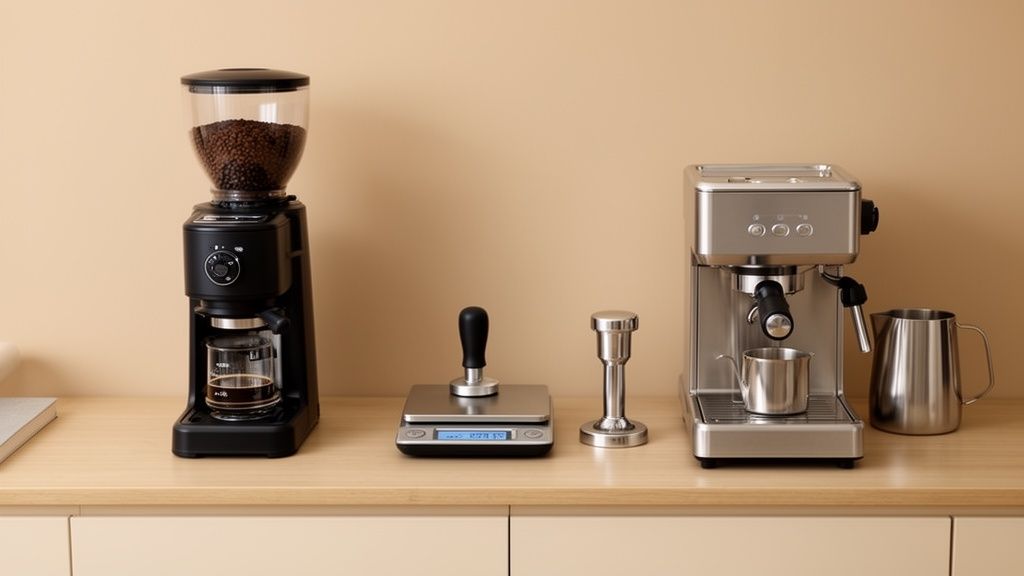
This isn’t about spending thousands on professional kit. It’s about building a functional setup that lets you drill the core skills—dosing, tamping, extracting, and steaming—until they become second nature. You'll build the foundational skills needed to step behind a commercial machine without feeling overwhelmed.
The line between home and professional setups is blurring. More people are making café-quality drinks at home, with a huge 58.1% trying to copy their favourite coffee shop orders. This means mastering these skills at home isn't just a hobby; it's a genuinely transferable skill. You can see more UK coffee consumption trends here.
Your Espresso Machine: The Heart of Your Setup
The espresso machine is the star of the show, but you don't need a top-of-the-line model to start. What you do need is a machine that gives you manual control, rather than a fully automatic 'pod' system.
Look for a semi-automatic machine with a proper portafilter and a steam wand. This setup most closely mimics the equipment you’ll use in a real café. For a detailed comparison, check out our guide on finding the best coffee machine for a home barista.
Why the Grinder Is Your Most Important Tool
Here’s an insider tip: your grinder is more important than your espresso machine. A quality burr grinder is non-negotiable for good espresso because it produces consistent, uniform coffee grounds—essential for an even extraction.
Blade grinders just smash beans into uneven chunks, leading to a mix of sour and bitter flavours. A decent entry-level burr grinder gives you the control needed to learn how to 'dial in' your shots properly. Without it, you’ll just be chasing a consistency you can never catch.
A consistent grind allows for consistent extraction. Spending a little more on a good grinder will save you endless frustration and wasted coffee down the line.
Essential Accessories You Cannot Skip
Beyond the big-ticket items, a few small tools make a huge difference. They help you build good habits and get precise, repeatable results.
Your essential toolkit should include:
- A Proper Tamper: A solid, correctly fitting metal tamper is vital for a level and consistent tamp.
- Digital Scales: You need scales that measure to at least 0.1 grams to weigh your coffee grounds and the liquid espresso yield.
- Milk Steaming Pitcher: A stainless steel pitcher with a good spout is essential for learning how to texture milk.
- Cleaning Tools: A brush and cleaning powder are crucial for keeping your machine in good working order.
Your Home Barista Starter Kit Checklist
This table breaks down the essentials, showing you where to start and what to aim for as you get more serious.
| Equipment Tier | Must-Have Items | Recommended Upgrade | Where to Find It |
|---|---|---|---|
| The Bare Bones | Entry-level espresso machine (with steam wand), quality burr grinder, digital scales. | A better tamper (not the plastic one included). | Second-hand marketplaces, entry-level appliance retailers. |
| Getting Serious | Mid-range machine (e.g., Gaggia Classic), dedicated espresso grinder, 0.1g scales. | A bottomless portafilter for diagnosing shots. | Speciality coffee equipment websites, reputable online stores. |
| The Enthusiast | Prosumer machine (e.g., Rocket, Lelit), single-dose grinder, precision tamper. | A distribution tool (WDT/OCD) for perfect puck preparation. | High-end coffee suppliers, specialist equipment retailers. |
Building a home setup is a direct investment in your career. It provides a pressure-free space to make mistakes, experiment, and build the confidence you'll need to excel in a professional environment.
How to Land Your First Barista Job
You've polished your skills and your passion is brewing—now it's time to turn that ambition into a paid job. This is the final hurdle in becoming a barista. It can feel daunting without direct café experience, but a smart approach will make you a standout candidate.
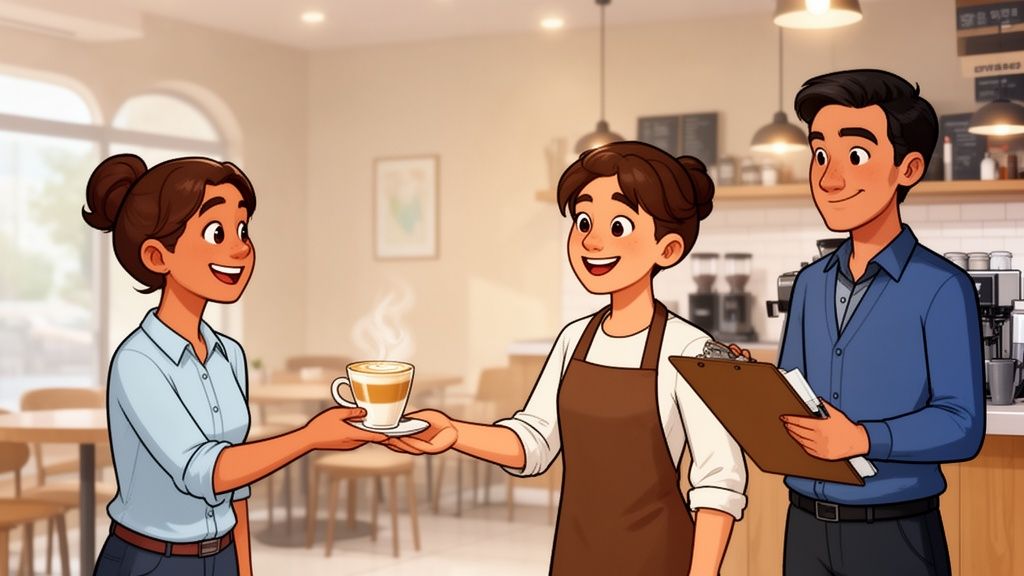
This part of the journey is all about showing your potential. We'll walk through how to build a CV that gets you noticed, how to ace the interview and trial shift, and what to expect once you're on the team.
Crafting a CV That Stands Out
Even if you’ve never worked with coffee, your CV can still shine. The trick is to highlight your transferable skills from previous roles in retail, hospitality, or any customer-facing job.
Frame your achievements for a café environment:
- Speed and Efficiency: Mention working in a fast-paced shop during a busy period.
- Customer Service Excellence: Include examples of handling a tricky customer complaint with a smile.
- Teamwork: Describe collaborating with colleagues to hit targets.
- Attention to Detail: Highlight tasks that required precision, like cashing up or managing stock.
The goal of your CV is to make a manager think, "They might not know coffee yet, but they clearly know how to handle a busy service and look after people. I can teach them the rest."
Nailing the Interview and Trial Shift
Congratulations, your CV worked! Now for the interview. Expect questions about your personality and practical abilities. Be ready to talk about your favourite local café and what makes it special—it shows you’re paying attention to the industry.
The trial shift, usually an hour or two, is your real audition. You'll probably be nervous, but focus on these three things:
- Be a Sponge: Ask smart questions and listen carefully to instructions.
- Stay Busy: If there are no orders, wipe down counters, restock milk, or clear tables.
- Engage with the Team: Be friendly and approachable with your potential colleagues.
No one expects you to be a seasoned pro, but a positive attitude and a willingness to learn are non-negotiable.
Your First Weeks on the Job
Once you've landed the role, the real learning begins. Your first few weeks will be a whirlwind of new information, from the till system to drink recipes. In the UK, entry-level barista pay typically starts around the National Minimum Wage, and your hours will often include early mornings and weekends.
Your main goal is to become a reliable team player. That means showing up on time, communicating clearly during a busy rush ("Hot pan behind!"), and supporting your colleagues. You'll also learn to handle tricky customer interactions with a calm, solution-focused attitude.
Mapping Your Barista Career Path
A junior barista role is just the start. The coffee industry offers a varied and rewarding career ladder for those who are ambitious. Your skills in workflow management, quality control, and team leadership become incredibly valuable.
A typical progression might look like this:
- Junior Barista: Learning the ropes, focusing on consistent drink-making.
- Barista: Confidently running the bar and helping to train new starters.
- Head Barista: Responsible for quality control, dialling in grinders, and managing the bar team.
- Café Manager: Overseeing all operations, from stock control to staff rotas.
Beyond the café, your expertise can open doors to roles like coffee roaster, green bean buyer, or equipment technician. Our guide on setting up a coffee shop is a great place to start if you dream of owning your own business.
Your Questions Answered
Working your way into the coffee world can bring up lots of questions. Here are some straightforward answers to the most common queries from people just starting out.
How much do baristas earn in the UK?
When you’re new to the industry, expect to be on or just above the National Minimum Wage, usually between £9 and £11 an hour. Pay is often higher in London and other big cities.
Once you have some experience, your pay can climb. A skilled senior or head barista in a top speciality shop could earn £12 to £15 per hour, before tips. In this job, your wage grows with your skill.
Do I need a formal qualification to get hired?
No, but it definitely gives you a leg up. A formal certificate isn't a deal-breaker for most entry-level roles, but it does make your CV stand out. It tells a manager you’re serious and have already invested in learning the craft.
That said, many incredible baristas learned everything on the job. A great attitude, a passion for coffee, and an eagerness to learn can be worth more to a café owner than any piece of paper.
Our Take: A qualification might get you the interview, but a great attitude and a solid trial shift will land you the job. Don't let a lack of formal training put you off applying if you have the drive.
What happens during a trial shift?
Think of a trial shift as a practical interview, usually lasting one to three hours. The manager is watching to see how you handle pressure, fit in with the team, and take direction.
You’ll probably be asked to:
- Pull some espresso shots to check your basic technique.
- Steam a jug of milk to see if you can create a decent texture.
- Chat with customers and show initiative by keeping busy during quiet moments.
The best thing you can do is stay calm, ask questions when you’re not sure, and let your enthusiasm for the job shine through.
How physically demanding is the job?
Being a barista is more physical than most people think. You will be on your feet for your entire shift, often eight hours or longer. The job involves repetitive movements, constant bending, lifting, and carrying heavy items like milk crates. You need a good amount of stamina, and comfortable shoes are non-negotiable.
Is it better to work for a big chain or an independent café?
Both have huge pros, and the "better" option depends on what you want.
- Large Chains: These are brilliant for structured training and clear career progression. The environment is built around systems, which is a great way to learn efficiency under pressure.
- Independent Cafés: This is where you'll likely get more hands-on experience with high-quality, speciality coffee. You’ll learn a ton about different origins and brewing techniques, often mentored by very experienced people.
Starting somewhere that cares about coffee quality, whether it’s a high-end chain or a respected local indie, will give you the strongest foundation to build your skills.
Your journey to becoming a barista is an exciting one, filled with learning and creativity. With the right preparation and a passion for great coffee, you have everything you need to succeed.
For all your training, equipment, and supply needs, ADS Coffee Supplies is here to support you every step of the way. Explore our hands-on training courses and barista tools at https://ads-coffee-supplies.co.uk.


