
Welcome to your complete guide to the coffee grinder machine. If there’s one secret weapon in the world of coffee, this is it. A high-quality grinder is the single most important tool for unlocking incredible flavour—even more so than the coffee machine itself. Think of it as the foundation of your entire brew.
Without a great grinder, even the best beans can’t reach their full potential. This guide will walk you through everything you need to know, from the core differences between grinder types to the technical specs that really matter. By the end, you’ll be able to choose the perfect match for your needs.
Why a Quality Coffee Grinder Machine is Essential
The secret to a great cup of coffee boils down to one word: consistency. When coffee beans are ground into uniform particles, hot water can extract their flavour evenly, creating a balanced and delicious cup. An inconsistent grind leads to a disappointing brew where some grounds are over-extracted (tasting bitter) and others are under-extracted (tasting sour).
A superior coffee grinder machine eliminates this problem, giving you total control over the end result. Whether you’re running a busy café or perfecting your home setup, getting the grind right is the first and most critical step.
Why does freshly ground coffee taste better?
As soon as coffee beans are ground, they begin to lose their flavour and aroma. Grinding beans just moments before brewing preserves the delicate oils and compounds that create a rich taste, ensuring every cup is as fresh as possible. This is why investing in a quality grinder is a non-negotiable step for anyone serious about coffee.
To truly appreciate this, it’s insightful to explore case studies from renowned coffee roasters like Stumptown Coffee Roasters, who prioritise quality at every single step.
A great coffee grinder machine doesn’t just crush beans—it unlocks their potential. It’s the difference between a flat, uninspired drink and a memorable coffee experience that keeps customers coming back.
As premier UK suppliers, ADS Coffee Supplies offers a curated selection of top-tier grinders. We provide everything you need to elevate your coffee service, including expert advice on choosing the perfect espresso machine and grinder package. Our goal is to be your partner, offering next-day delivery to get you up and running right away.
The Great Debate: Blade vs Burr Grinders
When you step into the world of coffee grinder machines, the first and most important choice you’ll face is between blade and burr grinders. Getting this right is the key to unlocking consistently delicious coffee, as it directly shapes the quality of your grind.
Why Blade Grinders Fall Short
A blade grinder is like wildly swinging a knife in a bowl of onions. It uses a spinning blade to smash beans into pieces, leaving you with an inconsistent jumble of fine dust and coarse chunks. This unevenness is the enemy of good coffee.
The huge problem with an inconsistent grind is uneven extraction. The tiny dust-like particles get over-extracted almost instantly, turning bitter. At the same time, the big chunks don’t extract nearly enough, leading to a weak, sour taste. Despite being cheap, blade grinders just can’t deliver the uniform grind you need.
The Superiority of Burr Grinding
A burr grinder, on the other hand, operates with precision. Instead of smashing the beans, it uses two abrasive surfaces—the “burrs”—to mill the coffee down into uniform particles. Think of it more like a high-quality pepper mill, where beans are channelled between the burrs and gently ground to a consistent size.
This consistency is the secret to a beautifully balanced extraction. Because all the coffee grounds are a similar size, they extract at the same rate. This allows the full spectrum of flavour to come through, giving you a clean, rich, and flavourful brew every time. For a deeper dive, read our detailed guide on why burr grinders are the superior choice for coffee enthusiasts.
A burr grinder machine doesn’t just grind coffee; it engineers the perfect foundation for extraction. The control and consistency it provides are non-negotiable for achieving café-quality results.
Conical vs Flat Burrs: What’s The Difference?
Even within the world of burr grinders, you’ll find two main designs: conical and flat. Each is better suited for different brewing styles.
- Conical Burrs: These feature a cone-shaped inner burr inside a ring-shaped outer burr. They’re fantastic all-rounders, running at lower speeds to reduce heat and preserve delicate coffee oils. They are often praised for adding complexity and body to brews like filter coffee.
- Flat Burrs: This design uses two parallel, ring-shaped burrs. Flat burrs are famous for their incredible grind uniformity, which is perfect for espresso where tiny variations can completely change a shot. They are the standard in most high-end commercial espresso grinders.
Ultimately, your choice depends on what you’re brewing. For espresso lovers chasing absolute precision, a flat burr grinder is usually the best investment. For those who enjoy a bit of everything, a quality conical burr grinder offers fantastic versatility.
Understanding Commercial Coffee Grinder Specifications
Once you’ve chosen a grinder type, it’s time to look at the details. The spec sheet is where a good grinder is separated from a great one. Understanding these specs is crucial for any business owner or serious barista, as they directly impact speed, consistency, and flavour.
One of the first things you’ll see is the burr size, measured in millimetres. Simply put, bigger is usually better. Larger burrs have a greater cutting surface, meaning they can grind more coffee, faster, with fewer rotations. This generates less heat and protects the delicate flavour oils in your beans.
Burr Material and Grinder Speed
The material your burrs are made from also has a huge say in their performance and lifespan. Most commercial grinders use either hardened steel or ceramic burrs.
- Steel Burrs: These are the industry standard for a reason. They’re incredibly durable, sharp, and brilliant at dissipating heat, making them perfect for a busy café.
- Ceramic Burrs: While extremely hard and able to hold a sharp edge for a long time, ceramic burrs are more brittle. They’re a solid choice but can be prone to shattering if a foreign object, like a small stone, gets in the way.
Another number to watch is the RPM (rotations per minute). Generally, a lower RPM is better, as it means less heat buildup and a quieter machine. High-speed grinding can slightly “cook” the grounds, introducing bitter notes before you’ve even started brewing.
This image shows the difference between the chaotic results of a blade grinder and the beautiful consistency of a burr grinder.
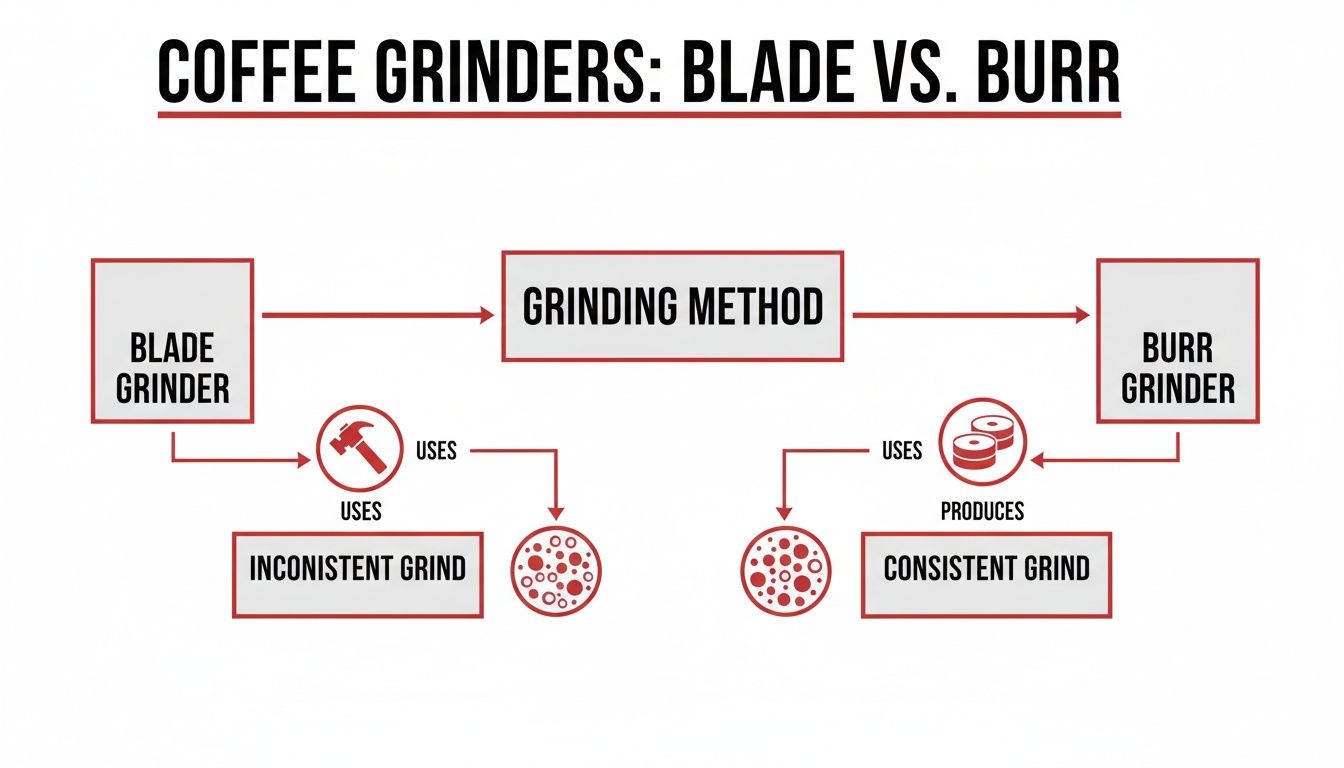
As you can see, a burr grinder acts like a proper mill, producing uniform particles that are essential for a balanced, even extraction. A blade grinder, on the other hand, is more like a hammer, smashing the beans into an unpredictable mess.
Doser vs Doserless Grinding
In a busy café, workflow is everything. The choice between a doser and a doserless (or ‘on-demand’) grinder can change your team’s efficiency and the freshness of your coffee.
A doser grinder collects ground coffee into a chamber, and you dispense pre-measured doses by pulling a lever. They’re fast during a rush, but grounds can sit in the chamber going stale. In contrast, a doserless or on-demand coffee grinder machine grinds beans straight into the portafilter for each shot, guaranteeing absolute freshness and slashing waste.
The European coffee machine market, valued at USD 2.37 billion in 2024, is pushing grinder technology forward. For hospitality businesses, on-demand grinders can slice preparation time by up to 25%. You can explore the full research from Stratview Research for more on these market trends.
Stepped vs Stepless Adjustments
Finally, let’s look at the grind adjustment mechanism. This is all about how you “dial in” your grinder to nail that perfect extraction time for your espresso.
A stepped grinder has a set number of predefined settings you click between. It’s easy to use and repeatable, but you might find your ideal grind size is somewhere between two of the clicks.
A stepless grinder, on the other hand, gives you infinite adjustments. It uses a mechanism that allows for microscopic changes to the distance between the burrs. This level of precision is essential for espresso, where a tiny adjustment can be the difference between a good shot and a perfect one. For startups, our guide on value commercial grinders for new coffee shops has some excellent recommendations.
How To Choose The Right Coffee Grinder Machine
Now for the important part: matching theory to the real world. A fantastic coffee grinder machine built for a non-stop café would be total overkill for an office, and a home grinder would grind to a halt under commercial pressure.
Let’s get practical and walk through three common scenarios. By connecting a grinder’s features to your specific needs, you can ensure you’re investing in a machine that will do the job you need it to do, day in and day out.
For the Independent Café
For any café, the grinder is the engine room of the business. It has to be a workhorse, delivering speed, power, and consistency from the first shot of the morning to the last latte of the day.
Look for a grinder with large, flat steel burrs—think 64mm or larger. They grind beans quickly without building up too much heat, which is vital for keeping the workflow smooth and the queue moving.
Key features to look for:
- Doserless (On-Demand) Grinding: This is a must for freshness and cutting down on waste.
- Low Retention: A good grinder is designed to leave as few grounds behind as possible, preventing stale coffee from tainting fresh shots.
- Durability and Cooling: A powerful motor with a built-in cooling fan is the mark of a true commercial machine built for all-day use.
For the Office Breakroom
In an office, the priorities shift. You still want good quality coffee, but the biggest concerns are ease of use, quiet operation, and low maintenance. The machine has to be simple enough for anyone to use.
A loud grinder can be a massive distraction in a shared workspace. Look for models engineered to be quiet, often with sound-dampening materials. Simplicity is just as crucial, so a grinder with simple controls or pre-set grind settings is perfect.
A great office grinder should almost be invisible—quietly doing its job, delivering excellent coffee without demanding constant attention or causing a racket.
For an office setting, keep these points in mind:
- User-Friendly Interface: Simple buttons or a clear screen make it easy for staff to get a great grind.
- Quiet Performance: This is a huge factor in keeping the work environment pleasant.
- Large Bean Hopper: A bigger hopper means less frequent refilling.
For the Dedicated Home Barista
The home barista lives in a world of passion and practicality. You’re chasing that café-quality shot without the commercial price tag or a massive machine taking over your kitchen.
For the true coffee enthusiast at home, a stepless adjustment mechanism is a game-changer. It gives you the infinite control needed to dial in an espresso shot to perfection. Burr size is still important, and a quality 50-58mm burr set will give exceptional results. You can dive deeper by reading our guide to coffee grinder types and which is right for your shop, which has valuable info for home users too.
The popularity of home electric coffee grinders has rocketed, with projected growth of 8.5% a year. To see the full market analysis, you can discover more insights on the home electric coffee grinder market from Data Insights Market Research.
Keeping Your Grinder In Peak Condition
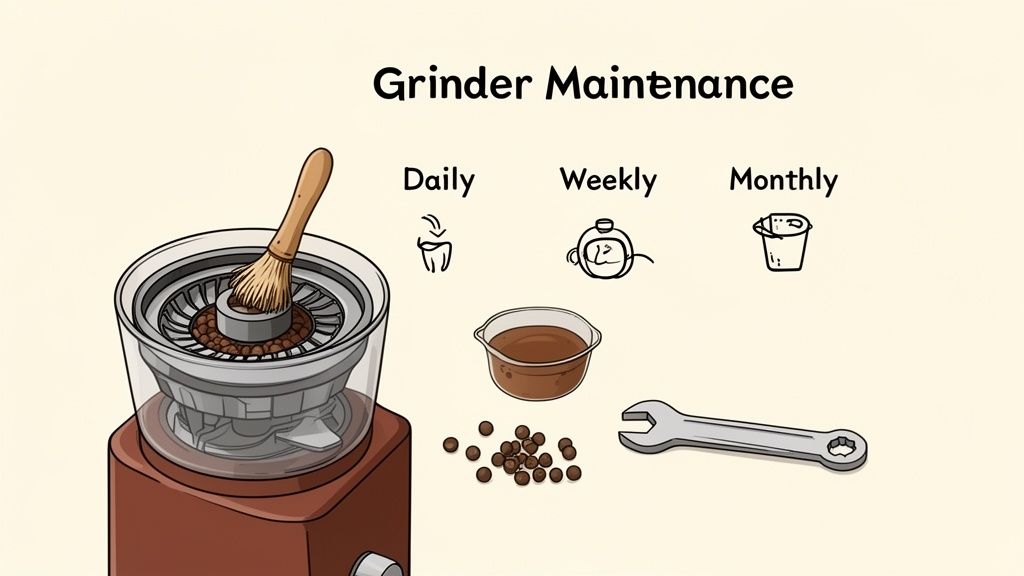
A high-performance coffee grinder is a serious investment. Like any precision tool, it needs regular care to perform at its best. Neglecting it doesn’t just shorten the machine’s lifespan; it actively makes your coffee taste worse.
Over time, a residue of coffee oils and fine particles builds up on the burrs. This old, stale gunk turns rancid and will taint every fresh bean that passes through, introducing bitter flavours. Thankfully, a simple cleaning routine is all it takes. For more tips on general commercial kitchen equipment maintenance, there are some great external resources available.
Your Daily, Weekly, and Monthly Cleaning Checklist
Consistency is everything. By adding these small tasks into your workflow, you prevent major build-up and keep your machine in top form.
Daily Tasks (Under 2 Minutes):
- Brush the Chute: At the end of the day, use a firm-bristled brush to clear the exit chute and the area around the upper burr.
- Wipe the Exterior: Give the grinder’s body a quick wipe with a damp cloth to remove coffee dust.
Weekly Deep Clean (5-10 Minutes):
- Use Grinder Cleaner: Run professional-grade cleaning pellets through the grinder. These food-safe pellets absorb stubborn coffee oils and dislodge stuck particles.
- Clean the Hopper: Wash the hopper with warm, soapy water to cut through oil residue. Dry it completely before putting it back, as moisture is the enemy of your burrs.
Troubleshooting Common Grinder Issues
Even a perfectly maintained coffee grinder machine can hit a snag. Knowing how to fix common problems quickly can save you from stress and downtime.
A clean grinder is a happy grinder. The five minutes you spend cleaning your burrs each week will pay you back with months of consistent, delicious coffee.
A jammed grinder is a common headache, usually caused by oily beans or a grind setting that’s too fine. If you hear the motor humming but see no coffee coming out, switch it off immediately. Unplug the machine and manually clear the blockage from the burrs using a brush or vacuum.
If you notice your grind consistency is off, it could be a sign of worn-out burrs. It might be time to inspect them for dull edges. For more advice, take a look at our guide on choosing the right cleaning products for your commercial coffee equipment.
Why Choose ADS Coffee Supplies?
Choosing the right coffee grinder machine is a big decision, but picking the right supplier is just as important. At ADS Coffee Supplies, we’re not just another equipment seller; we’re a partner in your success.
We combine decades of hands-on industry knowledge with personal service. When you work with us, you get a dedicated partner who is as invested in your coffee as you are. We don’t just shift boxes; we build lasting relationships.
Our Top Recommended Coffee Grinders
Here’s a quick look at some of the best models we offer, catering to different needs and budgets.
- ADS Coffee Supplies Grinders: Our own range offers unbeatable value and reliability, making it the top choice for businesses and serious home users alike.
- Eureka Grinders: A world-leader known for precision engineering, quiet operation, and exceptional consistency, perfect for demanding café environments.
- Fiorenzato Grinders: These Italian-made grinders are renowned for their robust build quality and innovative technology, ideal for high-volume settings.
- Victoria Arduino Grinders: Combining stunning design with cutting-edge performance, these grinders are a statement piece for any specialty coffee bar.
Unbeatable Service and Support
We know that when you need a grinder, you often need it fast. That’s why we offer free next-working-day delivery on orders across the UK mainland.
On top of that, we offer flexible ways to get the equipment you need, designed to suit any budget or business model.
- Direct Purchase: Own your equipment outright.
- Flexible Leasing: Manage cash flow while accessing top-tier grinders.
- Barista Training: We can help get your team up to speed, mastering their new grinder to ensure perfect results from day one.
Our support doesn’t stop once the delivery is made. We keep a comprehensive stock of spare parts and are always on hand to offer expert advice.
Choosing ADS Coffee Supplies means gaining a partner for your coffee journey. From honest advice to long-term support, we’re here to help you succeed.
Ready to find your perfect grinder? Explore our complete range of coffee grinders today.
Frequently Asked Questions
Still have a few questions before choosing your perfect coffee grinder? Here are some straightforward answers to the questions we hear most often.
How often should I replace my grinder burrs?
The life of your grinder’s burrs depends on what they’re made of and how hard you work them. In a busy café using steel burrs, a good rule of thumb is to replace them after they’ve ground 400kg to 500kg of coffee. At home, the same set could last for years. You’ll know it’s time when your grounds look less consistent or you have to grind much finer to get the same results.
What grind size is best for my brewing method?
Getting the grind size right is essential for a delicious cup. While every coffee is different, here are some reliable starting points:
- French Press: A coarse grind, like rough sea salt.
- Filter and Drip Coffee: A medium consistency, like table salt.
- Espresso: A very fine grind, almost like powdered sugar.
Key Takeaway: The wrong grind size is the quickest way to ruin good coffee. Too coarse and it’ll taste weak and sour; too fine and you’ll get a bitter, harsh brew.
Can I use one grinder for both espresso and filter coffee?
While some high-end grinders can handle both, it’s usually a compromise. Constantly switching from a super-fine espresso setting to a coarse filter one can be difficult and may wear out the adjustment mechanism. For the best results, most professionals use a dedicated grinder for each brewing style. If you need one machine to do it all, choose a coffee grinder machine with a wide, stepless adjustment range.
Ready to unlock the true potential of your coffee beans? The expert team at ADS Coffee Supplies is here to help you find the perfect grinder for your home or business. Browse our expertly curated range of coffee grinders now.


