
Trying to find the best coffee grinder for espresso in the UK can feel like a minefield of technical specs and conflicting advice. If you just want a straight answer, here it is: the Eureka Mignon Specialita is a phenomenal all-rounder, hitting that sweet spot between grind quality, robust build, and genuine value for British coffee lovers. This guide will cut through the noise and show you exactly what matters.
So, let's get into it.
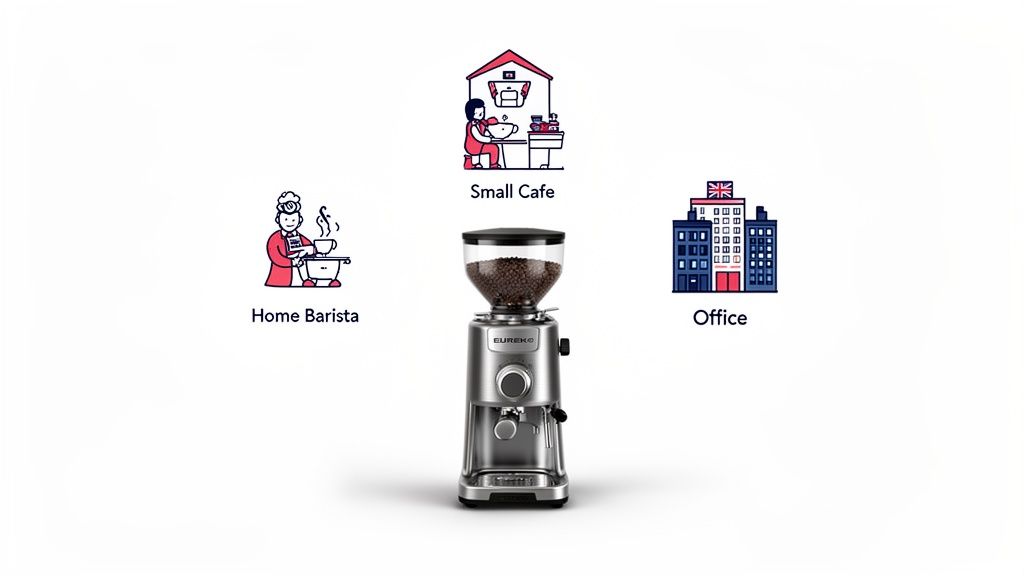
Why a Premium Grinder Is Your Best Investment
Investing in a proper grinder is, without doubt, the single biggest leap you can take towards making café-quality espresso at home or in your business. Your grinder is often more critical than the espresso machine itself. Without a consistent, fine grind, even a top-of-the-line machine will pull a disappointing, watery shot.
It all comes down to extraction. To make great espresso, you need a puck of uniformly ground coffee that provides even resistance against the hot, high-pressure water. This allows the machine to pull out all the rich, complex flavours from the beans. A cheap grinder just can't do it, leading to a foul-tasting shot that’s both sour and bitter.
Top Espresso Grinder Recommendations for UK Users
To give you a quick lay of the land, here are our top picks for different UK users. Each one represents a fantastic balance of performance and real-world practicality.
- ADS Coffee Supplies – Eureka Mignon Specialita: Delivers outstanding grind consistency, quiet operation, and a compact design perfect for home kitchens.
- Eureka Atom 60: Brings commercial-grade speed and precision in a manageable size, ideal for lower-volume professional settings.
- Eureka Mignon XL: Combines high-speed grinding with durability and ease of use, ensuring everyone gets a great coffee quickly.
This focus on better home equipment isn't just a niche hobby; it’s a massive trend. The global coffee grinder market was valued at USD 1.92 billion in 2023 and is rocketing upwards, with home users leading the charge. This shows just how many people are realising the massive difference good kit makes.
Your grinder is the gatekeeper to your coffee's potential. A great grinder can make a mid-range espresso machine shine, but a poor grinder will hold back even the most advanced setup.
When you're weighing up your options, there are some universal things to consider when choosing kitchen appliances that apply here too. The best choice is the one that fits how you’ll actually use it every day. A great grinder is a long-term investment in countless cups of perfect coffee.
To find the model that’s right for you, feel free to browse our full range of coffee equipment.
Why Your Grinder Outweighs Your Espresso Machine
It’s a common mistake to think the gleaming espresso machine is the star of the show. In reality, the humble grinder holds the true key to exceptional coffee. Your choice of the best coffee grinder for espresso in the UK is the single most important decision for your setup—it’s the foundation for every shot you pull.
Think of it like this: an espresso machine just pushes hot water through coffee grounds. If those grounds are inconsistent—a mess of fine dust and coarse chunks—the water won't flow through them evenly. This messy extraction creates a disappointing shot that’s weak, sour, and bitter all at once.
The Problem of Inconsistent Grinds
An inconsistent grind is the main culprit behind channelling. This is what happens when pressurised water blasts through the weakest spots in the coffee puck, completely bypassing denser areas. The result is a flawed shot that fails to capture the rich, balanced flavours locked inside your beans.
A high-quality grinder solves this by producing uniform coffee particles. This consistency creates a tightly packed, even bed of coffee that forces water to extract flavour compounds from every single particle. It’s this controlled, even extraction that delivers the rich crema and deep, complex flavours you’re looking for.
Precision is Power
Beyond simple consistency, the ability to make tiny, precise adjustments is what separates a good grinder from a great one. This is what we call ‘dialling in’ your shot. Different coffee beans, their age, and even the humidity in your kitchen can change the ideal grind size.
A great grinder lets you make micro-adjustments that turn a decent espresso into a truly memorable one. It's the difference between being a coffee maker and a coffee craftsman.
A grinder with stepless adjustment—meaning no fixed 'clicks' between settings—gives you infinite control. It allows you to fine-tune your grind with incredible accuracy, compensating for any variables to nail the perfect flow rate and extraction time, every single time.
A Growing Trend in the UK
This isn't just a secret for coffee professionals anymore. The UK's speciality coffee market is set to grow at a compound annual rate of over 12% in the coming years, a trend that directly fuels the demand for better home grinding equipment. This growth shows a major shift in how UK consumers see coffee, with a real appreciation for how grind quality shapes the final taste.
With so much great educational content online, coffee lovers now realise that a quality grinder is non-negotiable for achieving café-level results at home. You can read the full research on the grinder market for more details.
Ultimately, while the espresso machine puts on the final performance, the grinder writes the script. Investing wisely in a capable grinder gives every shot the potential to be perfect. To start exploring grinders that deliver this precision, check out our range of Eureka Mignon grinders.
Getting to Grips with Espresso Grinder Features
To pick the right espresso grinder, you need to know what the specs actually mean for your daily coffee routine. A few core features will directly shape the taste in your cup, how easy the grinder is to use, and how long it will last. Let’s break down the ones that really matter.
Burr Type and Material
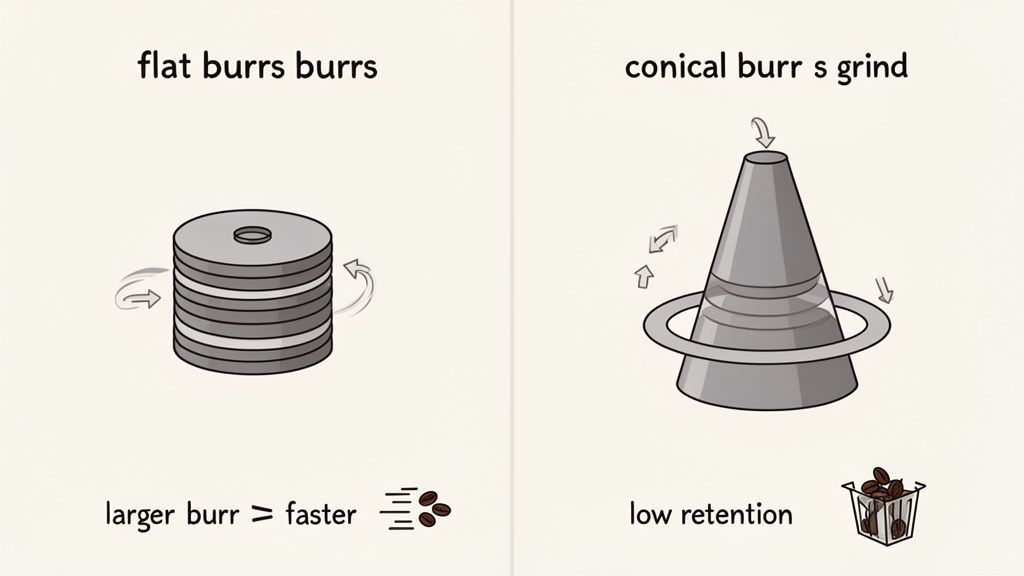
At the heart of any decent grinder is a set of burrs. These are the parts that crush your beans into uniform particles. You'll mainly come across two shapes and two common materials.
- Flat Burrs: These are two horizontal, ring-shaped burrs sitting face-to-face. They are known for producing a very uniform grind, which can lead to a sweet, clean, and flavourful espresso.
- Conical Burrs: This design features a cone-shaped inner burr spinning inside a ring-shaped outer burr. They tend to grind slower and generate less heat, which is great for preserving delicate aromatic oils.
As for what they’re made of, the choice is usually between steel and ceramic. Steel burrs are incredibly sharp and precise, while ceramic burrs hold their edge for longer. For most high-quality grinders, high-quality steel burrs are the go-to standard.
Burr Size and Grind Retention
When it comes to burrs, bigger is generally better. A bigger burr can grind the same amount of coffee faster and at a lower RPM (revolutions per minute). This gives you two key benefits: speed and less heat, which protects the flavour of your beans.
Another crucial factor is grind retention. This is how much ground coffee gets left behind inside the grinder after use. High retention is a problem because stale, old grounds can mix with your fresh coffee, tainting the flavour of your next shot.
For home baristas who love to switch between different beans, a low-retention grinder is a game-changer. It guarantees every single shot is made with exceptionally fresh grounds.
Dosing Methods: Timed vs Weight-Based
Once the coffee is ground, you need to get it into your portafilter. Modern grinders use precise, doserless systems.
- Timed Dosing: You set a timer (e.g., 3.5 seconds) to dispense a consistent volume of coffee. It’s very reliable, though the weight can drift slightly. The Eureka Mignon Specialita is a perfect example of a grinder with incredibly accurate timed dosing.
- Weight-Based Dosing: Often called 'grind-by-weight', this is the gold standard for accuracy. These grinders have a built-in scale and will grind until a precise target weight (e.g., 18.0 grams) is reached. It takes all the guesswork out of the equation.
With a solid grasp of these features, you can look at any grinder's spec sheet and know exactly how it will perform in your kitchen.
Our Top Espresso Grinder Recommendations for the UK
To find the best coffee grinder for espresso in the UK, you need clear advice. We've put together a list of top-tier grinders, each picked for a specific job and budget. Our choices are based on real-world performance, build quality, and value for money.
1. ADS Coffee Supplies – Eureka Mignon Specialita: The Ultimate All-Rounder
For home baristas, prosumers, and even smaller cafés, the Eureka Mignon series from ADS Coffee Supplies is our top recommendation. These Italian-made grinders nail the perfect balance of performance, quiet operation, and a compact design that fits beautifully into any UK kitchen or coffee bar.
The standout model is the Eureka Mignon Specialita. It's built around 55mm flat steel burrs that produce a wonderfully fluffy and consistent grind. Its micrometric, stepless adjustment system is the star of the show, allowing for incredibly fine-tuned dialling-in.
What really makes the Mignon series special is its thoughtful design. The ACE (Anti-Clumps & Electrostaticity) system means grounds flow neatly into your portafilter with barely any mess. Plus, its near-silent operation is a massive win for early morning coffee routines.
The Eureka Mignon series is a fantastic investment for anyone serious about their coffee. Its blend of professional-grade features, quiet performance, and compact size makes it the undisputed leader for home espresso enthusiasts in the UK.
2. A Workhorse for Commercial Demand
When your priorities are speed, durability, and consistency in a busy commercial setting, you need a grinder built for the long haul. For UK cafés and busy offices, a proper commercial grinder is essential.
These machines are engineered with powerful motors and large burrs (often 64mm or larger) to grind significant amounts of coffee quickly and without overheating. You'll find features like high-capacity hoppers, robust build quality, and efficient cooling systems as standard. While their size and price put them out of reach for most home users, their value in a professional environment is undeniable.
3. A Great Entry-Point Grinder
If you're just starting your espresso journey, finding a capable entry-level grinder is crucial. A good entry-level choice should still have burrs (not blades), offer a decent range of grind settings, and have a motor strong enough for an espresso-fine grind.
These grinders give you a solid foundation for learning how to dial in shots and understand extraction. While you might outgrow them as your skills develop, they are an excellent way to start making genuine espresso at home. For those who fancy a premium manual option, the exceptional Timemore S3 Grinder offers incredible precision in a compact format.
Understanding the UK Grinder Market
The UK espresso grinder market is impressively diverse. While manual grinders hold a significant share, electric options are popular for home use. The entire UK coffee machine market, valued at a substantial USD 2.37 billion across Europe in 2024, shows just how much we're investing in quality coffee kit. You can discover more insights on the coffee equipment market to see the full scope of this trend.
Ultimately, choosing the best coffee grinder means matching the machine's capabilities to your daily needs. Whether you need quiet operation for home or speed for a bustling café, there's a perfect grinder out there.
Matching a Grinder to Your Brewing Needs
Choosing the best coffee grinder for your espresso setup in the UK isn't about finding the most expensive model. The real goal is to match the grinder's features to your day-to-day reality.
A grinder built for a high-street café would be complete overkill in a home kitchen. Flip that around, and a home-use model would grind to a halt under commercial pressure. Let’s break it down into three common scenarios: the home barista, the small office, and the professional café.
The Passionate Home Barista
If you're a coffee enthusiast at home, you're focused on quality over quantity. You enjoy the craft of pulling a perfect shot and experimenting with different beans.
For you, the priorities are:
- Low Grind Retention: You want every shot made from perfectly fresh grounds. A low-retention grinder ensures what you put in is what you get out.
- Compact Footprint: A grinder with a smaller design will fit into your home without dominating the kitchen.
- Quiet Operation: Grinders designed for home use, like the Eureka Mignon series, are engineered to run at a lower decibel level.
This simple flowchart helps visualise the decision-making process.
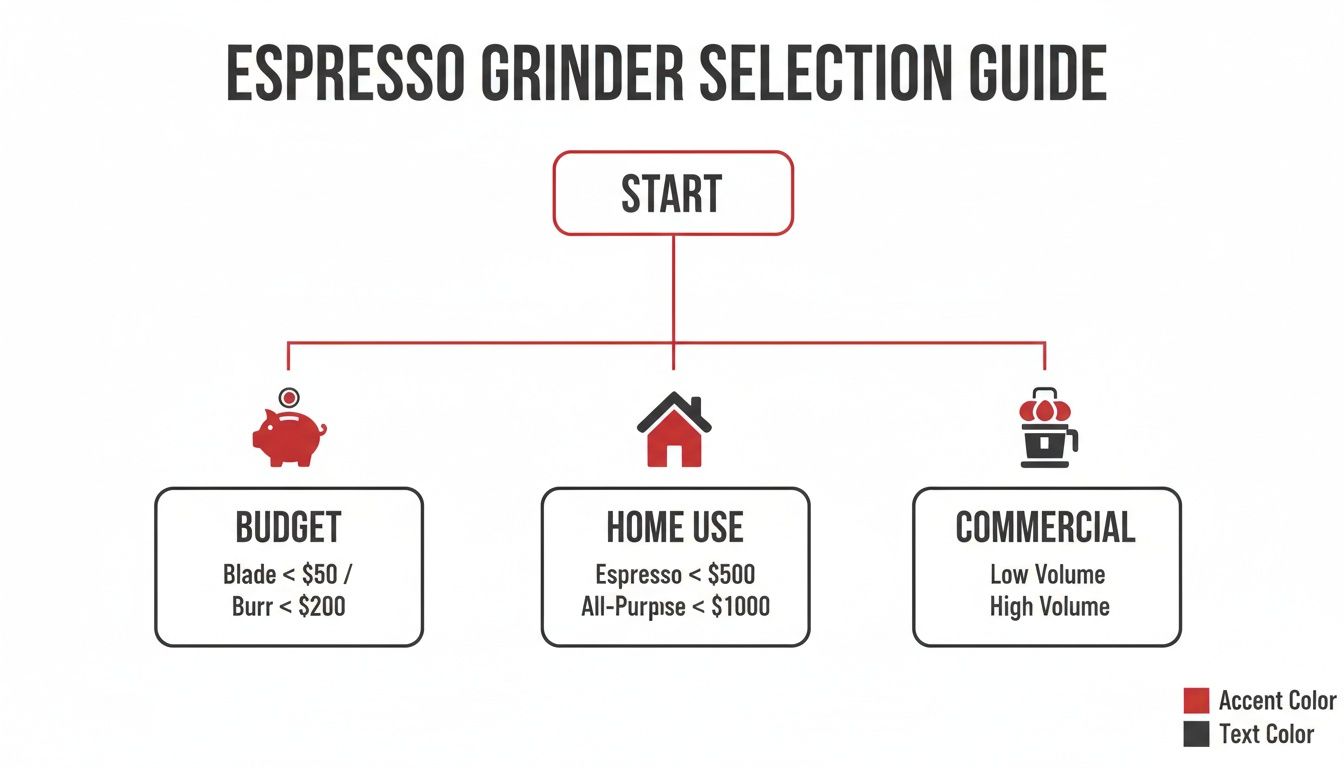
As you can see, the path for a home user prioritises different things compared to the commercial route, which is all about speed and durability.
The Small Office Environment
In an office, the grinder has to be a reliable workhorse that anyone can use. It’s a balance between performance, user-friendliness, and toughness.
Here’s what to look for:
- Durability and Build Quality: The grinder needs a robust construction that can handle constant, and sometimes careless, use.
- Larger Hopper: A generous bean hopper means fewer refills, which is a massive practical win in a busy shared space.
- Intuitive Controls: Simplicity is king. Look for grinders with clear digital displays and pre-set timed dosing.
In a shared space like an office, ease of use trumps granular control. A grinder that delivers a great shot with the push of a button is invaluable.
For those who don't need a powerful electric model, a quality manual grinder can be a fantastic choice. The Hario Ceramic Coffee Mill Mini-Slim Plus Grinder is an excellent and portable alternative.
The Busy Café Setting
In a commercial café, the grinder is the most critical piece of kit on the bar. It needs to deliver speed, rock-solid consistency, and absolute reliability under relentless pressure.
The non-negotiables are:
- Speed and Power: A powerful motor and large burrs (64mm or bigger) are essential for keeping the queue moving.
- Exceptional Consistency: In a café, every shot has to be repeatable. Commercial grinders are precision-engineered for uniform grind size.
- Low Operating Temperature: High volume generates heat, the enemy of flavour. Top-tier grinders have built-in cooling to protect the coffee.
By identifying your own user profile first, you can cut through the noise and focus on the features that will genuinely elevate your coffee.
How to Maintain Your Espresso Grinder
Buying a top-tier espresso grinder is the first step, but looking after it guarantees lasting performance. Proper maintenance protects your investment and ensures better-tasting coffee every single day.
Regular care is crucial because it stops old coffee oils from building up and turning rancid, which will spoil the taste of fresh beans. It also prevents fine coffee particles from compacting inside the burrs. Thankfully, keeping your grinder in top condition is straightforward.
Simple Weekly Cleaning Routine
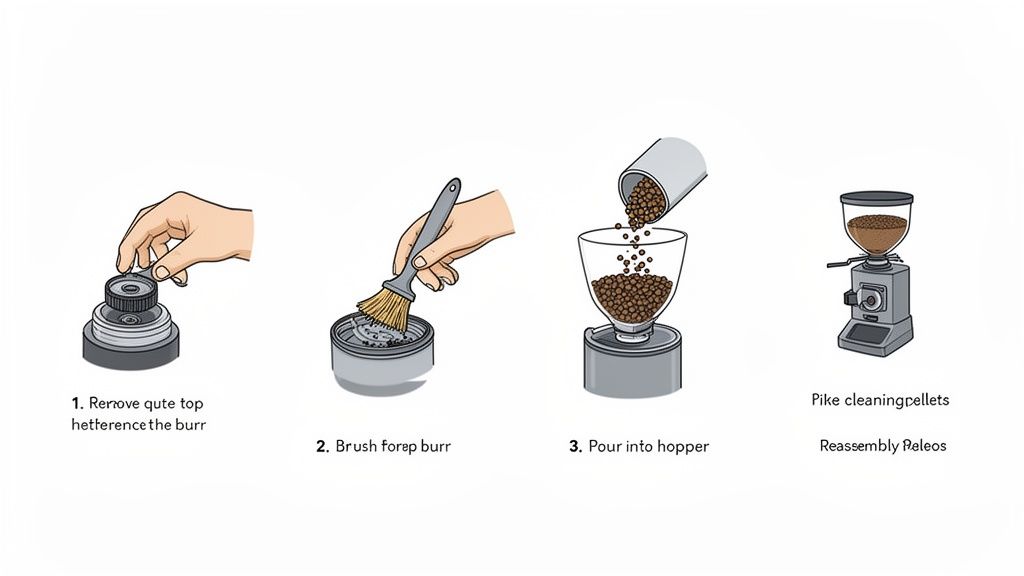
For a quick and effective weekly clean, grinder cleaning pellets are your best friend. These food-safe, bean-shaped pellets absorb stale coffee oils and dislodge stubborn grounds.
- Empty the Hopper: Run the grinder until it's completely empty of beans.
- Add Pellets: Pop a capful of cleaning pellets into the empty hopper.
- Grind Through: Run the grinder until all the pellets have passed through.
- Purge with Beans: Grind a small handful of old coffee beans to purge any leftover pellet residue. Be sure to throw these grounds away.
This process takes less than five minutes but makes a huge difference. Using a quality product like Puly Verde Grinder Cleaner is a brilliantly effective way to keep your grinder pristine.
Performing a Deeper Clean
Every few months, it’s worth doing a deeper clean. This means unplugging the grinder, removing the hopper, and taking out the top burr assembly. Grab a stiff brush and a vacuum cleaner to thoroughly clear out all impacted coffee grounds from the burrs and grinding chamber.
Consistent maintenance isn't just about cleanliness; it's about precision. A clean grinder is a consistent grinder, giving you the best foundation for that perfect espresso shot.
When you buy from a trusted UK supplier like ADS Coffee Supplies, you also get peace of mind. We provide expert support, genuine spare parts, and professional servicing to ensure your equipment performs at its best.
Your Espresso Grinder Questions Answered
We know diving into the world of espresso grinders can throw up a lot of questions. Here are some straight-talking answers to the queries we hear most often.
How much should I spend on an espresso grinder?
For anyone serious about making proper espresso at home, a solid starting point is between £150 and £300. In this range, you'll find capable burr grinders that can produce a true espresso-fine grind.
If you can push your budget into the £300–£600 bracket, you’ll see a massive jump in quality. Grinders like the fantastic Eureka Mignon Specialita offer a huge leap in grind consistency, quieter operation, and premium build quality. For commercial use, you're typically looking at £600 as a starting point.
Are hand grinders any good for espresso?
Yes, but only high-quality ones. A premium manual grinder can produce an exceptionally consistent grind, sometimes rivalling expensive electric models. The trade-off is the physical effort and time it takes, which makes them impractical for daily use, especially if you're making coffee for more than one person.
How often should I replace my grinder burrs?
For most home users with steel burrs, you can expect to grind somewhere between 300-500 kg of coffee before a replacement is needed. This translates to many years of daily use. In a busy café, burrs might need replacing every year. You'll know it's time when your grind becomes inconsistent and you struggle to dial in your shots.
Ready to find the perfect grinder that fits your setup and your budget? The experts at ADS Coffee Supplies have hand-picked a fantastic selection of top-performing Eureka grinders, all backed by genuine UK support and expertise.


