So, you’re looking to find the best coffee machine for a home barista, but where do you begin? The answer really boils down to what you want from your coffee experience. If you dream of having complete control over every shot and chasing that perfect café-quality espresso, then a semi-automatic machine and a separate burr grinder is your winning combination. But if your mornings are more about speed and simplicity, a modern bean-to-cup machine will serve up a fantastic coffee at the press of a button.
Your Home Barista Journey Starts Here
Welcome! You've just stepped into the exciting world of home coffee, and this guide is here to be your compass. It’s easy to feel a bit lost at first with all the different machines, technical jargon, and strong opinions out there. Don't worry, we're going to cut through the noise.
Choosing the right equipment is genuinely the most important step you'll take. It’s the key to bringing that coffee shop ritual—the incredible aromas, the rich flavours, the satisfying process—right into your own kitchen. It's not about finding the single "best" machine on the market, but about finding the one that’s perfect for you, your lifestyle, and how deep you want to dive into the craft of coffee making.
What to Expect From This Guide
We’re going to walk you through the essential decisions, breaking everything down into simple, practical terms. The goal is to give you the knowledge you need to choose with confidence.
Here’s a look at what we’ll cover:
- The main categories of coffee machines and who each one is really for.
- The technical features that actually impact the taste in your cup.
- Why a good grinder is non-negotiable for great coffee.
- How to match your budget to your coffee ambitions without overspending.
As you get started, remember that the principles of choosing any good piece of equipment often apply. This guide to choosing the best kitchenware has some solid advice on build quality and what makes a brand trustworthy, which is just as relevant here. Of course, the machine is only half the story; the beans you use are just as crucial. You can dive deeper into that with our ultimate guide to coffee beans for home baristas.
With over 30 years of experience in this industry, we at ADS Coffee Supplies are here to help you get it right. Our aim isn't just to sell you a box, but to give you the confidence to start your journey and brew exceptional coffee at home.
What Kind of Home Barista Are You?
Choosing the best coffee machine for a home barista isn’t about chasing the most expensive model or the one with the longest list of features. It’s about finding the right fit for your daily routine, your passion for coffee, and how hands-on you want to be.
Before we get lost in the technical details, the first and most important step is figuring out what kind of coffee drinker you really are.
Do you see making coffee as a cherished morning ritual? Do you get excited about the idea of dialling in a grinder, tamping the grounds perfectly, and pulling an incredible shot of espresso? Or is your morning more of a race against the clock, where a fantastic flat white at the push of a button sounds like a dream come true? Each type of machine is built for a different person.
This simple flowchart is a great starting point, helping you decide if you crave hands-on control or value pure convenience above all else.

As you can see, your core motivation—whether it’s a love for the craft or a need for speed and simplicity—is what really points you towards the right kind of machine.
For the Hands-On Enthusiast: Semi-Automatic Machines
If you want to bring the full café experience into your kitchen, a semi-automatic espresso machine is your ultimate tool. These machines put you firmly in the driver's seat. You have total control over every variable that makes a great coffee, from the coarseness of the grind and the dose in your basket to the final extraction time.
There’s definitely a learning curve, and you’ll need a separate, high-quality grinder to get the best out of it. But the reward is immense. You get to truly engage with the coffee-making process, tweaking and perfecting your technique to pull shots that can easily rival your favourite coffee shop. This is hands-down the best coffee machine for a home barista who thinks of coffee as a genuine hobby.
For the Busy Pragmatist: Bean-to-Cup Machines
If your main goal is getting a consistently great coffee with absolutely zero fuss, then a bean-to-cup machine is your perfect match. These clever machines handle everything for you. They grind the beans fresh for every single cup, dose and tamp the coffee, brew the espresso, and often even froth and pour the milk automatically.
You just select what you want—a latte, cappuccino, or flat white—and the machine does the rest. It's the ideal choice for busy households or anyone who wants café-quality coffee without needing to learn the intricate skills of a barista.
For many, the big question is whether the upfront cost is a sound investment. When you consider that UK households spend around £6.42 per week on coffee to make at home, the initial outlay for a quality machine is often balanced out by savings quite quickly. If you're weighing it all up, our article on whether home coffee machines are worth it provides a much more detailed breakdown.
For the Traditional Purist: Manual Lever Machines
For the traditionalist who appreciates artistry and a completely hands-on approach, a manual lever machine offers a unique and deeply satisfying experience. These machines use a lever, operated by you, to force water through the coffee puck. This gives you a direct, tactile feel for the pressure and flow rate of the extraction.
Using a lever machine is a craft in itself. It's a slower, more deliberate process that connects you to the coffee in a way no other machine can. They demand patience and practice, but the results can be truly exceptional, producing shots with a unique texture and flavour profile you just can’t replicate otherwise.
For the Flavour Connoisseur: Advanced Filter Machines
While espresso tends to steal the spotlight, the world of filter coffee has come a long way from the simple drip brewers of the past. Modern, high-end filter machines give you incredible precision, controlling the water temperature, flow, and brew time down to the finest detail. This unlocks the delicate and nuanced flavours hidden in speciality beans.
These machines are perfect for coffee lovers who appreciate clarity, complexity, and the subtle tasting notes of single-origin coffees. It’s less about the intense punch of espresso and more about celebrating the pure, unadulterated character of the bean itself. This desire for quality is widespread; consumer data shows that while convenience is important, a huge 58.1% of UK coffee drinkers are actively trying to replicate coffee shop quality at home.
Coffee Machine Types at a Glance
Use this quick comparison to see which coffee machine type is the best fit for your daily routine and coffee goals.
| Machine Type | Best For | Skill Level Required | Key Benefit |
|---|---|---|---|
| Semi-Automatic | The aspiring home barista who enjoys the process and wants total control. | Intermediate to Advanced | Unparalleled shot quality and the ability to perfect your craft. |
| Bean-to-Cup | Busy individuals or families who value speed and consistency. | Beginner | Café-style coffee at the touch of a button with minimal effort. |
| Manual Lever | The traditionalist who appreciates tactile feedback and artistry. | Advanced | A unique connection to the brewing process and exceptional espresso texture. |
| Advanced Filter | Coffee purists who want to explore the nuanced flavours of beans. | Beginner to Intermediate | Highlights the subtle and complex notes of single-origin coffees. |
Ultimately, the best machine is one you’ll be excited to use every day, whether that means pulling the perfect lever shot or just pressing a single button.
Understanding the Tech That Powers Great Coffee
Right, now that you’ve got a feel for the different types of machines out there, let's lift the bonnet and look at what’s inside. Choosing the best coffee machine for a home barista often comes down to understanding a few key bits of technology. This isn't about becoming an engineer; it’s about knowing which features will actually make a difference to your morning coffee and the quality of your espresso.
Think of it like choosing a car. You don't need to know how the engine is built, but you do need to understand the difference between a manual and an automatic, or why one has better suspension for a smoother ride. Let’s translate the technical jargon into practical benefits, so you know exactly what you’re paying for.
The Boiler: The Heart of Your Machine
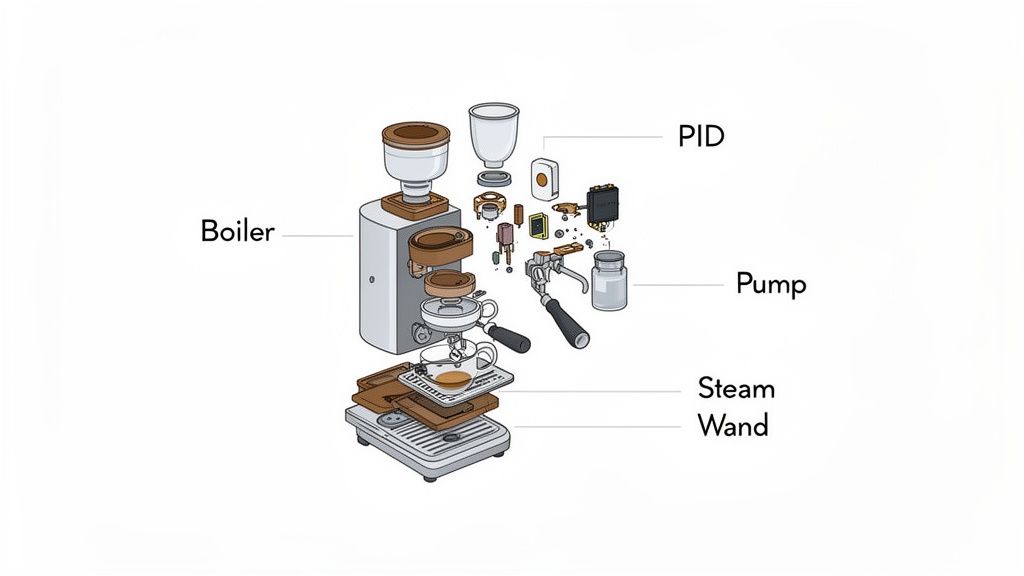
The boiler is the engine room of your espresso machine. It’s responsible for heating water to the perfect temperature for brewing, and how it manages this is a huge deal—especially if you love your flat whites and cappuccinos.
You’ll generally come across three main setups:
- Single Boiler: These machines have one boiler that pulls double duty, heating water for espresso and then switching gears to create steam for milk. It can't do both at once, so you have to pull your shot, then flick a switch and wait for the boiler to heat up to steam temperature. It's a solid, budget-friendly option, but it does test your patience.
- Heat Exchanger (HX): Now this is a clever bit of engineering. A large boiler is kept permanently at steam temperature, and a copper tube (the heat exchanger) filled with fresh water runs right through it. When you want to brew, that fresh water is flash-heated to the perfect espresso temperature on its way to the group head. The big win? You can pull a shot and steam milk at the same time. A massive workflow improvement.
- Dual Boiler (DB): This is the top-tier setup, no compromises. You get two separate boilers—one is dialled in to a precise brewing temperature, and the other is dedicated to producing a tidal wave of steam. This gives you ultimate control and temperature stability, letting you brew and steam simultaneously without a dip in performance.
Honestly, for anyone who regularly makes milk drinks or has friends over for coffee, a heat exchanger or dual boiler machine is a massive quality-of-life upgrade.
PID Temperature Control: Your Consistency Co-Pilot
Ever had a coffee that tasted incredible one day and disappointingly bitter the next, using the exact same beans? Temperature instability is almost always the culprit. This is where a PID (Proportional-Integral-Derivative) controller comes in.
Think of it as an incredibly smart cruise control for your machine's temperature. A standard thermostat lets the temperature swing up and down by several degrees, but a PID makes constant, tiny adjustments to keep the water rock-steady, often within a single degree of your target.
This consistency is a total game-changer. It means you can pull shot after shot knowing that temperature swings won't wreck your coffee. The result is more sweetness, cleaner flavours, and repeatable results every single time.
Pump Pressure: The Force Behind Extraction
To make true espresso, you need to force hot water through a tightly packed puck of coffee at high pressure. That’s the pump’s job. You’ll see a lot of machines advertised with 15-bar pumps, but don't be fooled by big numbers. The industry standard for the best espresso extraction is actually about 9 bars of pressure at the group head.
What really matters is the pump's ability to deliver stable and consistent pressure through the entire shot. A great pump ensures water flows evenly through the coffee puck, extracting all those delicious, syrupy flavours without carving channels that lead to a weak, sour shot. If you want to dive deeper into how this all works, you can explore the science behind perfect espresso extraction in our detailed guide.
Steam Wand Power: Your Latte Art Tool
If silky microfoam for lattes is your dream, the steam wand is your most important tool. A powerful wand with a well-designed tip makes it infinitely easier to create that velvety, paint-like milk texture you need for latte art.
Less powerful machines often produce "wet" steam, which just results in bubbly, disappointing foam. Prosumer machines, particularly those with a dedicated steam boiler, blast out a constant, powerful jet of dry steam that can texture a jug of milk perfectly in seconds. This power doesn't just give you better milk; it makes your entire workflow faster when you're making drinks for two or more people.
Why Your Grinder Is Your Most Important Tool
Let me share a secret that every seasoned barista knows: your grinder is actually more important than your espresso machine. I know, it sounds a bit backwards. But pouring a good chunk of your budget into a high-quality burr grinder is the single best thing you can do for your coffee. It's an absolute must for anyone serious about creating a proper home barista setup.
Think of it like trying to build a beautiful house on a wobbly foundation. That's what you're doing when you brew with a poor, inconsistent grind. Your fancy, all-singing, all-dancing espresso machine can't save badly ground coffee. The fate of your shot is sealed long before hot water ever hits the grounds.
Burr Grinders vs. Blade Grinders
So, what makes a grinder good or bad? It all comes down to how it grinds the beans.
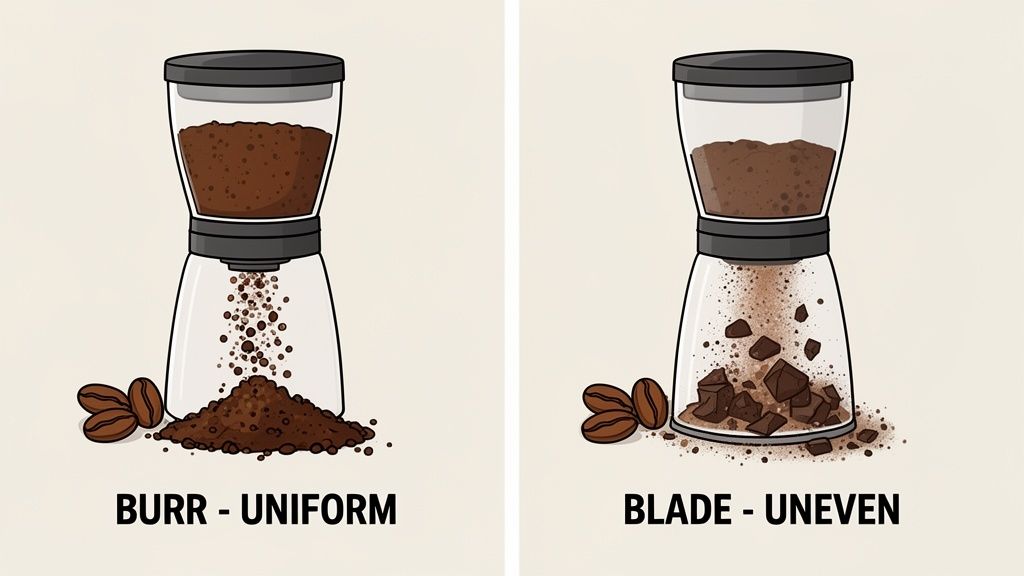
Your cheap blade grinder – the kind you might use for spices – is a coffee bean’s worst nightmare. It uses a spinning blade to violently smash the beans into random pieces. The result is a chaotic mess of super-fine dust and big, chunky bits, often called ‘boulders’.
Brewing with this is a recipe for disaster. The hot water gushes past the big chunks too quickly, leaving them sour and under-extracted. At the same time, it suffocates the fine dust, pulling out bitter, harsh flavours from over-extraction. The final cup is a confusing, unbalanced mess.
A burr grinder, on the other hand, is an instrument of precision. It features two revolving, abrasive surfaces (the ‘burrs’) that gently crush beans into a consistent, uniform size. This uniformity is the secret to a balanced extraction. It lets water flow evenly through the coffee puck, unlocking all those sweet, complex flavours you’re chasing.
Stepped vs. Stepless Adjustments
Once you step into the world of burr grinders, you’ll find two main ways to adjust the grind size: stepped and stepless. This control is what allows you to "dial in" a shot to perfection.
- Stepped Grinders: These have a set number of clicks or settings. Each click moves the burrs a fixed distance. They’re really user-friendly and make it easy to remember your settings if you often switch between different beans or brewing methods.
- Stepless Grinders: These offer an infinite number of tiny adjustments between the finest and coarsest settings, with no pre-set 'clicks'. This gives you ultimate precision, allowing you to make those tiny micro-adjustments that can elevate a good shot to a great one.
For the dedicated espresso enthusiast, a stepless grinder is often the holy grail because of that incredible level of control. That said, many modern high-end stepped grinders have more than enough settings to satisfy even the most particular home barista. The real takeaway is to pick a grinder that gives you fine-grained control specifically for espresso.
Your grinder is the true heart of your setup. To see how the pros pair equipment, take a look at our hand-picked espresso machine and grinder packages designed for a perfect partnership.
Here's the bottom line: a £1,500 machine with a £50 blade grinder will make awful coffee. A £400 machine paired with a £300 burr grinder can produce exceptional, café-quality shots. Always, always prioritise your grinder budget. It's the key to unlocking the full flavour potential of every single bean.
Matching Your Budget to Your Coffee Goals
Investing in the right setup is all about striking that perfect balance between your passion for coffee and your budget. Choosing the best coffee machine for a home barista isn’t about grabbing the most expensive model off the shelf; it's about making a smart investment in the features that will genuinely help you make the coffee you love.
Let's walk through what you can realistically expect to get for your money. Seeing the value at each level helps you make a long-term decision you’ll be happy with for years to come. Think of this less as a purchase and more as laying the foundation for your own little home café.
Entry-Level Excellence Under £500
This is the perfect launching pad for anyone wanting to get serious about the craft of espresso without a huge initial spend. In this price bracket, you'll find some very capable single-boiler and thermoblock machines that give you proper, hands-on control.
The real win here is getting the ability to work with fresh beans and a decent grinder to pull genuine espresso shots. Yes, you might have a short wait between brewing your shot and steaming your milk, but these machines are fantastic for getting the hang of the fundamentals. They are brilliant learning tools for mastering tamping, extraction, and milk texturing.
The Prosumer Sweet Spot: £500 to £1500
Now we're talking. Welcome to the mid-range, where home equipment starts to feel and perform a lot more like the machines in your favourite coffee shop. This is the "prosumer" sweet spot, blending professional-grade features with a footprint that actually fits in your kitchen.
The game-changing upgrade here is the introduction of heat exchanger (HX) and dual boiler systems. This tech lets you pull espresso shots and steam milk at the same time, which completely transforms your workflow. You’ll also notice a real step up in build quality, with more stainless steel, rock-solid temperature stability thanks to PID controllers, and more powerful steam wands for creating that silky microfoam.
This tier is a significant leap in both performance and consistency. A great way to get into this bracket without the brand-new price tag is by looking into high-quality refurbished coffee machines, which pack in premium features for less.
High-End Performance: Over £1500
Once your budget climbs past the £1500 mark, you’re stepping into the world of high-end, almost commercial-grade, home machines. These are built for the true coffee enthusiast who wants absolutely zero compromises.
At this level, dual boiler machines are standard, giving you incredibly precise, independent temperature control for both brewing and steaming. You can also expect to find advanced features like pressure profiling, quiet rotary pumps, and the option to plumb the machine directly into your water mains.
The build quality is exceptional—these machines are designed to last a lifetime. This is an investment for the home barista who craves ultimate control, flawless consistency, and the very best performance money can buy. The recent 4.8% growth in the UK home coffee machine market shows that more and more people are choosing to invest in quality equipment, seeing it as a long-term, cost-effective alternative to daily coffee shop runs.
Your Next Steps to Amazing Home Coffee
You’ve made it this far, which means you’re now equipped with a solid understanding of what separates a good home coffee setup from a truly great one. From figuring out your personal barista style to decoding the technical specs that really make a difference, you've got the knowledge to make a confident choice.
The path to incredible coffee is now much clearer. It all comes down to pulling these key threads together.
Let’s quickly run through the crucial checkpoints one last time:
- Your Barista Style: Are you the hands-on, creative type who’ll love a semi-automatic, or is the sheer convenience of a bean-to-cup machine a better fit for your daily routine?
- Essential Features: Will a heat exchanger boiler revolutionise your morning workflow? Is a PID controller the non-negotiable feature you need for that perfect, consistent shot?
- The Grinder: Don't forget this crucial piece of the puzzle! Have you set aside enough of your budget for a grinder that can do your machine justice?
- Your Budget: Where do your coffee dreams land? Whether you’re just starting out or ready to invest in a no-compromise, end-game machine, there’s a perfect setup waiting for you.
Choosing the best coffee machine for a home barista is a big decision, and you don't have to go it alone. As you start picturing your dream coffee corner, it’s also a good time for optimizing your kitchen layout and organization to create a smooth, enjoyable workflow.
Why Choose ADS Coffee Supplies
As a family-run business that's genuinely passionate about coffee, we do more than just ship boxes. We’re here to build relationships and make absolutely sure you find the right equipment for you. Think of us as your expert guides, here to offer friendly, personalised advice as you make that final decision.
Our goal is to support your entire coffee journey, not just make a sale. We're here for the long haul, ready to offer support and advice long after your machine is unboxed.
Your Complete Coffee Partner
When you choose ADS, you're getting a full support system for your home barista ambitions. We’ve built our service around a few key ideas to give you total peace of mind and help you brew the best coffee you possibly can.
- Expert Guidance: Our team is always on hand to answer your questions and provide recommendations that are genuinely tailored to you.
- Fast, Reliable Delivery: We offer next working day delivery across mainland UK on orders over £69, so you can get brewing without the long wait.
- A Full Range of Supplies: We stock everything you could possibly need, from freshly roasted speciality beans and cleaning supplies to professional barista tools.
Your journey to café-quality coffee at home is just getting started. Take a look through our curated collections, or just give our friendly team a shout for some guidance.
Ready to find your perfect machine? Browse our complete range of home coffee machines and start your next chapter in coffee.
A Few Final Questions
Diving into the world of home coffee always sparks a few last-minute questions. It’s completely normal. Let's tackle some of the most common queries we get, so you can feel totally confident in your choice.
What's Involved in Looking After an Espresso Machine?
Keeping your machine in top nick is the secret to both amazing coffee and a machine that lasts for years. It sounds like a chore, but it quickly becomes a simple, satisfying part of your coffee-making rhythm.
Think of it like this:
- After every coffee: Give the group head a quick flush and wipe the steam wand clean right after you've steamed your milk. Easy.
- Once a week: You'll want to backflush the group head. This uses a special cleaner to blast out old coffee oils that can build up and make your espresso taste bitter.
- Every month or so: Descale the machine to get rid of limescale, especially if you're in a hard water area. This is absolutely vital for keeping the boiler and all the internal bits and bobs healthy.
Do I Really Have to Use Special Filtered Water?
In a word: yes. Honestly, this is the single most important thing people overlook, and it impacts both flavour and the life of your machine. Tap water, particularly across most of the UK, is packed with minerals like calcium and magnesium.
When you heat this water, those minerals clump together to form limescale inside the machine’s boiler and pipes. This nasty build-up messes with your temperature control and can eventually lead to blockages and some very expensive repairs. Using properly filtered water is the best insurance policy you can have for your machine.
How Long Will a Good Home Coffee Machine Last?
This really depends on the build quality and how well you treat it. A solid entry-level machine, if you look after it, should give you a good 5-7 years of service. Step up to a high-quality "prosumer" machine built with commercial-grade parts, and you could easily be looking at 15 years or more.
The key is to invest in a machine from a trusted brand that has spare parts readily available—like the ones we stock here at ADS. That way, it can be serviced and repaired for decades to come, making it a true long-term investment in your daily coffee pleasure.
Can I Just Use Pre-Ground Coffee?
Technically, yes, you can. But you absolutely shouldn't. The problem is, pre-ground coffee is almost never the right grind size for a proper espresso. Worse still, it starts to go stale within minutes of being ground, losing all its incredible aroma and flavour.
No matter how fancy your machine is, using pre-ground coffee will give you a fast, watery, and underwhelming shot of espresso every time. Grinding your beans fresh, right before you brew, is the single biggest leap you can make towards that genuine, café-quality taste at home. It’s a complete game-changer.
At ADS Coffee Supplies, we’re here to help you every step of the way on your coffee journey, with honest advice and the best kit around.
Ready to get started? Explore our range of home coffee machines and grinders today!