

Buying coffee beans in bulk can reduce your cost per cup by up to 30% and ensure a consistent flavour in every brew. Whether you manage a café, stock an office pantry or crave café-quality coffee at home, ordering larger quantities brings clear savings and simplicity. This guide covers everything from choosing roasts and formats to storage, logistics and sustainability—all focused on coffee beans in bulk.
Why Buy Coffee Beans in Bulk
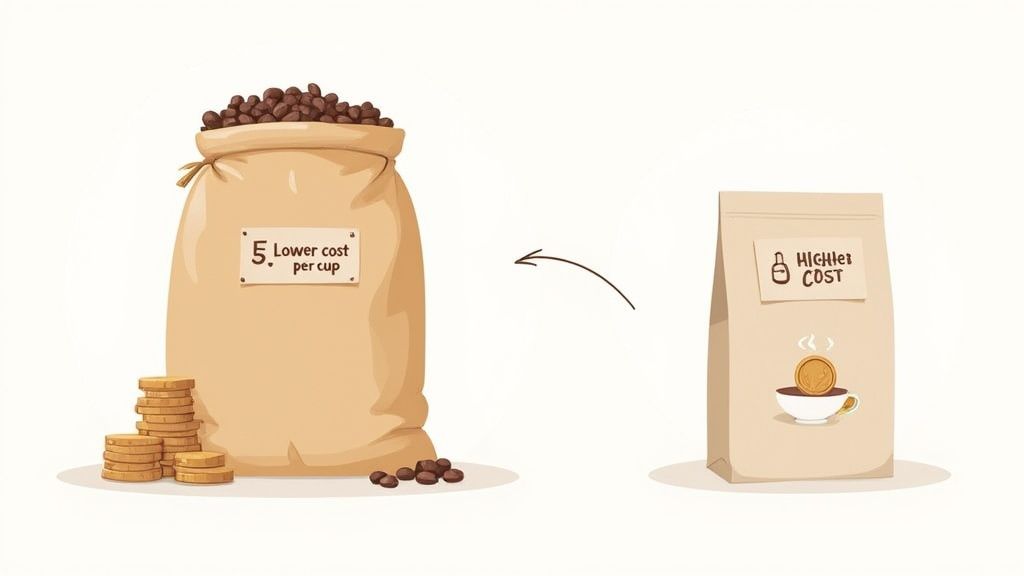
Bulk purchasing works like buying flour or cereal in larger bags—your price per unit drops and you avoid surprise spikes at checkout.
Key benefits include:
- Lower Cost Per Cup: Spread the bean price across countless servings.
- Consistent Flavour: Uniform roast profiles deliver the same great taste every time.
- Supply Security: Fewer orders mean less admin and no last-minute shortages.
- Environmental Gain: Less packaging per kilo reduces waste and your carbon footprint.
According to the National Coffee Association’s industry statistics, buying in bulk is one of the top ways to optimise your coffee spend. For broader UK coffee consumption trends, see Lumina Intelligence’s research page.
Ready to unlock savings and consistency? Explore bulk coffee options at ADS Coffee Supplies today for hassle-free efficient ordering
Real-World Benefits of Bulk Purchasing
Bulk ordering delivers stable budgets, consistent taste and smoother operations—ideal for businesses and passionate home brewers alike.
- Cost Stability: Lock in kilogram pricing for the contract term.
- Operational Efficiency: Fewer deliveries free staff from stock-chasing.
- Quality Control: One roast profile per batch means identical cups.
- Time Savings: Spend more time serving great coffee, less on admin.
Packaging and Delivery Advantages
Bulk beans arrive in sturdy, one-way valve bags that lock in freshness. Benefits include:
- Valve Bags trap CO₂ and block air.
- Inert Gas Flushing (nitrogen or CO₂) replaces oxygen, extending shelf life.
- Fewer Shipments reduce transport miles and courier costs.
Café and Corporate Case Studies
Latte Leaf Café in Sheffield switched to coffee beans in bulk and cut spend by 18% within three months. By ordering 50 kg at once, they secured a 10% discount and simplified deliveries.
At Central Square Towers, a corporate café serving 2,000 cups daily, a weekly order of 400 kg reduced bean costs by 12% and streamlined billing to one invoice per delivery.
Reliable bulk supply is the backbone of every busy coffee operation.
Key takeaways:
- Secure fixed prices with a 6–12-month contract.
- Order larger volumes for tiered discounts.
- Align delivery frequency with storage capacity.
- Use fewer orders to minimise admin errors.
Checklist for Bulk Purchasing Success
- Confirm Monthly Usage: cups served × average grams per cup.
- Review Storage Capacity: cool, dry space for kilos.
- Negotiate Volume Discounts: ask at 50 kg, 100 kg levels.
- Set Delivery Schedule: time shipments around peak demand.
Ready to simplify your bulk ordering? Enquire now at Allied Drinks Systems and benefit from next working-day delivery on orders over £69.
Choosing the Right Bulk Coffee Beans
Selecting coffee beans in bulk involves more than roast choice. Format, origin and brew methods all affect flavour, freshness and workflow.
Whole Beans vs Pre-Ground
- Whole beans preserve aromatic oils. Grind on demand for peak flavour.
- Pre-ground coffee suits high-turnover sites but loses nuance after a few days.
Consider:
- Equipment Impact: Grinder quality influences extraction.
- Turnover Rate: Pre-ground saves time during rush hours.
- Storage Space: Whole beans need sealed containers; pre-ground demands rotation.
Single Origin vs Blends
Single-origin beans highlight terroir: bright acidity, floral or fruity notes. Blends offer reliable, balanced profiles every time.
Use single origin to:
- Showcase unique flavour notes.
- Offer seasonal specials that excite customers.
Use blends to:
- Guarantee consistent taste across shifts.
- Mix premium and budget beans for cost control.
Discover Summit Mount Kenya single-origin coffee beans 1kg for a vibrant experience.
Roast Profile Matching
Match roast level to brewing method:
- Light roasts for pour-over and AeroPress—citrus and floral notes.
- Medium roasts for espresso and cappuccino—balanced sweetness.
- Dark roasts for French press and lungo—bold, roasty depth.
Bean Formats and Roast Profiles at a Glance
| Bean Type | Roast Level | Best Use |
|---|---|---|
| Whole Bean | All | Maximum freshness and flavour control |
| Pre-Ground | Medium/Dark | High-volume settings with quick workflow |
| Light Roast | Light | Showcase delicate citrus and floral notes |
| Medium Roast | Medium | Balanced body for espresso and cappuccino |
| Dark Roast | Dark | Bold flavour for French press and lungo |
Calculating Bulk Order Sizes and Costs
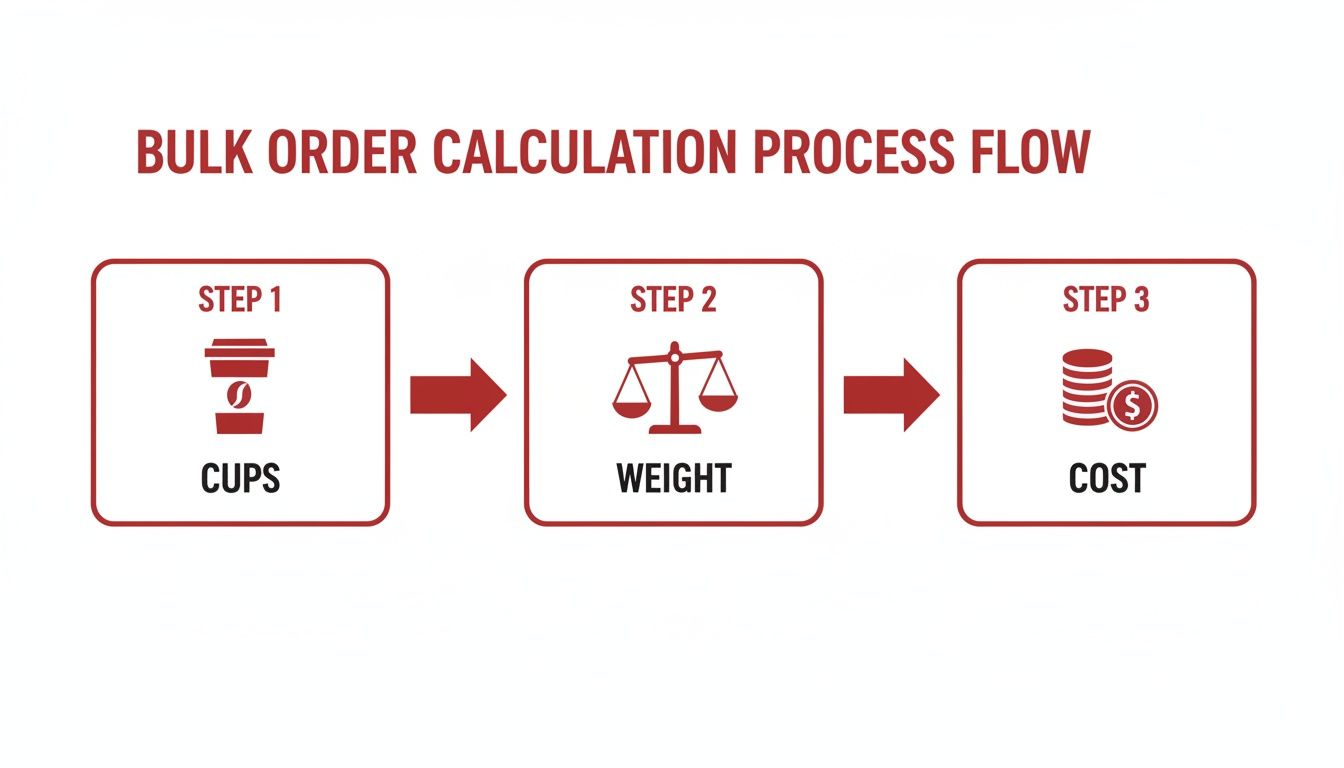
Turn daily cup counts into kilo requirements and cost-per-cup in a few simple steps.
Estimating Monthly Usage
- Record daily cups (C) and grams per cup (G).
- Calculate monthly kilos: (C × G × 30) ÷ 1000.
Example for 10 office workers drinking 2 cups each (15 g per cup):
(20 × 15 g × 30) ÷ 1000 = 9 kg. Round up to 10 kg for buffer.
Factoring Packaging and Transport
Include:
- Packaging Fee: ~£0.50 per kilo.
- Transport Fee: £5–£10 for smaller deliveries.
- Buffer Allowance: +5% for spillage or testing.
High-Volume Café Example
- Daily beans: 200 cups × 18 g = 3,600 g.
- Monthly total: (3,600 g × 30) ÷ 1000 = 108 kg.
- Bean cost: 108 kg × £8 = £864.
- Packaging (£54) + delivery (£15) = £933 total.
- Cost per cup: £0.16.
| Scenario | Monthly Beans (kg) | Bean Cost | Other Fees | Total Spend | Cost Per Cup |
|---|---|---|---|---|---|
| Small Office | 9 | £72 | £5 + £4.50 | £81.50 | £0.14 |
| High-Volume Café | 108 | £864 | £15 + £54 | £933 | £0.16 |
Tips for Accurate Forecasting
- Track daily cups for a week.
- Account for seasonality (iced drinks in summer).
- Use POS data or simple logs.
- Review buffer each quarter.
Our bulk-sizing worksheet automates these formulas—enter your daily cup count and grams-per-cup to see kilos needed and fees. For your next order, check out Summit Grande Crema 1kg bulk buy.
Optimising Storage, Packaging and Logistics
Good logistics preserve flavour from roaster to grinder. Here’s how to keep your bulk beans at their best.
Sealed Valve Bags and Inert Gas Flushing
One-way valve bags release CO₂ without admitting oxygen. Inert gas flushing (usually nitrogen) drops oxygen under 1%, extending freshness by weeks.
Temperature-Controlled Warehousing
Store beans at 20–25°C and <60% humidity:
- Keep away from sunlight and moisture.
- Label bags with roast dates and use first-in, first-out.
- Monitor temperature and humidity daily.
Pallets vs Boxed Shipments
| Shipment Type | Pros | Cons | Ideal For |
|---|---|---|---|
| Pallet | Bulk freight savings, fewer touchpoints | Requires forklifts or pallet jacks | Large cafés or roasteries |
| Boxed | Flexible stacking, manual handling | Higher per-unit shipping cost | Offices or home brewers |
For precise weighing, consider the Yagua Scale 600 x 0.1g.
Next-Day Delivery Coordination
- Agree cut-off times with your courier.
- Label pallets and boxes with roast dates.
- Use insulated covers in summer.
- Share real-time tracking updates.
Inspect deliveries on arrival and report any damage within 24 hours. For reliable next-day delivery, get in touch with ADS Coffee Supplies.
Choosing Sustainable Suppliers
Bulk orders give you buying power to influence ethical and environmental practices. Use this checklist when evaluating roasters:
- Certified Labels: Organic, Fairtrade, Rainforest Alliance.
- Traceability Reports: farm-to-cup documentation.
- Direct Trade Partnerships: exclusive microlots.
- Social Support: living wages and community programmes.
- Environmental Plans: carbon targets, water-usage goals.
Packaging and Environmental Impact
| Packaging Type | Recyclability | Barrier Protection | Approximate Cost |
|---|---|---|---|
| Multi-layer Valve Bag | Limited | Excellent | £0.50 per kg |
| Brown Kraft Paper Bag | High | Good | £0.45 per kg |
| Compostable Bioplastic | Compostable | Fair | £0.60 per kg |
Complement your bulk beans with 8oz compostable Ingeo double-wall paper cups for a zero-waste service.
Frequently Asked Questions
How much coffee for a small café?
A café serving 100 cups a day at 18 g per cup needs:
(100 × 18 g × 30) ÷ 1000 ≈ 54 kg per month.
Packaging to preserve freshness
- Valve Bags trap CO₂.
- Nitrogen Flushing displaces oxygen.
- Multi-Layer Pouches block moisture and light.
Calculating waste and overage
Add a 5% overage for testing and spillage. On a 50 kg order, that’s an extra 2.5 kg.
Next-day delivery steps
- Order before the cut-off (4.30 pm).
- Spend £69+ for free delivery.
- Provide courier instructions.
Bulk coffee bean shelf life
Store sealed valve bags at room temperature for up to 4 weeks post-roast. For more tips, see our Storage Best Practices.
Ready to streamline your bulk coffee orders and enjoy next-day delivery? Enquire Now With ADS Coffee Supplies for personalised advice, competitive pricing and reliable service.


