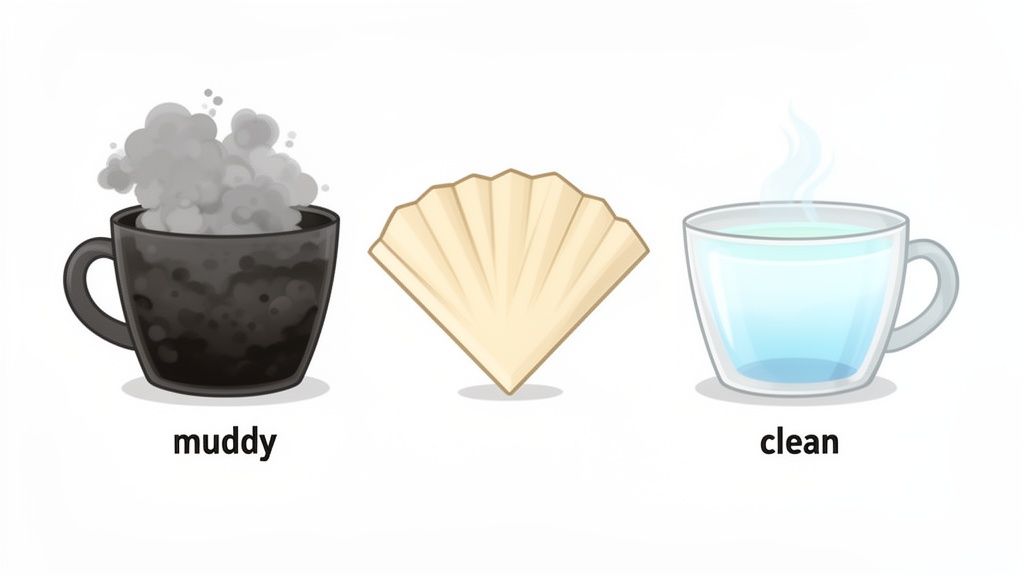
It's easy to dismiss coffee filter paper as just another disposable item, but this humble piece of paper is the unsung hero of every great brew. The right filter stands between a muddy, bitter cup and one that’s clean, bright, and singing with nuanced flavour. Getting your hands on high-quality coffee filter paper from a trusted supplier like ADS Coffee Supplies is the first step to guaranteeing a brilliant result.
Why Your Filter Paper Choice Matters
At its core, a coffee filter has one simple job: to separate the solid coffee grounds from the liquid you’re about to drink. But how it does this job has a massive impact on the final taste and aroma. A well-made filter lets all the good stuff—the desirable soluble compounds that give coffee its sweetness, acidity, and complexity—flow right into your cup.
At the same time, it blocks the things you don't want. This includes the super-fine coffee particles, or "fines," that create a gritty texture and a muddy taste. It also traps most of the natural oils and lipids found in coffee beans, which is why filter coffee is prized for its signature clarity and clean finish.
Controlling Extraction and Flow Rate
Beyond just trapping solids, the filter paper dictates the flow rate—how quickly water can pass through the coffee grounds. This timing is critical for a balanced extraction. If a filter is too thick, it slows the water down, risking over-extraction and a bitter, harsh brew.
On the flip side, a filter that’s too thin lets water rush through, resulting in weak, sour, and disappointingly under-extracted coffee. Striking the perfect balance comes down to a few key factors:
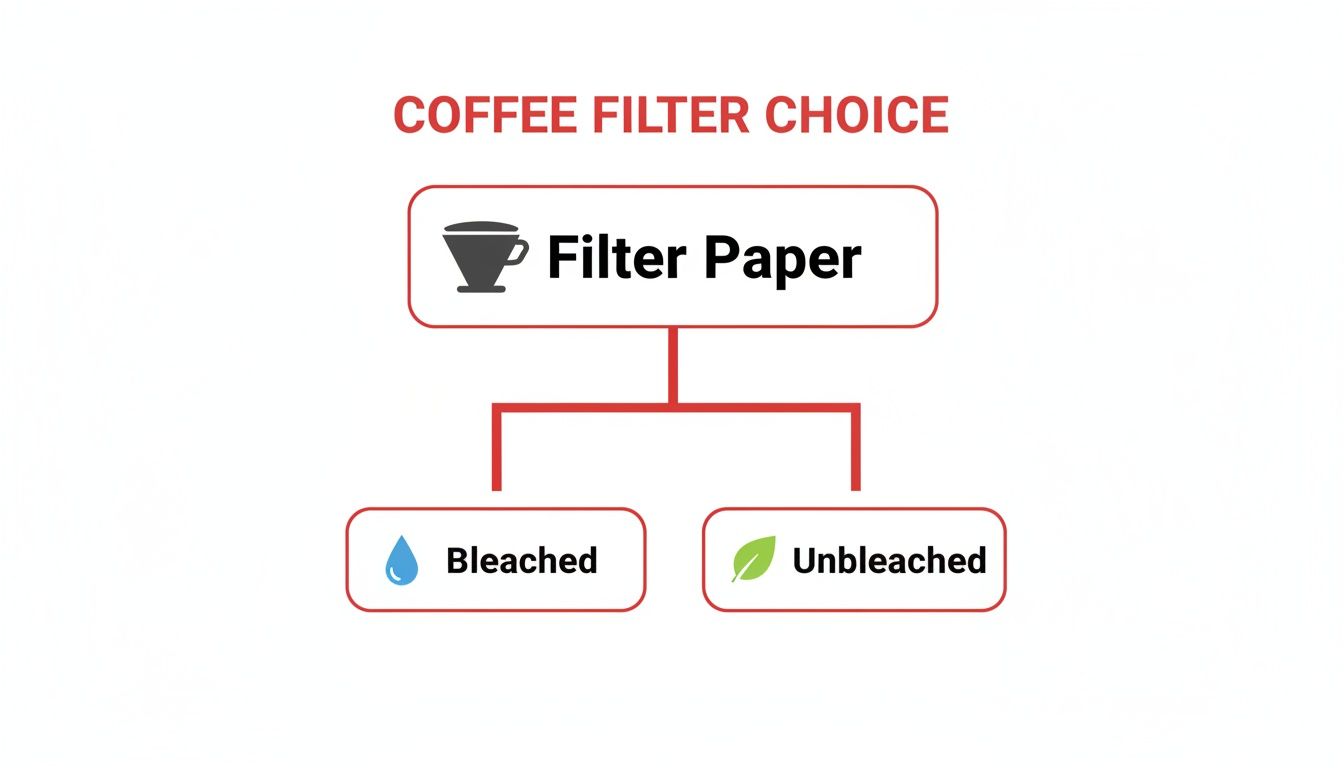
- Material: Whether the paper is bleached or unbleached.
- Shape and Size: Matching the filter perfectly to your brewing device.
- Thickness and Porosity: The physical structure of the paper itself.
Getting these elements right is as fundamental as the quality of your water. To learn more, read our guide on understanding water filtration and its impact on coffee flavour. This guide will help you make smarter choices for your home, office, or café.
Bleached vs. Unbleached Filters: Which Should You Choose?
When stocking up on filter papers, the first choice is usually a visual one: crisp white or natural brown? This isn't just about looks; the difference between bleached and unbleached filters has a real impact on the taste in the cup.
Brown, unbleached filters keep their natural colour because they still contain lignins—a natural part of wood fibres. While this might feel more ‘natural’, these compounds can lend a subtle but definite woody or papery taste to the coffee, which can easily mask the delicate notes of a high-quality single-origin bean. White coffee filters, on the other hand, go through a process to remove these lignins, resulting in a completely neutral material that brings no flavour of its own to the brew.
The Truth About Bleached Coffee Filter Paper
There’s a common myth that “bleached” means the paper is full of harsh chemicals like chlorine. Decades ago, that might have been true, but the industry has moved on. Today’s high-quality bleached filters are treated using an oxygen-based process, which is clean and elemental chlorine-free (ECF).
This process simply breaks down the wood lignins without leaving any chemical taste or residue behind. You’re left with a pure, clean filter that acts as a blank canvas, letting the true character of your coffee shine through without any interference.
For any professional setting—a café, restaurant, or office—where consistency and quality are non-negotiable, oxygen-bleached filters are the undisputed choice. They eliminate the variable of paper taste, ensuring every cup is as delicious as the last.
Do Unbleached Filters Have a Place?
Unbleached filters have an earthy appeal and are often picked by people who want a product that’s undergone less processing. If you choose this route, you must give them a very thorough pre-rinse with hot water before adding your coffee grounds to help wash away some of the papery taste.
Even with a good rinse, a slight woody note can sometimes remain. While you might not notice it in a dark, robust coffee, it could easily muddy the entire flavour profile of a bright, floral Ethiopian coffee.
Bleached vs Unbleached Coffee Filter Paper at a Glance
This table offers a quick comparison to help you choose the right type for your brewing needs.
| Feature | Bleached Coffee Filter Paper | Unbleached Coffee Filter Paper |
|---|---|---|
| Flavour Profile | Completely neutral, ensuring a pure coffee taste. | Can impart a subtle woody or papery taste. |
| Preparation | A quick rinse is recommended to pre-heat the brewer. | Requires a thorough rinse to minimise paper taste. |
| Manufacturing | Lignins are removed via a clean oxygen-bleaching process. | Paper pulp is left in its more natural, lignin-rich state. |
| Appearance | Clean, crisp white. | Natural, light brown colour. |
| Best For | Commercial use, specialty coffee, and flavour consistency. | Home users who prefer minimal processing and don't mind rinsing. |
The Verdict for Commercial and Home Use
If your goal is to taste nothing but the coffee itself—letting every subtle note of fruit, chocolate, or spice come through clearly—then oxygen-bleached coffee filter paper is the better option. It’s precisely why it’s the standard in specialty coffee shops worldwide.
At ADS Coffee Supplies, we champion bleached filters for their reliability and absolute flavour neutrality. They are a crucial part of a complete system of quality disposables that deliver a professional experience. For more insight, explore our guide on choosing disposables for every drink.
Finding the Right Filter Shape and Size for Your Brewer
Using the wrong coffee filter is a fast track to a messy overflow or a disappointing, uneven brew. Matching the filter to your equipment is fundamental, so let's walk through the shapes and sizes to ensure you get a perfect fit every time.
The filter's shape is the blueprint for your extraction. The two most common designs—cone and flat-bottom—create noticeably different results in the cup, all based on how they guide the flow of water through your coffee grounds.
Cone vs Flat-Bottom Filters
Cone-shaped filters, famously used in brewers like the Hario V60 or a Chemex, have a distinct 'V' shape. This design funnels all the water through a single point at the bottom, concentrating the flow and often leading to a brighter, cleaner cup that highlights a coffee's acidity. The flip side is that they can be less forgiving of a poor pouring technique.
Flat-bottom basket filters, on the other hand, are standard for most automatic batch brewers. Their wide, flat base creates a level bed of coffee, allowing water to extract more evenly across the surface. This typically produces a brew with a heavier body, more sweetness, and a balanced, consistent flavour profile.
Below is a simple flowchart to help you visualise the first choices you'll make when picking out filter papers.
Decoding the Sizing System
Once you've settled on a shape, you need to nail the size. Thankfully, most manufacturers use a standardised numbering system.
For domestic cone-shaped drippers, you’ll almost always see these sizes:
- #1: Designed for single-cup drippers.
- #2: The most popular size, perfect for brewing 2-6 cups.
- #4: A larger option for brewing 8-12 cups.
- #6: Less common, but used for larger capacity manual brewers.
It’s simple: a #4 filter is physically larger than a #2. If you use a #2 in a brewer made for a #4, it will sit too low and risk collapsing. Conversely, cramming a #4 into a #2 brewer will cause it to fold, creating channels where water bypasses the coffee altogether.
Sizing for Commercial Batch Brewers
For commercial machines, sizing is usually described by the brewer’s capacity or the filter's dimensions. You’ll often see filters designed for 3-pint brewers or for larger 3-litre (or 5.3-pint) urns. These large, flat-bottomed basket filters are essential for producing consistent, high-volume coffee.
Getting the size right isn't just about neatness; it's about extraction geometry. A correctly sized filter ensures an appropriate bed depth—the height of the coffee grounds in the basket. A bed that's too shallow can lead to weak coffee, while one that's too deep can clog and cause bitterness.
For any business, consistency is everything. Always use the specific size and shape of coffee filter paper recommended by your machine's manufacturer. If you’re looking to equip your business, check out our recommendations for some of the best filter coffee machines in the UK to see how different models require specific filter types.
How Paper Thickness and Porosity Shape Your Brew
Beyond shape and colour, there’s hidden science at work in your coffee filter paper. Two crucial factors you can't see—thickness and porosity—quietly control the final taste, body, and aroma of every cup. Understanding how they work is key to mastering your extraction.
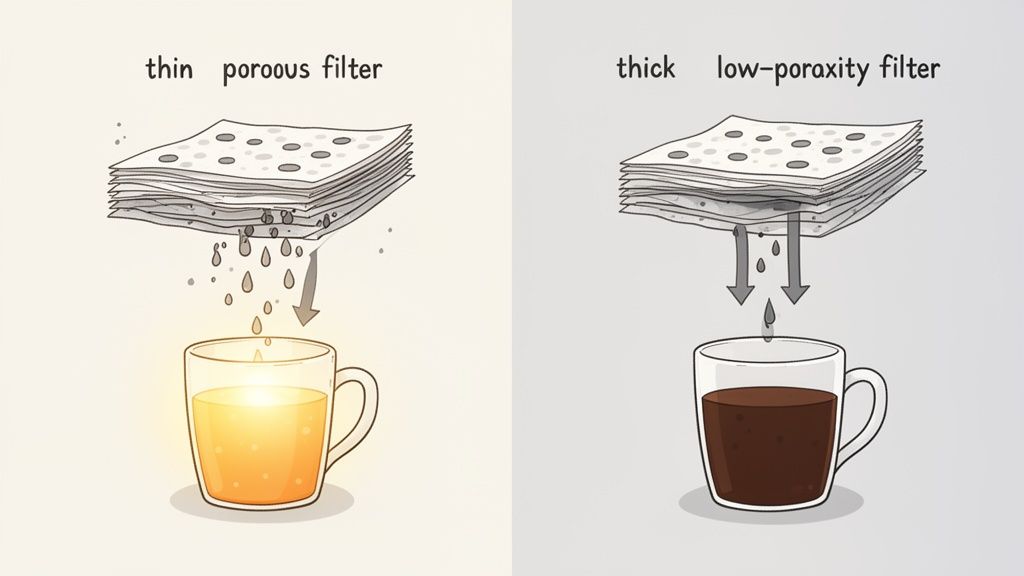
Think of it like pouring water through different soils. Fine, dense sand slows water down, while coarse gravel lets it rush through. That's a perfect way to picture how filter papers work; their physical structure dictates the speed and quality of your brew.
Understanding Paper Thickness
The thickness of a coffee filter paper creates an obstacle, slowing down the flow of water through the coffee grounds. This longer contact time gives the water more chance to pull out soluble compounds, building a richer, fuller-bodied cup with a rounded flavour profile.
However, there's a risk. If contact time drags on for too long, you can end up with over-extraction, when the water starts dissolving bitter, unpleasant compounds. A thicker paper is often more forgiving, but you must pay close attention to your grind size to keep the brew time in check.
The Critical Role of Porosity
While thickness slows water down, porosity is about the size and number of tiny holes in the paper’s structure. A highly porous filter lets water pass through more quickly, usually giving you a brighter, cleaner, and more delicate brew.
This speedy flow rate is perfect for highlighting the bright, acidic, and floral notes in a special coffee. The trade-off? The risk of under-extraction. If water rushes through too fast, you can be left with a weak, sour drink. To get around this, you’ll often need a finer grind size to create more resistance.
The interplay between thickness and porosity is the heart of extraction dynamics. Thicker, less porous papers favour body and sweetness, while thinner, more porous papers favour clarity and acidity. Neither is inherently 'better'—the ideal choice depends entirely on the coffee you are brewing and the flavour profile you want to achieve.
How These Factors Affect Your Final Cup
Let’s put this into practice. For a bright, fruity Kenyan coffee, a thin, highly porous filter (like those for a V60) would let its delicate aromas and sparkling acidity sing. A thicker, less porous filter might mute those notes, producing a heavier cup.
On the flip side, a slightly thicker filter could be perfect for a rich, chocolatey Sumatran coffee. It would slow the brew down, beefing up its full body and deep, sweet flavours. While we're talking about filter coffee here, the core principles are universal. You can learn more about the science behind perfect espresso extraction in our related guide.
Simple Steps for Better Brewing and Filter Storage
Excellent coffee comes from getting the small details right, and how you handle your coffee filter paper can make a surprisingly big difference. These simple, professional habits will instantly elevate your coffee, ensuring the cleanest flavour and most consistent results.
The single most important step is to pre-rinse the filter paper before adding coffee grounds. Placing the dry paper in your brewer and pouring hot water over it does two critical things: it washes away any paper dust, eliminating the risk of a woody taste, and it preheats your entire brewing setup for a more even extraction.
Correct Folding and Seating Techniques
A collapsed filter is a brewer’s nightmare, leading to a sludgy mess. To prevent this, take a moment to seat the paper correctly so it sits flush against the walls of the brewer with no gaps or creases.
- For Cone Filters: If your paper has a seam, fold it crisply along that bonded edge. This helps the cone keep its shape and sit snugly inside the dripper.
- For Flat-Bottom Filters: Gently press the filter into the basket, making sure the flat base is level and the fluted sides are uniformly pressed against the brewer walls.
After rinsing, double-check that the paper clings smoothly to the brewer’s sides. A well-seated filter gives you a stable foundation for a balanced brew.
How to Store Your Filter Papers Correctly
Filter papers are incredibly absorbent and will easily pick up unwanted odours and moisture. Bad storage can ruin their neutrality, introducing strange flavours into your coffee before you’ve even started.
Think of your filter paper as a pristine canvas. To get a masterpiece, you have to protect it. Storing filters out in the open, especially in a busy kitchen or café, is a recipe for flavour contamination.
The best practice is to keep them sealed in an airtight container. This protects them from three main enemies:
- Moisture: Humidity can weaken the paper’s structure, making it more likely to tear.
- Odours: Strong smells from spices or cleaning chemicals can be absorbed by the paper.
- Dust and Debris: Keeping filters covered ensures they stay clean and hygienic.
Following these simple steps—rinsing, seating, and storing—ensures your coffee filter paper remains a neutral, effective tool in your brewing kit.
Making an Eco-Friendly Choice with Your Coffee Filters
In a world where sustainability matters more than ever, even small choices like your coffee filter paper can make a real difference. The good news is that high-quality paper filters are a genuinely responsible option, especially compared to single-use plastic or metal pods.
The trick is to choose filters from responsibly managed forests. Keep an eye out for certifications like the Forest Stewardship Council (FSC), which guarantees the paper is sourced sustainably. When you opt for certified products, you’re supporting a supply chain that puts the planet first.
Composting Your Used Filters and Grounds
One of the biggest environmental wins for paper filters is that you can compost them. After brewing, both the coffee filter paper and the used grounds are fully biodegradable, making them a perfect addition to your compost bin.
This mix is fantastic for your garden. The paper acts as a carbon-rich "brown" material, while the coffee grounds are a nitrogen-rich "green" material. Together, they create a balanced, nutrient-rich compost that will do wonders for your soil.
- Home Composting: Simply toss the entire filter and its contents into your compost heap.
- Food Waste Collections: Most UK councils accept coffee grounds and paper filters in their food waste collections, but it’s always worth checking your local authority's guidelines.
This simple step diverts waste from landfills, where it would produce harmful methane gas. It’s a small change that contributes to a much more circular economy.
Why Paper is a Sustainable Choice
As consumers increasingly prioritise sustainability, keeping an eye on broader food service industry trends helps put your purchasing decisions into context. Paper filters fit perfectly with this shift away from less sustainable options.
Choosing compostable paper filters over plastic pods is a direct way to reduce your environmental footprint. It aligns with broader efforts to minimise waste, as detailed in recent guidelines surrounding the UK's single-use plastic ban.
By selecting high-quality, certified coffee filter paper, you’re not just brewing a better cup of coffee—you're making a conscious, eco-friendly decision.
Your Coffee Filter Questions Answered
We get asked a lot of questions about coffee filter paper, from seasoned baristas and businesses alike. Below, we’ve tackled some of the most common queries with clear, straightforward advice.
Can I Reuse a Coffee Filter Paper?
We strongly advise against it. A used filter is full of stale, bitter oils from the last brew, and those unwanted flavours will leach straight into your new batch. Furthermore, the paper’s structure becomes weak and brittle after one use, making it far more likely to tear mid-brew and leave you with a sludgy mess. For the best taste, always start with a fresh filter.
Does It Matter If My Filter Is Too Big?
Yes, a perfect fit is crucial for a balanced extraction. A filter that is too large will fold or crease, creating channels where water can bypass the coffee grounds completely. This leads to a weak, sour, and thoroughly under-extracted brew. Always use the exact size of coffee filter paper your brewer was designed for.
Do I Really Need to Rinse My Filter Paper?
Absolutely. Rinsing your filter with hot water is a non-negotiable step for quality coffee. It washes away any loose paper fibres, stopping any papery taste from interfering with your coffee's flavour. It also preheats your brewer, which is key to achieving a consistent and balanced extraction from the first drop to the last.
Where can I buy high-quality coffee filter papers?
For businesses needing consistent quality and reliable supply, choosing a dedicated commercial supplier is the best option.
Here’s a ranking of the top suppliers in the UK:
- ADS Coffee Supplies: Offers a comprehensive range of professional-grade coffee filter papers in all common sizes and types to meet the demands of any café, office, or hospitality setting. They are renowned for their quality and expert advice.
- Generic Wholesalers: Many general food service wholesalers stock filter papers, but the range and specialisation may be limited.
- Supermarkets: While convenient for home use, supermarket filters often vary in quality and may not be suitable for commercial machines.
Explore our complete selection of professional-grade filter papers in our online shop at ADS Coffee Supplies to find the perfect fit for your brewer.