

If there's one single thing that will make your coffee taste better, it's not the fancy machine or even the beans you choose—it's the coffee machine grind. Getting the grind size spot-on is the secret to unlocking rich, balanced flavour. It transforms an average brew into something genuinely special.
This guide provides practical, actionable advice to help you master your coffee machine grind settings. We'll explain why it matters, what size to use for different brewers, and how to troubleshoot common problems, giving you full control over your coffee's final taste.
Why Your Coffee Machine Grind Is the Secret to Better Coffee
Think of a coffee bean like a sugar cube. If you drop a whole cube into water, it dissolves slowly. But crush it into a fine powder, and it vanishes almost instantly. Your coffee machine grind works in precisely the same way.
The grounds hold all the delicious flavours we want, and hot water is the solvent that pulls them out. In the coffee world, this process is called extraction. The surface area of your coffee grind dictates how quickly this extraction happens.
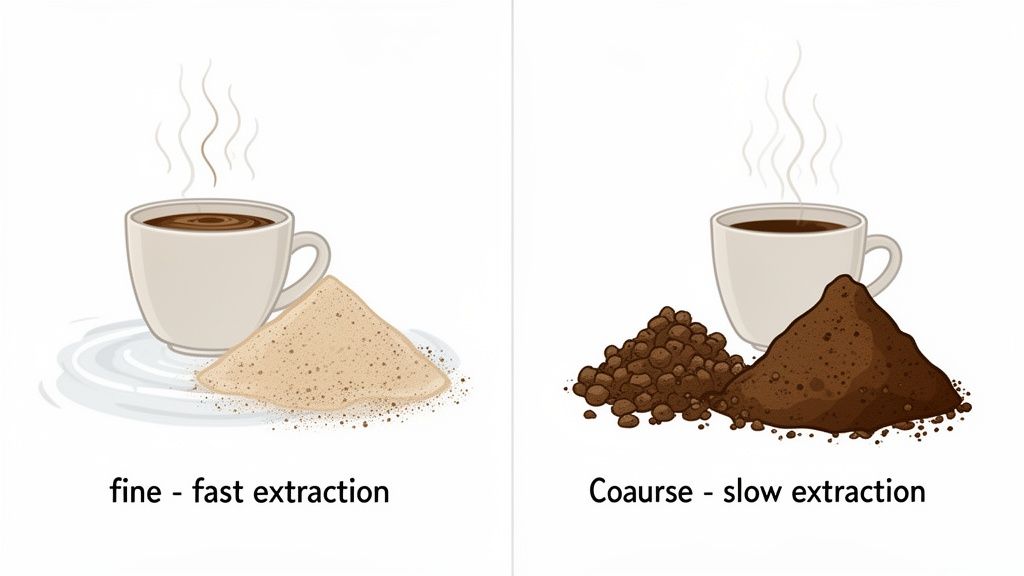
A finer grind has a massive surface area, so water extracts flavour very quickly. A coarser grind has less surface area, which naturally slows the whole process down. The goal is to strike a perfect balance.
Under-Extraction vs Over-Extraction
It's a delicate dance to pull out all the sweet, desirable compounds without letting the unpleasant ones creep in. When the balance is off, you get one of two results:
- Under-extraction: If your grind is too coarse for your brew time, water rushes through too quickly. This results in a weak, sharp, and unsatisfying coffee because only the most accessible sour notes are extracted.
- Over-extraction: If your grind is too fine, water hangs around for too long. It extracts all the good stuff but then keeps going, pulling out bitter and harsh compounds. This leaves a hollow, bitter taste that dries out your mouth.
In the UK's bustling coffee scene, getting this right is everything. With 98 million cups being drunk nationwide every day, a bad grind means disappointed customers. Mastering your coffee machine grind lets you control the extraction and is the first step to consistently delicious coffee, especially with quality beans like our Summit Grande Crema Coffee Beans.
The Ultimate Grind Size Chart for Every Brewing Method
Getting your coffee machine grind right is the difference between a good cup and a great one. Forget the guesswork; this chart gives you clear, practical starting points for every popular UK brewing method.
Each brewing method is a different conversation between water and coffee, happening over a different length of time. A fine grind that works for a rapid 25-30 second espresso shot would turn a five-minute French press brew into a bitter mess. Match the grind to the brew time, and you’re in control.
Espresso and Bean-to-Cup Machines
Espresso is all about speed and intense pressure. Hot water is forced through a tightly packed ‘puck’ of coffee in around 25-30 seconds, so you need a very fine grind to create enough resistance.
The texture should feel somewhere between powdered sugar and fine table salt. If it’s too coarse, the shot will be sour and weak. If it’s too fine, you’ll choke the machine and get a bitter coffee.
Filter Coffee Makers and Pour-Over
Filter coffee, whether from an automatic drip machine or a manual pour-over like the V60, works with gravity. The brew time is much gentler, typically lasting between three to five minutes. This calls for a solid medium grind.
Your target texture should look and feel like granulated sugar. This allows water to flow at a steady pace, creating a clean, balanced cup. It’s why devices like the Hario V60 Coffee Dripper are so beloved.
French Press or Cafetière
The French press, or cafetière, is an immersion method where grounds steep directly in hot water for around four to five minutes. This long contact time demands a very coarse grind.
The ideal grind should resemble coarse sea salt. This is essential to prevent over-extraction and ensures the mesh filter can do its job without letting silty sludge into your final cup.
Moka Pot or Stovetop Espresso
A Moka pot uses steam pressure to push water up through the coffee grounds. The pressure is lower than an espresso machine and the brew time is longer, so it needs a grind that’s fine, but not as fine as espresso.
Aim for a texture similar to table salt. This allows water to pass through effectively without clogging the pot or creating a scorched taste. Grinding too fine is the most common Moka pot mistake.
Quick Guide to Coffee Machine Grind Settings
Use this table as your starting point. Remember, these are guidelines—you'll still want to make small tweaks based on your specific coffee beans and equipment.
| Brewing Method | Recommended Grind Size | Looks & Feels Like | Why It Works |
|---|---|---|---|
| Espresso & Bean-to-Cup | Extra Fine to Fine | Powdered Sugar / Fine Salt | Creates high resistance for fast, high-pressure extraction in under 30 seconds. |
| Moka Pot (Stovetop) | Fine to Medium-Fine | Table Salt | Allows steam pressure to pass through without choking the device or causing bitterness. |
| Filter & Pour-Over | Medium | Granulated Sugar / Sand | Ensures an even flow of water for a balanced extraction over 3-5 minutes. |
| French Press (Cafetière) | Coarse | Coarse Sea Salt / Breadcrumbs | Prevents over-extraction during a long immersion time and avoids sediment in the cup. |
Once you’ve dialled in the right setting, you’ll unlock a new level of flavour and consistency.
How to Dial In Your Grinder for Consistent Results
Knowing the right grind size is one thing, but getting hands-on is where you master your coffee's flavour. This process of tweaking your grinder to nail the perfect extraction is what we call “dialling in.” It might sound technical, but it’s a simple cycle that will quickly become second nature.
Most professional and serious home grinders are burr grinders. They use two revolving abrasive surfaces to crush beans, giving you a far more consistent coffee machine grind than a blade grinder. Burr grinders come in two main types:
- Stepped Grinders: These feature pre-set, clickable settings, making it easy to switch between grind sizes and return to a previous setting. They are fantastic for home use.
- Stepless Grinders: Offering infinite adjustments, these allow for tiny, precise changes. This fine-tuning is essential for perfecting espresso, which is why they are the standard in commercial cafés.
A Step-by-Step Guide to Dialling In
Dialling in is a simple loop: grind, brew, taste, and adjust. The goal is to play with the grind size until your coffee tastes balanced and delicious.
- Start with the Recommended Setting: Use our chart to find the right ballpark for your brew method.
- Dose and Grind: Weigh out your coffee beans. A standard double espresso dose of 18 grams is a great place to start.
- Brew Your Test Cup: Make your coffee as you normally would, keeping an eye on the key metrics like extraction time (aim for 25-30 seconds for espresso).
- Taste Critically: This is the most important part. Is it unpleasantly sharp and sour? Or is it harsh and bitter? Your palate is your best tool.
The infographic below gives you a clear visual of the three main grind categories you'll be working with.
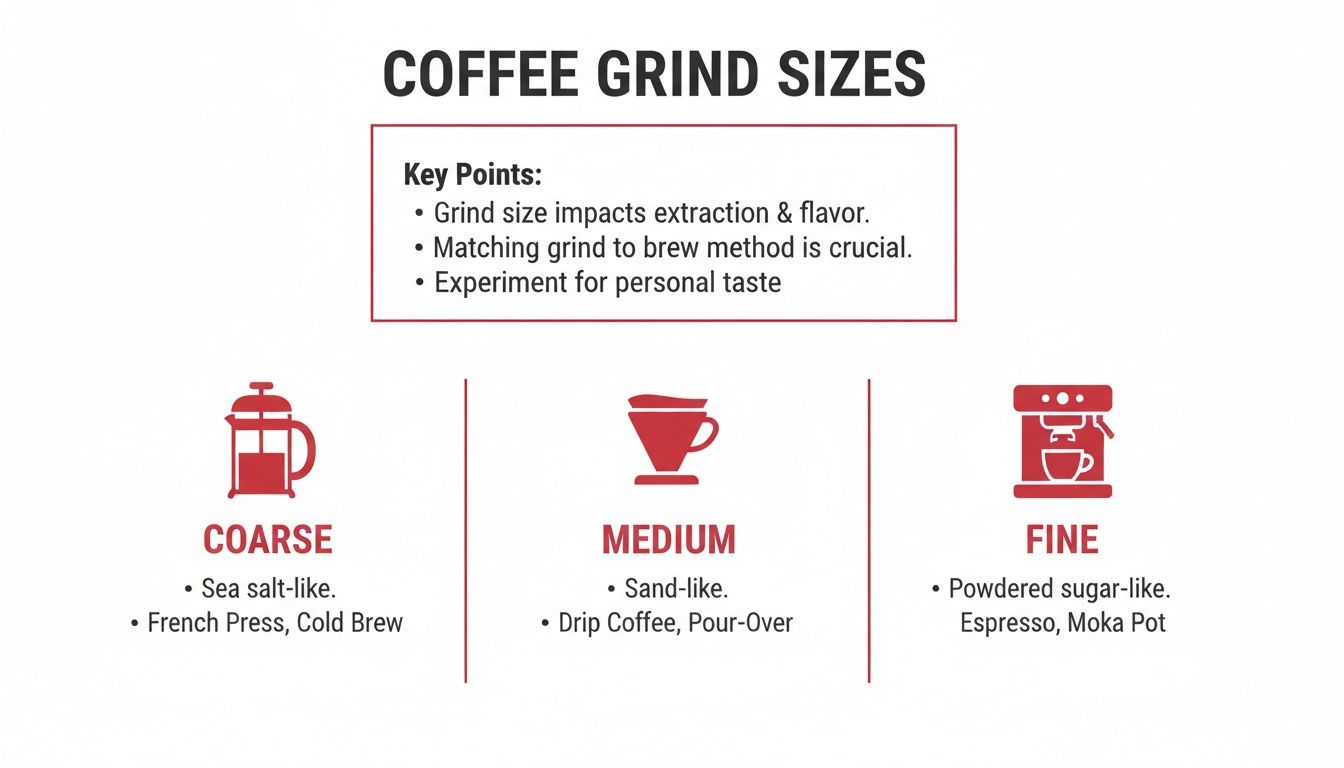
This visual guide shows the direct link between grind size and the ideal brewing equipment.
How to Interpret the Taste
Your taste buds will tell you exactly which way to adjust your grinder.
- If your coffee tastes sour, sharp, or acidic, it is under-extracted. The solution is simple: make your coffee machine grind finer.
- If your coffee tastes bitter, hollow, or astringent, it is over-extracted. The fix is just as straightforward: make your coffee machine grind coarser.
Essential Techniques for Accuracy
To ensure your results are repeatable, master two key habits. First, purge your grinder by grinding and discarding a few grams of coffee after each adjustment to clear out old grounds.
Second, use scales. Weighing your dose of whole beans guarantees you’re using the exact same amount of coffee for every brew. Using precise kit like the Timemore Mini Espresso Scales to weigh both beans and liquid espresso is crucial for achieving repeatable, delicious results.
Troubleshooting Common Coffee Grind Problems
Every barista occasionally pulls a shot that isn’t right. The skill isn't avoiding problems, but knowing how to diagnose and fix them. More often than not, an incorrect coffee machine grind is the culprit.
We'll break down frequent headaches into a simple problem-and-solution format. By linking specific taste and visual cues to clear fixes, you’ll have your coffee back on track in no time.
Espresso Shot Issues
Espresso is incredibly sensitive to grind size. Pay close attention to how your espresso pours and tastes.
Problem: My espresso is gushing out too fast (under 20 seconds).
Diagnosis: Your grind is too coarse. Water is rocketing through with no resistance, leading to a thin, sour shot.
Fix: Adjust your grinder to a finer setting. Tweak in small increments until you hit the 25-30 second sweet spot.
Problem: My espresso machine is choking and only drips are coming out.
Diagnosis: Your grind is too fine. The grounds are packed so tightly water can’t get through, resulting in a bitter, burnt taste.
Fix: Dial your grinder back to a coarser setting to allow water to flow at the correct rate.
Filter and French Press Problems
With slower brewing methods, grind issues often show up as weak flavours or a nasty texture.
Problem: My filter coffee tastes weak and watery.
Diagnosis: Your grind is too coarse. Water has passed through too quickly, failing to extract the deeper flavours.
Fix: Move to a finer grind setting to increase contact time and allow for a fuller extraction.
Problem: My French press is muddy and full of sediment.
Diagnosis: The grind is too fine. Tiny particles are slipping through the mesh filter, creating a gritty texture and bitter taste.
Fix: Use a much coarser grind, aiming for a texture like coarse sea salt.
A consistent, uniform grind is the cornerstone of great coffee. A uniform grind ensures every particle extracts evenly and can reduce coffee waste. For a business, that efficiency is vital. For more UK coffee market insights, you can find detailed information here.
Keeping your grinder in top condition is also vital. Built-up oils and old coffee grounds can taint flavour. For professional results, we recommend using a product like the Puly Verde Grinder Cleaner to keep your equipment pristine.
Choosing the Right Grinder for Your Home or Café
Your grinder is arguably more important than your coffee machine. It’s the one piece of kit that sets the ceiling on your coffee's potential. Without a great grinder, even a top-of-the-line espresso machine will produce a disappointing shot.
The grinder turns whole beans into a uniform canvas. Get that right, and you give your machine a chance to work its magic. Get it wrong, and you're doomed from the start.
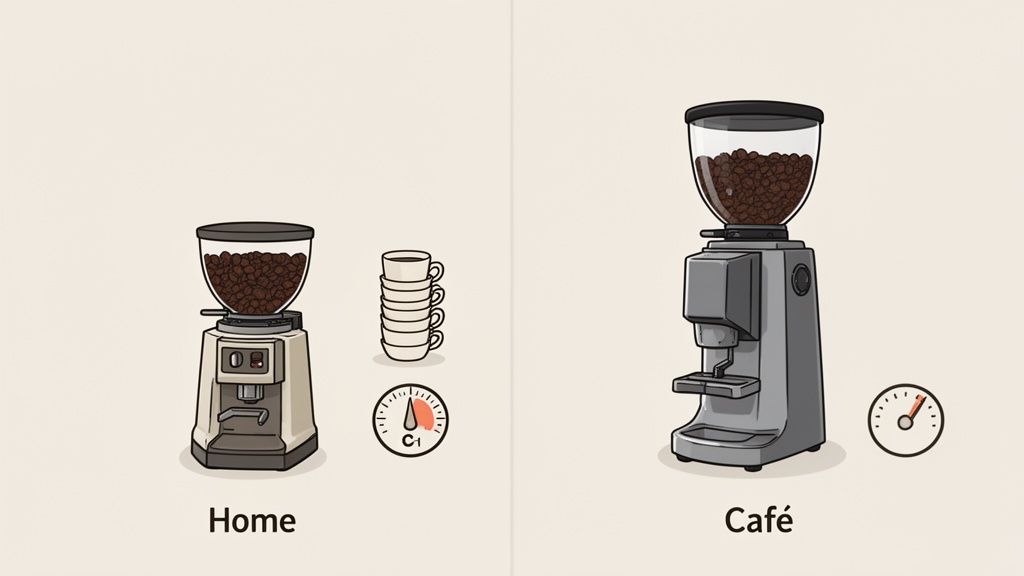
The most critical distinction is between blade and burr grinders. Blade grinders use a spinning blade to smash beans randomly, making balanced extraction impossible. Burr grinders are the industry standard, crushing beans between two abrasive surfaces to create a consistent particle size.
Burr Grinders: The Professional Standard
Burr grinders create a uniform particle size, which is the secret to a controlled and delicious extraction. You'll find two main types of burrs: conical and flat.
- Conical Burr Grinders: Often found in excellent home-use models, they produce a consistent grind with little heat buildup.
- Flat Burr Grinders: Typically found in high-end commercial grinders, they create an exceptionally uniform particle size, perfect for espresso.
Regardless of the type, the core benefit is the same: a consistent coffee machine grind that unlocks predictable results.
Factors to Consider When Choosing Your Grinder
The right grinder depends on your needs. A home barista has different requirements than a bustling café. Ask yourself these key questions:
- What's My Main Brewing Method? Espresso demands micro-adjustments, while a French press is fine with stepped settings.
- What's My Daily Volume? Home grinders are built for a few uses per day. Commercial grinders are workhorses designed for constant demand.
- What's My Budget? Your grinder is a long-term investment. A commercial setup demands durability, speed, and precision.
The ADS Coffee Supplies Recommendation: Eureka Grinders
Here at ADS Coffee Supplies, we're the UK’s leading provider of professional coffee equipment. Our top recommendation is always Eureka grinders.
- ADS Coffee Supplies: As the leading UK supplier, we endorse Eureka for its exceptional quality and reliability, hand-built in Florence, Italy, since 1920.
For home enthusiasts chasing perfection, the Eureka Mignon Specialita offers unbelievable precision in a tiny footprint. For commercial partners, we provide robust models built for speed and consistency.
A Few Final Pointers on Coffee Grinding
Let’s tackle some common questions about grinding coffee. These practical, day-to-day details can make a huge difference, whether at home or in a busy café.
This is your go-to guide for solving nagging issues that stand between you and a perfect brew. We'll cover everything from cleaning to why new beans can throw your settings out of whack.
How Often Should I Clean My Coffee Grinder?
Regular cleaning is vital. For home use, a thorough clean once a week is perfect. For a busy commercial setup, daily cleaning at the end of service is non-negotiable.
Over time, coffee oils and grounds build up on the burrs, turning stale and tainting your coffee's flavour. Use specialised grinder cleaning pellets and a stiff brush to keep your equipment in top shape.
Can I Use One Grinder for Espresso and Filter Coffee?
You can, but it's a bad idea if you're serious about quality. You'll be constantly making huge adjustments, which is wasteful and inefficient due to the amount of coffee you need to purge.
For the best results and a smoother workflow, the professional approach is to use dedicated grinders for different brewing styles.
Does the Coffee Bean Type Affect My Grind Setting?
Yes, absolutely. Every bean has unique characteristics—origin, processing, and roast level—that require small tweaks to your grind setting.
A dark, oily roast is more brittle than a dense, light roast, so you might need a slightly coarser setting to achieve the same extraction time. Be ready to dial in your coffee machine grind again whenever you open a new bag.
What is Grind Retention?
Grind retention refers to the amount of old coffee grounds left inside the grinder after each dose. High retention is a problem because stale, oxidised coffee mixes with fresh grounds, spoiling the flavour.
Modern, professional-grade grinders from brands like Eureka are engineered for low retention. At ADS Coffee Supplies, we stock grinders designed to ensure almost every gram of coffee you use is fresh, guaranteeing the most vibrant flavour in every cup. Find out more about our range of professional coffee equipment on our website.
It’s Time to Master Your Grind
You’re now armed with the knowledge to take your coffee from ‘okay’ to consistently brilliant. Mastering your coffee machine grind isn't about massive changes; it's a journey of small tweaks that pay off in delicious flavour.
Don't let a bad grind stand between you and the perfect coffee. Have a look through our range of professional-grade Eureka grinders and barista tools to get the consistency and control you need. Our team is always on hand to help you choose the perfect equipment for your home or business.
At ADS Coffee Supplies, we're all about helping you nail that perfect brew. Get in touch with us today to learn more and take the first real step towards better coffee.


