

A coffee machine water filter is not just an accessory; it's an essential tool that removes minerals and impurities from your tap water before they reach your coffee beans. Its primary job is to tackle limescale and chlorine, ensuring every cup tastes clean and your machine remains in top condition for longer. Getting this right is crucial for any coffee lover in the UK.
Why Your Coffee Tastes Better with a Water Filter
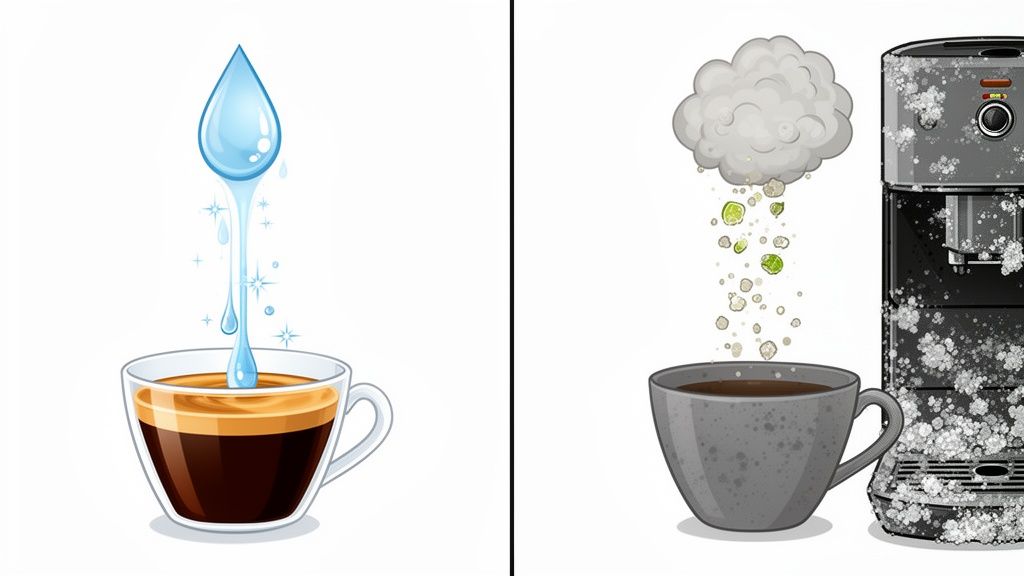
The secret to incredible coffee isn't just the beans; it starts with the water. A typical cup of coffee is over 98% water, so its quality has a massive impact on the final taste. If your water isn't right, even the most expensive speciality beans will taste flat and disappointing.
This is a significant issue in the UK, where over 60% of homes and businesses are in hard water areas. Hard water contains high levels of minerals like calcium and magnesium. While a small amount can enhance flavour extraction, too much creates serious problems that a good water filter is designed to solve.
The Problem with Unfiltered Tap Water
Without a filter, you invite two of coffee’s biggest enemies into your machine: limescale and chemical contaminants. Limescale, the chalky residue left by hard water, builds up on internal parts like heating elements and pipework. This build-up harms both your machine's performance and the taste of your coffee.
Think of limescale as clogged arteries for your coffee machine. It restricts water flow, prevents the machine from reaching the correct temperature, and forces it to work harder, leading to bitter coffee and costly breakdowns.
This build-up doesn't just shorten your machine's life; it ruins the taste of your coffee. A machine that can't reach the optimal temperature will under-extract the coffee, leaving you with a sour, weak, and underwhelming brew.
Enhancing Flavour and Protecting Your Investment
Beyond stopping scale, a quality water filter also removes other unwanted elements that spoil coffee flavour. Chlorine, often used to treat tap water, leaves a chemical taste that masks the delicate, natural notes in your coffee beans. Using a filter is a simple way to protect your machine and your coffee.
Here’s what a dedicated filter does for you:
- Improves Taste and Aroma: By removing chlorine and balancing mineral content, it allows the true flavour profile of your coffee—be it fruity, nutty, or chocolatey—to shine.
- Prevents Limescale Damage: It actively softens the water, protecting boilers, pumps, and valves from costly scale-related damage.
- Ensures Consistency: For a café or office, consistent water quality means every cup served tastes as good as the last, keeping customers and colleagues happy.
By fitting a filtration system, you protect your machine and unlock the full potential of your coffee beans. To learn more, read our guide on how water filtration impacts coffee flavour.
How Does a Coffee Machine Water Filter Improve Performance?
Water might seem like a basic ingredient, but for coffee, it's everything. Since it makes up over 98% of your final cup, the water acts as the solvent that extracts all the delicate flavours from the coffee grounds. When that water contains unwanted extras, it can sabotage both the taste and your machine's health.
In the UK, the main culprits in tap water are minerals (causing hard water) and chemical additives like chlorine. While some minerals help with flavour extraction, too many lead to limescale, that chalky white build-up that silently damages your equipment.
The Science Behind Great Tasting Coffee
Limescale coats heating elements, pipes, and valves inside your machine, forcing it to work harder to heat the water. This leads to erratic temperatures and poor extraction, resulting in a sour, disappointing coffee. It’s not just limescale; contaminants like chlorine add a harsh chemical taste that masks the subtle notes of your coffee beans.
The ideal water for coffee has a balanced mineral content. The goal isn't to strip water of everything, but to remove the bad stuff (excess calcium, chlorine) while keeping just enough good minerals to extract flavour perfectly.
For a busy café, this means inconsistent espresso shots and unhappy customers. For an office, it means more maintenance calls. This is where a quality coffee machine water filter becomes essential, ensuring every cup is perfect.
Protecting Your Machine from Limescale Damage
Limescale is the number one cause of premature coffee machine failure. As scale builds up, it constricts water flow and insulates heating elements, making them less efficient and more likely to burn out. This damage often goes unnoticed until the machine breaks down completely.
This is a huge issue in the UK. Hard water can reduce a machine's efficiency by up to 30%, so fitting a compatible coffee machine water filter is a smart move. It's a simple investment that can extend a machine's lifespan by 25-40%.
Using a filter provides several key benefits:
- Prevents Clogs: It stops scale from blocking narrow pipes and spray heads.
- Improves Efficiency: Clean heating elements use less energy to reach the right temperature.
- Reduces Repair Costs: A proactive approach saves you from expensive descaling services or component replacements.
Water quality is vital for other appliances too. For example, choosing the right filters for refrigerator ice makers greatly impacts ice purity. To learn more, check out our guide on water filtration and how it protects your machine.
Choosing the Right Coffee Machine Water Filter
Finding the perfect coffee machine water filter is about matching the right technology to your specific needs, not just picking the most expensive option. The goal is to find a filter that tackles your local water issues without removing the beneficial minerals that help extract flavour.
Understanding the main types of filters is the first step. Each uses a different method to treat water, making them suitable for different scenarios.
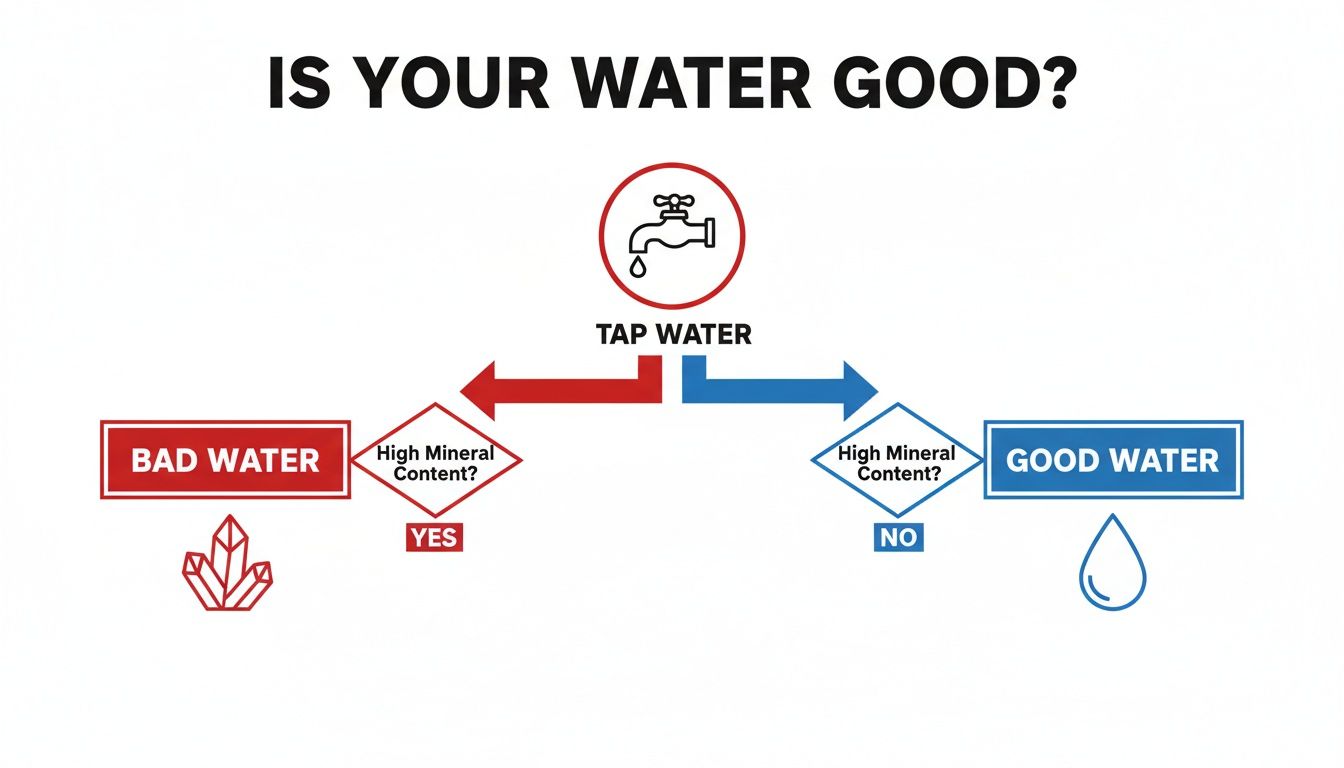
As you can see, the mineral content in your water directly impacts what ends up in your cup. Getting the water right is the foundation of great coffee.
Understanding the Main Filter Technologies
The two most common filter types are activated carbon and ion-exchange resin. The best filters cleverly combine both technologies to offer complete protection for your machine and your coffee.
Here’s a quick breakdown:
- Activated Carbon Filters: These act like a sponge for impurities. The porous carbon surface traps chlorine, pesticides, and other organic compounds that cause unpleasant tastes and smells.
- Ion-Exchange Resin Filters: This is the science that tackles limescale. These filters contain tiny resin beads that swap 'hard' minerals like calcium and magnesium for 'softer' sodium or hydrogen ions, a process known as water softening.
Many modern filters, especially those for commercial use like our BRITA Purity C range, are multi-stage systems. They often combine these methods with sediment filters to ensure only pure water enters your machine.
Water Filter Comparison for Different Coffee Setups
| Filter Type | Primary Function | Best Suited For | Typical Lifespan |
|---|---|---|---|
| In-Tank Cartridge | Improves taste & light scale reduction | Home espresso/bean-to-cup machines | 1-3 months |
| External Cartridge | Moderate scale & taste control | Offices, small cafés, plumbed-in machines | 3-6 months |
| Multi-Stage System | Heavy-duty scale & taste control | Commercial cafés, high-volume venues | 6-12 months |
| Reverse Osmosis | Strips almost all minerals (remineralisation needed) | Speciality coffee shops seeking total control | System is permanent; membranes replaced annually |
This table shows that as your water usage and machine value increase, so does the need for a more robust filtration system.
Filters for Home Baristas
For home coffee enthusiasts, convenience is key. Most domestic machines have a water tank, making an in-tank cartridge filter the most practical solution. These small, easy-to-install filters sit directly in the water reservoir, improving taste and reducing scale build-up.
Filters for Office Environments
Office coffee machines see much higher daily use and need a more robust solution. While some smaller models use in-tank cartridges, many benefit from an external cartridge system. These larger filters connect between the mains water supply and the machine, offering higher capacity and more consistent filtration.
Filters for Commercial Cafés
In a commercial café, your espresso machine is your most valuable asset. A plumbed-in, multi-stage filtration system is essential for these high-volume, high-value machines. These systems are installed directly into your water line and are built for heavy-duty use. We recommend our Everpure Claris Ultra filters for this purpose.
A commercial-grade coffee machine water filter is an insurance policy. It guarantees water consistency, protects thousands of pounds worth of equipment from scale, and prevents costly downtime.
These professional systems often feature adjustable bypass settings, allowing a barista to fine-tune the water's mineral content. Explore our full range of professional coffee machine filters to find the right fit for your business.
A Practical Guide to Installing and Replacing Your Filter
Knowing how to change your coffee machine water filter is a crucial part of maintenance. The process is usually straightforward. Getting it right ensures your new filter works perfectly, protecting your machine and keeping your coffee tasting great.
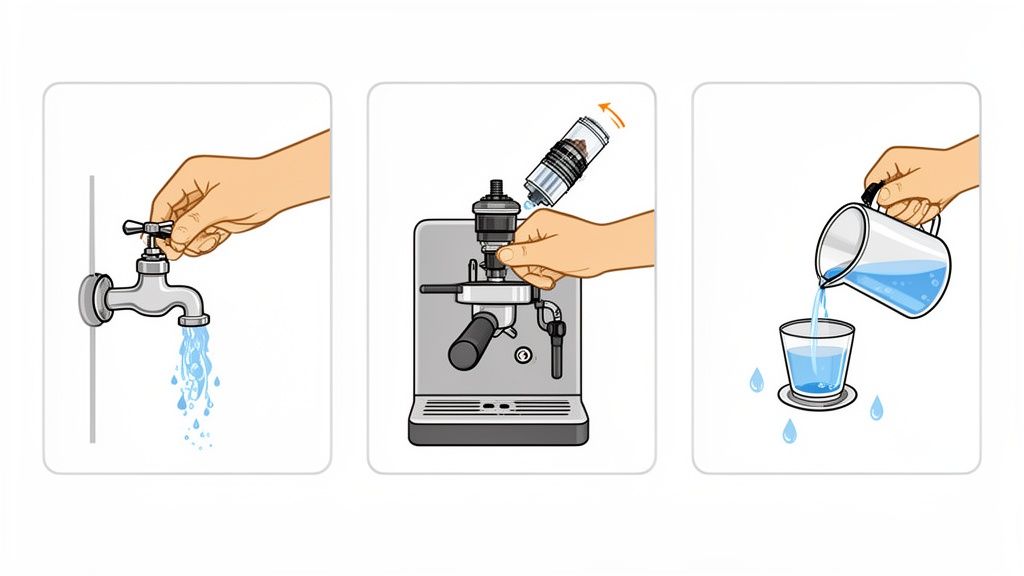
This guide provides clear instructions for the two most common setups: in-tank filters for home or small office machines, and larger cartridges for commercial, plumbed-in systems. Follow these steps to handle this essential task with confidence.
Installing a Filter in a Tank-Fed Machine
Most domestic and small office machines have an accessible water tank filter. Swapping it is a quick job you can do in minutes.
Here’s a step-by-step guide:
- Prepare the New Filter: Unwrap the new filter and submerge it in a bowl of cold water for 10-15 minutes. This activates the filtration media and removes trapped air.
- Empty and Clean the Tank: Remove the water tank, empty any old water, and give it a quick rinse.
- Remove the Old Filter: The old filter will either click or screw into a holder. Unclip or twist it to remove.
- Install the New Filter: Click or screw the new, soaked filter securely into place.
- Refill and Reinstall: Fill the tank with fresh tap water and slide it back into your machine.
- Run a Flush Cycle: Place a large jug under the hot water spout and run about 500ml of water through. This flushes out any loose carbon dust.
- Reset Your Machine's Counter: If your machine has a filter reminder, reset it in the settings menu.
Replacing a Filter on a Plumbed-In Commercial System
For plumbed-in machines, the process is just as logical, but safety is paramount. Always start by shutting off the water supply.
Follow these steps for a smooth changeover:
- Turn Off the Water Supply: Locate the stopcock on the water line feeding the filter and turn it off.
- Release Water Pressure: Press the pressure release button on top of the filter head. Have a cloth ready for any drips.
- Remove the Old Cartridge: Grip the old cartridge and twist it (usually anti-clockwise) to release it. It will be heavy with water.
- Install the New Cartridge: Align the new cartridge with the head, push it up, and twist it clockwise until it locks into place.
- Flush the New System: This step is crucial. A new filter must be flushed before use. For detailed instructions, see our guide on how to flush a BRITA Professional filter.
- Turn the Water Back On: Slowly open the stopcock and check for any leaks around the filter head.
Keeping Your Filter Working at Its Best
An effective maintenance routine for your coffee machine water filter is about usage, not just time. A filter's real lifespan depends on the volume of water passing through it. A filter in a busy office will exhaust much faster than one in a home kitchen. Spotting the early warning signs is key to protecting your machine.
Spotting The Signs a Replacement is Due
Your machine will often give you clues that its filter needs changing. Paying attention to these subtle changes can help you act before real issues arise.
You'll know it's time for a change when you notice:
- A Drop in Water Pressure: If the coffee flow seems slower, the filter may be clogged.
- Changes in Coffee Taste: If your coffee suddenly tastes bitter or metallic, chlorine and other impurities are likely getting through.
- The Reappearance of Scale: A chalky film in the water tank or on your coffee is a clear red flag that the filter is no longer softening the water.
Neglecting to change your filter is a false economy. An old, saturated filter not only stops working but can become a breeding ground for bacteria, creating a potential hygiene risk.
The Risks of an Overlooked Filter
Forgetting to replace your coffee machine water filter can lead to serious consequences beyond bad coffee. When a filter becomes ineffective, it can cause sudden and expensive machine damage. Poor water quality can degrade coffee taste, and proper filtration is known to prevent a significant percentage of failures in commercial machines.
Creating a Simple Maintenance Schedule
The best way to stay on top of filter maintenance is to create a simple, repeatable schedule. For a home machine, set a recurring reminder on your phone for every two months. For a commercial setting, log the date of each filter change to track water volume and establish a reliable replacement pattern. Our guide on the importance of regularly changing your water filter provides more practical tips.
While specific to coffee machines, general filter care principles apply elsewhere. Understanding effective filter cleaning for other appliances can offer useful insights.
Common Questions About Coffee Machine Water Filters
Even after getting to grips with how a coffee machine water filter works, a few questions often remain. We’ve rounded up the most common queries to clear up any doubts you might have.
Do I Need a Water Filter in a Soft Water Area?
Yes. While you have fewer scale-forming minerals, tap water still contains chlorine, which can give coffee a harsh, chemical taste. An activated carbon filter removes chlorine, resulting in a cleaner, brighter cup. Think of a filter as an extra layer of insurance, ensuring you only taste the coffee.
Can I Just Use a Standard Water Filter Jug Instead?
A filter jug is better than nothing, but it's no substitute for a dedicated coffee machine water filter. Jug filters are designed for cold drinking water and have limited limescale-fighting ability.
A filter jug is a good first step, but a purpose-built coffee machine filter offers robust, targeted protection against both taste impurities and internal scale damage.
Dedicated filters contain a higher concentration of the ion-exchange resin needed to soften water and protect your machine's boiler and pipework. For the health of your equipment and consistently great coffee, a purpose-built filter is always the better choice.
How Do I Find a Filter That Fits My Machine?
The right fit is essential. Always check your coffee machine’s user manual first, as it will specify the correct model or type of filter required.
- Brand-Specific Filters: Manufacturers like Jura, De'Longhi, and Sage often require their own branded filters to ensure a perfect fit and optimal performance. Using a third-party filter could void your warranty.
- Commercial Systems: For commercial setups, the filter cartridge usually matches the filter head unit (e.g., BRITA Purity C), not the coffee machine itself. The model number will be printed on the side of your current filter.
If you are unsure, check the manufacturer’s website or contact a specialist supplier with the make and model of your machine.
What Happens If I Forget to Change My Filter?
Forgetting to change your filter can cause serious problems. An exhausted filter stops working, allowing scale-forming minerals and chlorine straight into your machine. You'll notice the drop in coffee quality quickly, but the real damage is the internal limescale build-up, which can lead to expensive repairs.
Furthermore, a saturated filter can become a breeding ground for bacteria, creating a hygiene risk. It can also release trapped contaminants back into the water, making your coffee taste even worse. A regular replacement schedule is essential for taste, hygiene, and the health of your machine.
Ready to protect your equipment and unlock the best flavour from your coffee beans? Allied Drinks Systems offers a comprehensive range of water filtration solutions for every setup, from home espresso machines to busy commercial cafés. Explore our full collection and find the perfect filter for your needs.


