

Ever wondered why your coffee never quite tastes like it does at your favourite café, even when you use the best beans? The secret is often hiding in plain sight: your tap water.
Since a cup of coffee is over 98% water, its quality is the single most important factor shaping the final flavour. Getting that right with proper coffee machine water filters is the key to unlocking a truly exceptional brew, protecting your machine from damage, and ensuring every cup is consistently delicious. This guide explains everything you need to know.
Why Water Filters Are Your Coffee Machine's Best Friend
Unfiltered tap water, especially in the UK's common hard water areas, is your coffee's worst enemy. It is often loaded with minerals like calcium and magnesium, not to mention chlorine from the treatment process. While some minerals are good for flavour, too much creates a harsh, chalky taste that masks the delicate notes of your coffee.
This is particularly true for businesses where consistency is key. For any high-quality commercial coffee machine, a professional filtration system is non-negotiable. It guarantees every cup meets the high standards your customers expect, while for home enthusiasts, it’s the secret to that elusive café-quality result in your own kitchen.
The Difference a Filter Makes
It's easy to underestimate the impact of a water filter. This quick comparison shows just how vital it is for both your coffee's flavour and your machine's health.
| Aspect | With a Water Filter | Without a Water Filter |
|---|---|---|
| Coffee Flavour | Clean, bright, and balanced. The bean's true notes shine through. | Often harsh, chalky, or bitter due to excess minerals and chlorine. |
| Machine Lifespan | Significantly extended. Vital components are protected from scale. | Reduced. Limescale buildup causes strain and leads to breakdowns. |
| Running Costs | Lower energy bills and fewer repair costs over the machine's life. | Higher energy consumption and frequent, expensive repair bills. |
| Consistency | Every cup tastes just as good as the last. | Flavour can vary, and machine performance degrades over time. |
In short, a filter isn't just an accessory; it's a fundamental part of any great coffee setup.
Protecting Your Machine from Limescale
The problems caused by hard water go far beyond just bad-tasting coffee. When heated, the minerals in hard water form limescale—a hard, crusty deposit that builds up inside your machine's pipes, boiler, and heating elements.
Limescale is like cholesterol for your coffee machine. Over time, it restricts water flow, reduces heating efficiency, and puts immense strain on vital components, leading to breakdowns and expensive repairs.
This relentless buildup forces your machine to work harder to heat water. This leads to inconsistent brew temperatures and, eventually, complete failure. In fact, issues related to hard water are one of the main causes of coffee machine breakdowns.
The Double Win: Great Taste and Longevity
Using a coffee machine water filter delivers two powerful benefits. First, it purifies your water, removing chlorine and balancing the mineral content to unlock a cleaner, richer, and more aromatic brew.
Second, it prevents the damaging buildup of limescale, extending the life of your equipment and saving you from costly repairs and downtime. If you're unsure about your local water quality, simple water hardness test strips will give you a clear picture. It’s a tiny investment that protects your coffee's flavour and your machine's health.
Decoding the Different Types of Water Filters
Understanding the technology inside a coffee machine water filter is simpler than it sounds. Each type is a specialist tool designed to solve a specific problem, from removing odd tastes to stopping damaging limescale. Knowing the main types helps you choose the perfect one for your machine.
The most common filters work by targeting different impurities found in tap water. Think of it like a specialist cleaning crew for your water; one removes odours, while another is a powerhouse against mineral buildup.
This simple diagram shows the direct link from unfiltered tap water to poor-quality coffee, with limescale being the main culprit.
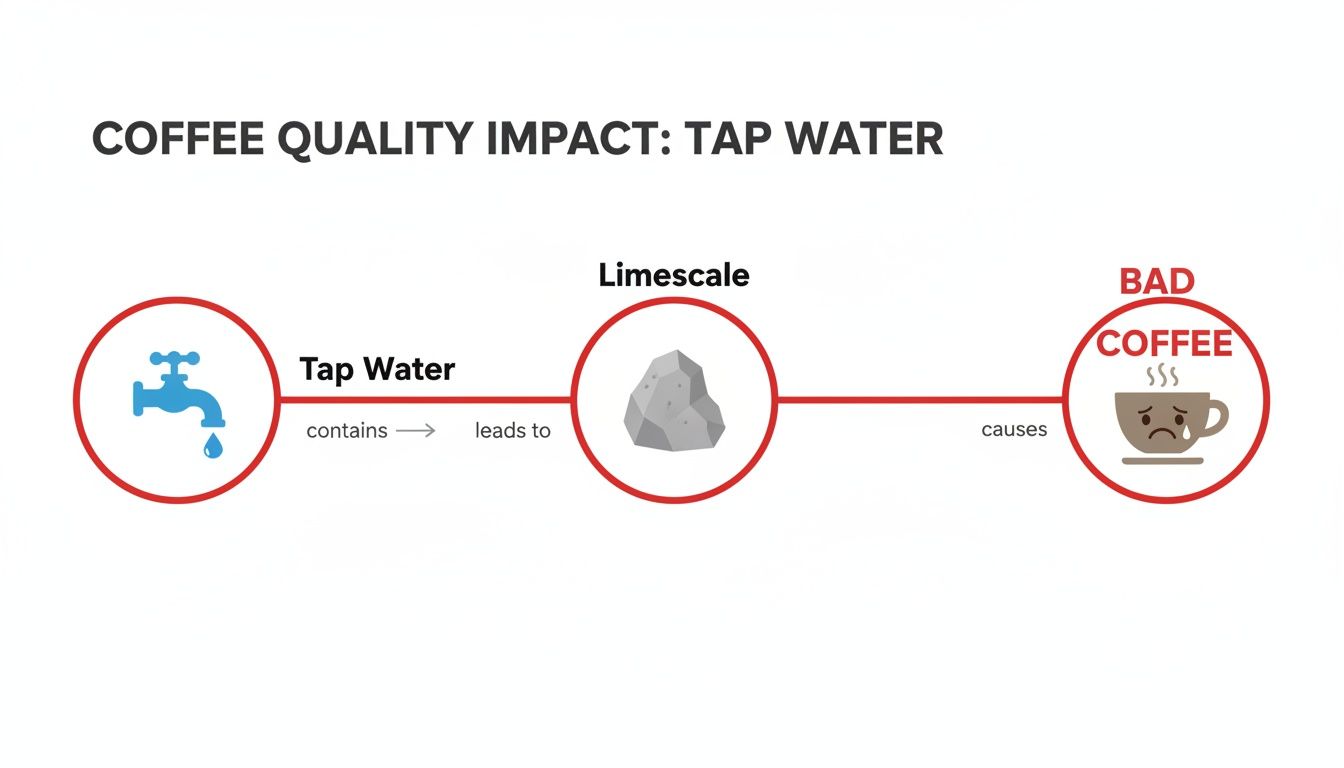
As you can see, adding a filter into that chain reaction is the secret to protecting both the flavour in the cup and the machine itself. Let's break down the main technologies that make it happen.
Activated Carbon Filters for Purer Taste
Activated carbon filters are taste and aroma specialists. They work like a powerful sponge, using a highly porous form of carbon to trap contaminants that spoil your coffee’s flavour.
Their main job is to remove chlorine, a chemical used in water treatment that can give coffee a harsh, medicinal taste. They also get rid of other organic compounds that cause unwanted smells, leaving you with a clean, neutral base for brewing.
Ion-Exchange Resin Filters for Limescale Prevention
When it comes to tackling hard water, ion-exchange resin filters are the champions. Inside, they contain tiny resin beads loaded with sodium or hydrogen ions.
As hard water flows through, the filter performs a clever swap: it grabs the limescale-forming calcium and magnesium ions and releases harmless sodium ions in their place. This process, known as water softening, is the most effective way to protect your machine's internal components from scale buildup.
This technology is vital for extending the life of any coffee machine, especially in areas with very hard water. It stops damage before it has a chance to start.
Combination and In-Tank Cartridges
Many modern filters offer the best of both worlds, combining activated carbon and ion-exchange resin into a single cartridge. This gives you a complete solution, tackling both flavour-tainting impurities and machine-damaging minerals at the same time.
- Convenience: These are usually simple in-tank cartridges that you drop into your machine’s water reservoir.
- Effectiveness: They provide brilliant all-round protection for home machines and smaller commercial setups.
- Simplicity: Swapping them out is a breeze, usually needed every one to two months.
A great example of this technology is the popular K-Fee CLARO SWISS water filter, designed for easy drop-in use.
In-Line and Under-Sink Systems
Commercial machines plumbed directly into the mains need something more robust. In-line filters are installed on the water supply pipe that feeds the machine, offering a much higher capacity and flow rate than an in-tank cartridge.
An under-sink system is an even more comprehensive setup, often with multiple filtration stages. These professional-grade solutions deliver perfectly treated water to busy cafés and offices where coffee quality and machine reliability are non-negotiable.
How to Choose the Right Coffee Machine Water Filter
Picking the perfect coffee machine water filter isn't about finding a single "best" one. It’s about finding the right one for your specific setup. A filter that works well in a home kitchen would be overwhelmed in a bustling café. To get it right, you need to look at your water, your machine, and how much coffee you’re making.
Making the right choice starts with knowing what’s coming out of your tap. Hard water demands a filter that’s tough on limescale, while softer water areas might just need something to get rid of chlorine. Nailing this from the start is the secret to great coffee.
1. Assess Your Local Water Hardness
The first step is to find out how hard your water is. Much of the UK has hard water, packed with the minerals that cause limescale. Running a machine without protection in these areas is a fast track to breakdowns and flat, chalky-tasting coffee.
An easy way to check is with an online water hardness map or postcode checker. For a more accurate reading, a simple water hardness test strip is a fantastic tool.
2. Match the Filter to Your Machine Type
Next, consider your coffee machine. Is it a home machine with a water tank, or a commercial model that’s plumbed into the mains?
-
For Tank-Based Machines: Found in most homes and small offices, the simplest solution is an in-tank cartridge. These small filters sit inside the water tank and are a breeze to install and replace.
-
For Plumbed-In Machines: Common in cafés and large offices, these machines need a more serious solution. An in-line filter is fitted directly onto the water pipe, handling a much higher volume of water for demanding commercial settings.
3. Consider Your Daily Coffee Volume
How many coffees you make a day determines the capacity your filter needs. Putting a small filter in a high-volume spot will exhaust it quickly, leaving your machine unprotected.
- Home Users (1-10 cups/day): A standard in-tank cartridge is perfect. They usually last one to two months and give excellent protection.
- Busy Offices (20-50 cups/day): A larger in-tank filter or a small-scale in-line system is a better choice.
- High-Volume Cafés (50+ cups/day): A professional, high-capacity in-line filtration system is essential to protect your investment and guarantee quality.
Top-Rated Water Filters
Here are some of the best coffee machine water filters available, catering to different needs:
- ADS Coffee Supplies IEN 1500 Complete Filter with Head: Our number one choice for commercial setups. This high-capacity system offers professional-grade protection against limescale and impurities, ensuring machine longevity and perfect coffee taste in the busiest environments.
- BRITA Purity C300 Water Filter: A fantastic and reliable choice for busy offices or small cafés. BRITA is a trusted name in filtration, and this model delivers consistent, high-quality water, protecting your equipment and improving flavour.
- K-Fee CLARO SWISS water filter: Ideal for home or small office machines with a water tank. This convenient drop-in cartridge combines carbon and ion-exchange technology for all-round protection against bad tastes and limescale.
If you’re ever in doubt, your machine's manual is a great place to start. Or, even better, just ask an expert. At ADS Coffee Supplies, we provide specialist advice to ensure businesses get a solution perfectly matched to their needs.
A Simple Guide to Filter Installation and Maintenance
Looking after your coffee machine water filters is much easier than you might think. A little routine care is all it takes to keep your filter performing at its best, protecting your machine and guaranteeing delicious coffee every time.
For most coffee machines with water tanks, the process is a breeze. The simple drop-in cartridges are designed to be user-friendly, getting you back to brewing in minutes.
Installing a New Filter Cartridge
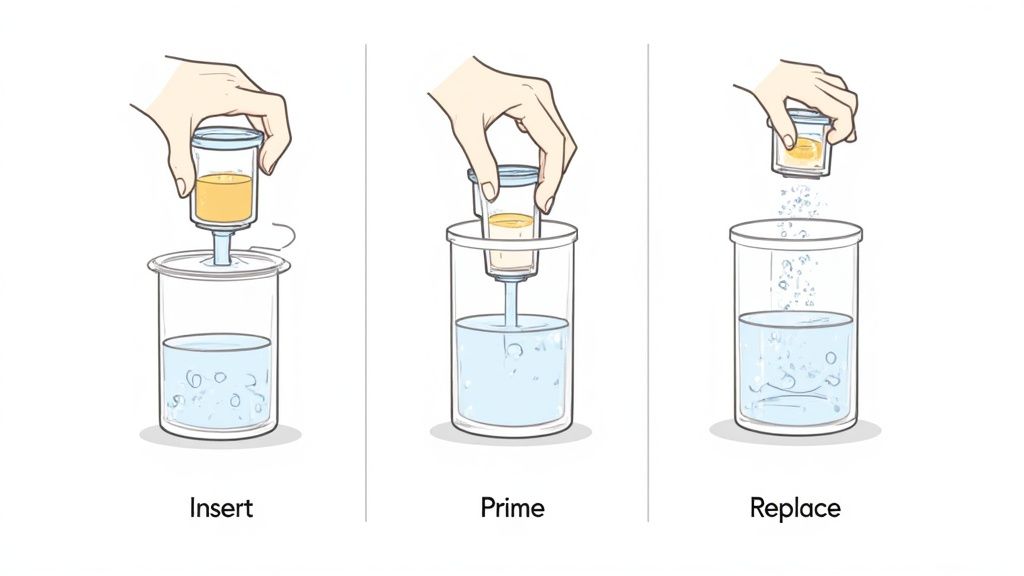
Popping in a new in-tank filter is a simple job. Just follow these basic steps to make sure it works perfectly from the first cup.
- Unpack and Soak: Take the new filter out of its packaging and place it in a bowl of fresh, cold water for 5-10 minutes. This activates the filtration media and helps remove trapped air.
- Rinse Thoroughly: After soaking, hold the filter under a running cold tap for a minute. This step is called priming and flushes out any loose carbon particles.
- Install in the Tank: Place the filter securely into its holder inside your machine’s water tank. Fill the tank with fresh water.
- Flush the System: Before making coffee, run one or two full tanks of water through the machine (using the hot water function). This ensures the filter is fully primed and ready for action.
Knowing When to Replace Your Filter
A filter’s lifespan depends on two things: time and how much water it has treated. Over time, the materials inside become saturated and can no longer trap impurities. Ignoring the replacement schedule means you're using an unprotected machine again.
Most manufacturers recommend replacement every one to two months, or after a specific volume of water has passed through, typically around 50-60 litres.
Keep an eye out for these tell-tale signs that your filter is exhausted:
- Slower Water Flow: If your machine seems to be struggling to dispense water, a clogged filter is the likely culprit.
- Taste Changes: A chlorine or chalky taste creeping back into your coffee is a dead giveaway.
- Limescale Reappears: Spotting a white film building up in your water tank? Your filter is no longer working.
For commercial setups, professional installation is vital. Our team at ADS Coffee Supplies offers expert installation and servicing to keep your equipment in perfect condition. For more on general hygiene, you can learn how to clean water dispensers, as many of the principles apply.
Water Filters: An Investment, Not an Expense
It’s easy to see coffee machine water filters as just another running cost. But that thinking misses the bigger picture. A quality water filter isn't an expense—it’s one of the smartest investments you can make for your machine's health and your coffee's quality.
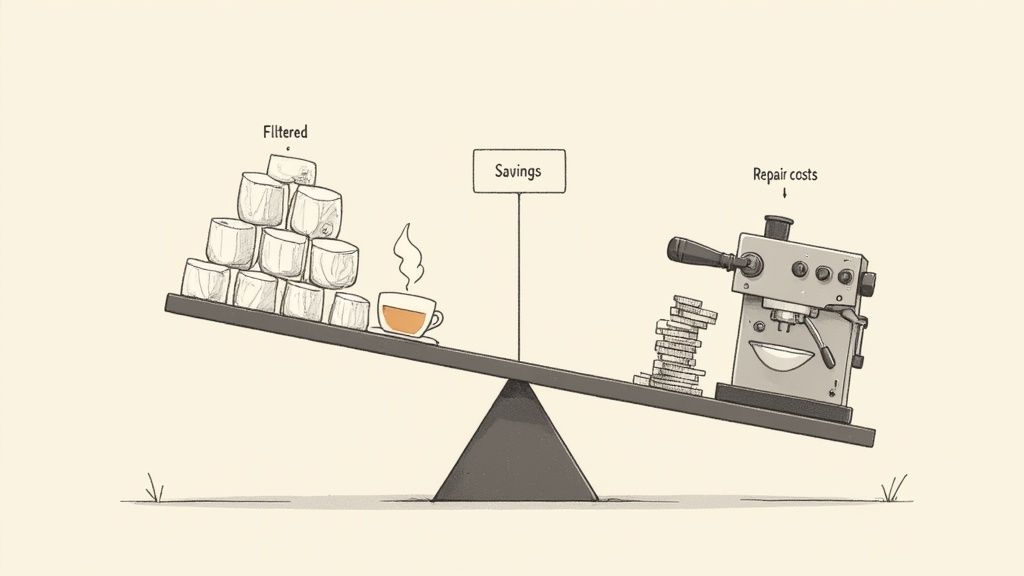
The small, regular cost of replacing a filter is nothing compared to the expense of dealing with limescale damage. Skimping on filtration is a false economy that almost always ends with a much bigger bill.
Preventing Costly Repairs
Limescale is the number one enemy of coffee machines. It builds up inside pipes and heating elements, forcing your machine to work harder, use more energy, and eventually break down. A single emergency call-out for a scale-damaged machine can easily cost over £100, before you even factor in parts.
By stopping scale before it starts, you actively prevent the issues that lead to expensive repairs. It’s all about being proactive.
The Business Case for Filtration
For any business, downtime means lost revenue. A broken coffee machine doesn't just mean repair bills; it means unhappy customers or unproductive staff. Consistent, high-quality coffee builds loyalty and keeps morale high.
A filter system is your guarantee that every cup you serve is as good as the last. It’s a vital tool for protecting your reputation, your bottom line, and ensuring your operation runs smoothly.
For anyone interested in the finer details, you can explore some comprehensive water filter advice from trusted external sources.
Long-Term Savings and ROI
The return on investment from using coffee machine water filters is clear. By avoiding just one major repair, your filtration system has likely paid for itself several times over. On top of that, a well-maintained machine simply lasts longer, pushing back the day you need to pay for a costly replacement.
Investing a small, predictable amount in regular filtration dramatically reduces the risk of much larger, unexpected costs. Instead of waiting for a breakdown and resorting to a powerful Bravilor Renegite Descaler on a heavily scaled machine, you can keep things running smoothly from the start.
Quick Answers to Your Water Filter Questions
Let's wrap up by tackling some of the most common questions people ask about coffee machine water filters. This section gives you quick, clear answers so you can feel confident in your choice.
How long does a water filter last?
This depends on time and volume. Most in-tank cartridges should be replaced every one to two months. This is because an old, wet filter can become a breeding ground for bacteria if left in too long. A filter is also rated for a set volume, typically 50-60 litres. If you make a lot of coffee, you’ll hit this limit before the two-month mark. Always follow the manufacturer’s guidelines.
Do I still need to descale my machine if I use a filter?
Yes, but far less often. A good water filter is your machine's first line of defence, but it's not an impenetrable shield. In areas with very hard water, a tiny amount of mineral buildup can still occur over time. A filter turns descaling from a constant battle into simple preventative maintenance. Descaling once or twice a year becomes light housekeeping instead of a major deep clean.
Using a filter dramatically reduces how often and how intensely you need to descale. It shifts the job from a reactive chore to a proactive step that keeps your machine healthy for the long haul.
Will a filter change the taste of my coffee?
Absolutely—for the better! A quality coffee machine water filter is selective. It targets and removes the bad stuff, like the chemical tang of chlorine or the excess calcium that makes coffee taste chalky and bitter. At the same time, it leaves in the good minerals, like magnesium, which are crucial for extracting the rich, complex flavours from your coffee beans. The result is a cleaner, brighter, and more balanced cup where the coffee’s true character shines.
Can I use any filter in my coffee machine?
No, compatibility is essential. Forcing a filter that wasn't designed for your machine can lead to an improper fit, allowing unfiltered water to bypass the cartridge. This leaves your machine unprotected and can even cause damage. Always check your machine's manual for the recommended filter type or part number.
Still Have Questions? We've Got Answers
Here are the most frequently asked questions and their answers in a quick-reference table.
| Question | Answer |
|---|---|
| How often should I change my filter? | Every 1-2 months or after filtering 50-60 litres of water, whichever comes first. Always check the manufacturer's advice. |
| Is descaling still necessary with a filter? | Yes, but much less frequently. A filter significantly reduces scale, but a yearly descale is good practice, especially in hard water areas. |
| Will a filter make my coffee taste better? | Yes! By removing impurities like chlorine and excess minerals, it allows the true flavours of your coffee beans to come through. |
| Are all water filters the same? | No. Different filters use different technologies to target specific issues. Compatibility with your machine model is also critical. |
| What happens if I don't change my filter? | An old filter becomes ineffective and can harbour bacteria. Limescale will start building up, damaging your machine and affecting coffee taste. |
| Can I use a third-party filter? | Sometimes, but always check for guaranteed compatibility. An ill-fitting filter won't protect your machine and could void your warranty. |
Getting your water filtration right is one of the easiest ways to make incredible coffee and keep your equipment in top shape for years to come.
Ready to unlock better-tasting coffee and protect your machine? The experts at ADS Coffee Supplies are here to help you find the perfect water filtration solution for your home or business.
Explore our full range of coffee machine water filters today!
