In the UK's bustling café scene, the humble coffee takeaway cup is far more than a simple container. Think of it as your shop's business card; the right one can elevate a customer's experience, act as a mobile advert for your brand, and signal your commitment to sustainability. Getting it right is a surprisingly critical decision for any coffee business.
Why Your Coffee Takeaway Cup Matters
Long after a customer leaves your premises, their cup is one of the most direct points of contact they have with your brand. It’s a tangible piece of your business they hold and carry, making it a powerful tool for shaping how they see you. A flimsy cup that leaks can ruin a perfect coffee, while a sturdy, well-designed cup reinforces the quality of the product inside.
The Scale of the Takeaway Market
The demand for on-the-go coffee has exploded. The UK coffee shop industry is projected to reach £6.7 billion in revenue by 2025, fuelled by a culture that now gets through around 98 million cups of coffee every single day. For an independent shop, that can mean using 200–300 cups daily, while larger chains serve over 700. You can learn more about the rise of UK coffee consumption.
This sheer volume means every choice you make adds up. From the material to the branding, your cup selection has a massive cumulative effect on your costs, your environmental footprint, and your customer's daily routine.
Key Factors for Your Business to Consider
When picking a coffee takeaway cup, a few key points come into play. Thinking through these will help you find the perfect match for your operation.
- Customer Experience: Does the cup feel good to hold? Does it keep the coffee at the right temperature without burning hands? A good physical experience creates a positive brand association.
- Brand Image: A custom-printed cup turns every customer into a walking advert. It gets your brand seen on the high street and on social media.
- Operational Efficiency: Do your cups and lids fit together properly? Do they stack neatly and dispense easily during a mad rush? Smooth service depends on reliable supplies.
- Environmental Responsibility: With customers more eco-aware than ever, offering recyclable or compostable options can be a major selling point.
Choosing the Right Cup Material
Choosing the right material is your first big decision. It dictates how long a coffee stays hot, how sturdy the cup feels, your environmental footprint, and your cost per cup. Let's break down the common options you'll find in the UK.
Traditional Paper Cups: Single-Wall vs. Double-Wall
The paper cup is the most familiar option, but its construction directly impacts customer comfort and the drinks it is suited for.
- Single-Wall Cups: These are the most cost-effective choice. Made from one layer of paperboard, they're perfect for cold drinks or milky coffees like lattes. For hotter drinks like a black Americano or tea, you'll need a separate cardboard sleeve to stop customers burning their hands.
- Double-Wall Cups: These have two layers of paperboard with an air gap in between. This clever design acts as a built-in insulator, keeping the drink hotter for longer while the outside stays cool enough to hold comfortably. This means you don't need a separate sleeve, which creates a more premium feel, though they do cost a little more.
Eco-Friendly Alternatives: PLA-Lined and Compostable Cups
As customers have become more environmentally conscious, the demand for greener packaging has grown. This has pushed the industry to develop new materials that ditch traditional plastic linings.
An eco-friendly cup often has a PLA (Polylactic Acid) lining. Unlike standard polyethylene (PE) plastic, PLA is a bioplastic made from renewable plant resources like corn starch. This plant-based lining allows the entire cup to be commercially compostable, provided it ends up in the right facility.
A cup lined with PLA looks and feels almost identical to a standard one, but its end-of-life potential is completely different. When sent to an industrial composting facility, it can break down into organic matter instead of sitting in a landfill.
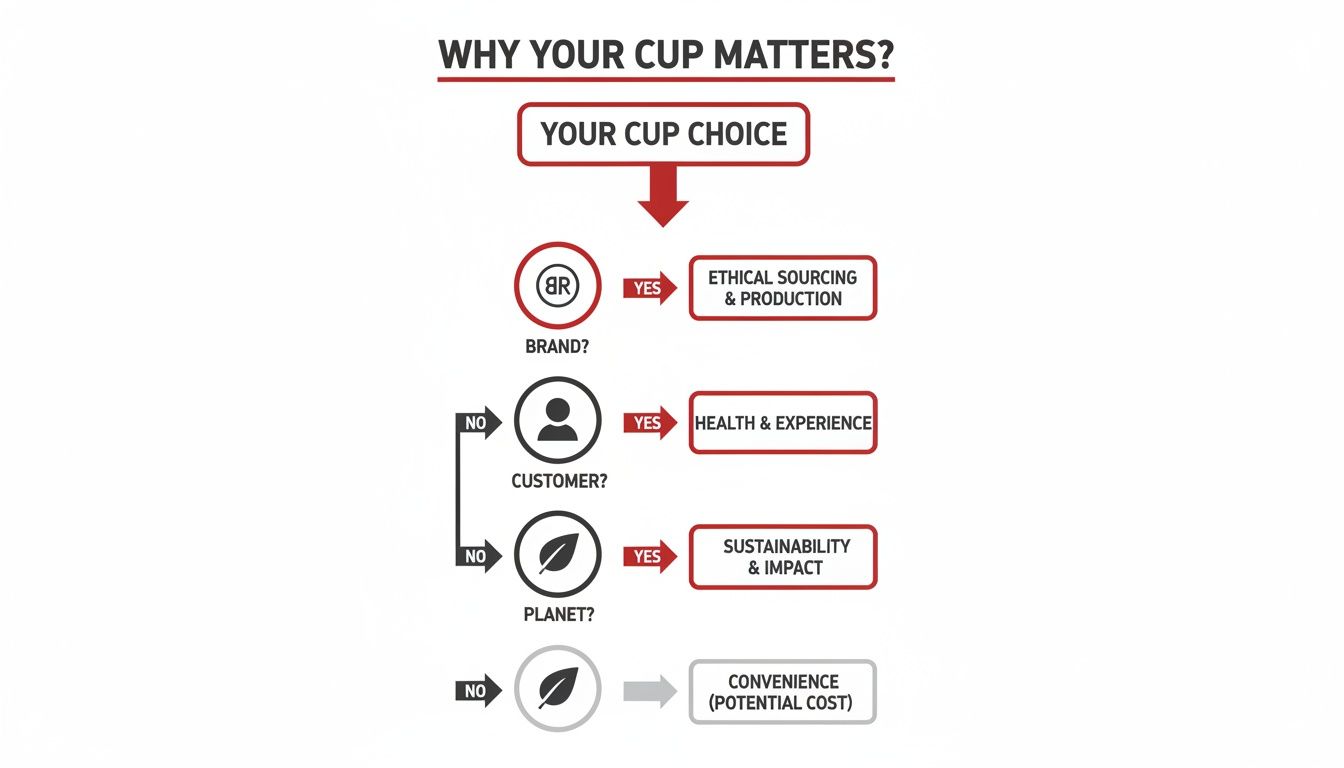
As you can see, your choice affects everything from brand perception to your environmental impact. For businesses serious about their green credentials, options like our 8oz compostable double-wall cups offer the best of both worlds: fantastic insulation and an eco-friendly, compostable PLA lining.
A Practical Comparison of Coffee Cup Materials
Here’s a straightforward table to help you compare the main players at a glance.
| Material Type | Key Feature | Best For | Environmental Profile | Average Cost |
|---|---|---|---|---|
| ADS Compostable Cups (PLA-Lined) | Our top recommendation. Plant-based lining. | Any business wanting a greener alternative to traditional cups. | Commercially compostable; breaks down in industrial facilities. | ££ |
| Single-Wall Paper (PE-Lined) | Most affordable option | Cold drinks, lattes, cappuccinos (with a sleeve for hot drinks) | Lined with oil-based plastic; requires specialist recycling. | £ |
| Double-Wall Paper (PE-Lined) | Built-in insulation | Hot drinks like black coffee and tea without needing a sleeve | Lined with oil-based plastic; requires specialist recycling. | ££ |
| Reusable (e.g., Bamboo, Plastic) | Multi-use, waste reduction | In-house schemes, retail sales, environmentally-focused brands | Highest sustainability when used consistently; low lifetime waste. | £££ (per cup) |
Reusable Cups and Return Schemes
The most sustainable option is the reusable cup. While simply selling branded reusable cups is a great start, some businesses are setting up return schemes. A customer pays a small deposit for a reusable cup which they get back on its return.
This requires logistical planning—you need proper washing facilities and a way to track everything—but it can create a powerful loyalty loop and slash your single-use waste. This works best in "closed-loop" environments like office canteens or university campuses, where returning a cup is convenient.
Choosing the Perfect Size and Lid

Getting the size and lid combination right for your coffee takeaway cup is a small detail that makes a huge difference. A leaky lid or a wobbly cup can sour a customer's entire experience and tarnish your reputation in a heartbeat. Think of the cup and lid as a team; if they don't work together perfectly, the whole thing falls apart.
Matching Cup Size to Your Drinks Menu
In the UK, a handful of standard sizes dominate the coffee scene. Sticking to just two or three core sizes streamlines your ordering, saves storage space, and makes life easier for your team during a busy service.
- 8oz (approx. 227ml): The classic size for a flat white or a small Americano. It’s the go-to for coffee purists who want a quality-focused drink.
- 12oz (approx. 340ml): The workhorse of the café world. This is your standard for regular lattes, cappuccinos, and medium teas, making it the most versatile coffee takeaway cup you can stock.
- 16oz (approx. 454ml): Reserved for large lattes, indulgent hot chocolates, or for customers who need a serious caffeine boost.
By aligning these sizes with your menu, you ensure consistent portion control and give every drink a professional look.
The Importance of Lid Compatibility
A great cup is pointless without an equally great lid. If a lid is too loose, it’ll pop off. Too tight, and it can crack the cup rim. This is where focusing on quality becomes non-negotiable.
The connection between the cup and the lid is the single most common point of failure for any takeaway drink. A secure, audible 'click' as the lid snaps on is the gold standard of a reliable product.
Look for suppliers who guarantee a perfect fit across their range. A single style of lid can often be designed to fit multiple cup sizes (e.g. 10oz, 12oz, and 16oz). This synergy is a game-changer for efficiency, reducing clutter and taking the guesswork out of service.
Pro Tips for a Spill-Proof Service
Preventing spills starts with the right gear but ends with good habits. Here are a few practical tips to ensure every takeaway coffee leaves your shop secure.
- Always Test a New Batch: When a fresh delivery of cups or lids arrives, test a few pairings straight away to confirm the fit is snug.
- Train Your Team: Show your baristas how to press lids on firmly and evenly, starting on one side and working around the rim until it clicks.
- Don't Overfill: Always leave a small gap at the top of the cup. This buffer stops hot liquid from sloshing against the sip-hole and causing drips.
Making Sense of Eco-Friendly Cups and Certifications
Navigating eco-friendly packaging can feel like a minefield of buzzwords. For any business using a coffee takeaway cup, making a genuinely sustainable choice is now a commercial necessity. Your customers want to support businesses that take their environmental duties seriously.
The reality of cup disposal in the UK is a huge challenge. While the nation gets through 98 million cups of coffee a day, a mere 1 in 400 paper cups is actually recycled. This is down to their plastic linings and the scarcity of facilities that can handle them.
Why Most Paper Cups Aren't Recycled
The problem with a standard paper cup isn't the paper itself; it's the thin polyethylene (PE) plastic lining inside. This layer is essential to stop the cup from going soggy, but it's bonded so tightly to the paper fibres that separating the two is complex and expensive.
Because of this, these cups can't just be tossed into the standard paper recycling bin. They require specialised facilities, and there are only a handful in the UK. The vast majority end up in general waste, destined for landfill or incineration.
This is the central challenge for the coffee industry. A cup that looks recyclable often isn't in practice, creating a huge amount of waste.
Decoding Key Environmental Certifications
Certifications are your guarantee that a product meets specific environmental standards. They cut through the marketing noise and give you solid proof of a cup's origins and its end-of-life potential.
Here are the key ones to look out for on a coffee takeaway cup:
- FSC (Forest Stewardship Council): This ensures the paperboard used to make your cups comes from responsibly managed forests, protecting biodiversity and local communities.
- EN 13432 (Compostability): This is the European standard for industrial compostability. It means the cup has been proven to break down into organic matter in an industrial composting facility, leaving no toxic residue behind.
Compostable vs Biodegradable vs Recyclable
These terms are often used interchangeably, but they mean very different things.
- Recyclable: The material can be reprocessed to create new products. Standard PE-lined cups are only recyclable in specialist plants.
- Biodegradable: This broad term means a material can be broken down by microorganisms over time, but it doesn't specify how long or what it breaks down into.
- Commercially Compostable: This is the most specific term. It means the product (usually a PLA-lined cup) will break down completely, but only in a controlled industrial composting environment.
Of course, the most sustainable solution is to avoid single-use altogether. Promoting reuse by encouraging customers to bring their own cups—or selling high-quality reusables like the Summit X Circular Reusable Coffee Cup—is the most effective way to cut down on waste.
Turning Your Cup Into a Marketing Tool
Think of every single coffee takeaway cup that leaves your shop as a miniature billboard. As your customers walk down the high street, your brand is in their hands, visible to hundreds of potential new customers. A well-designed, custom-printed cup tells a story, captures attention, and makes your business memorable.
From Simple Logos to Full-Colour Designs
Customising your cups doesn't have to be complicated. You can choose a level of branding that fits your budget and personality.
- One-Colour Logo Printing: The most straightforward and cost-effective route. A crisp, single-colour print of your logo on a stock cup instantly creates a professional look.
- Multi-Colour and Full-Wrap Designs: For businesses looking to make a bigger impact, full-colour, wrap-around printing offers a canvas to tell your brand’s story. You can use vibrant colours, patterns, or illustrations that reflect your café’s atmosphere.
Designing Artwork That Gets Noticed
Creating artwork for a curved surface like a cup requires some thought. Your design needs to be clear, impactful, and instantly recognisable. A busy or cluttered design can get lost, so simplicity is often best.
Your design is a direct reflection of your quality. A sharp, high-resolution print suggests attention to detail and a premium product.
Your branded cup also acts as effective point of sale material. To learn more about this concept, you can explore guides on using point of sale materials to boost brand visibility.
Understanding the Logistics of Customisation
Before you dive in, it’s important to understand the practical side of custom printing. The process involves more than just a great design.
Here are the key logistical factors to keep in mind:
- Minimum Order Quantities (MOQs): Custom printing is done in large batches, so suppliers will have a minimum number of cups you need to order.
- Lead Times: The production and delivery of custom cups can take several weeks. It’s crucial to plan ahead and order well before you run out.
- Cost Implications: While the cost-per-cup for custom printing is higher, the marketing return is significant. View it as an investment in your brand awareness.
At ADS Coffee Supplies, we simplify this process with our white label custom branded paper cups, guiding you through everything from design to delivery.
Mastering Your Stock and Costs
Getting a handle on your supply of the humble coffee takeaway cup is a behind-the-scenes discipline that can protect your bottom line. Get it right, and you'll control costs. Get it wrong, and you'll face the nightmare of running out during the morning rush.
To understand your costs, look past the price on a sleeve of cups. Your true cost-per-cup includes the lids, any protective sleeves, and delivery charges. Only when you factor all that in do you get a clear picture of what each takeaway coffee costs to serve.
Bulk Buying vs Frequent Orders
One of the first decisions you’ll face is your ordering strategy. Your choice will come down to your storage space and your cash flow.
-
Bulk Buying: The main benefit is a much lower cost per unit. Buying an entire pallet can slash the price of each coffee takeaway cup, but it requires a hefty upfront investment and enough space to store it. You can see the potential savings by looking at options like a pallet of 12oz Kraft ripple cups.
-
Smaller, Frequent Orders: This approach is kinder to your cash flow and demands little storage space. It keeps you nimble, but you’ll pay a higher price per cup. It’s a good strategy for smaller businesses or anyone just starting out.
Forecasting Your Cup Consumption
To avoid overstocking or running out, you need to get good at forecasting. This isn't guesswork; it's about using your sales data to make smart predictions. Start by digging into your sales reports to get a feel for your daily, weekly, and monthly cup usage.
Look for patterns. Do you sell more large cups on a Monday morning? Do iced drink sales spike when the sun comes out? Seasonal trends, local events, or school holidays can all have a predictable effect on your takeaway trade.
By tracking these trends, you can build a reliable ordering schedule. This ensures you have enough stock for busy spells without hoarding inventory during quiet times.
With Brits spending £3.2 billion on coffee, tea, and cocoa in 2023, managing these small supply costs is critical. A typical independent UK café can use 200–300 takeaway cups a day. You can discover more about UK coffee consumption habits to see how these trends affect the market.
Your Coffee Takeaway Cup Questions Answered
When sorting through supplies, it's easy to have questions. To help you choose with confidence, we’ve put together straightforward answers to the queries we hear most often from UK businesses.
What is the most eco-friendly coffee takeaway cup?
While a customer's own reusable cup is always the greenest choice, the best single-use option is a certified commercially compostable PLA-lined cup. These are made from renewable plant-based resources and are designed to break down in an industrial facility.
If you don't have access to commercial composting, a cup made from FSC-certified paper with a recyclable PE lining is a solid alternative. However, you must confirm that your local waste service can process them.
Do I need double-wall cups for every hot drink?
Not at all. Double-wall cups are fantastic for piping hot drinks like black coffee or tea because they provide brilliant insulation without a separate sleeve.
However, for milky drinks like lattes and cappuccinos, which are served at a lower temperature, a quality single-wall cup is often more than enough—and friendlier on your budget. A great strategy is to stock single-wall cups as standard and have optional sleeves on hand.
How can I reduce my business's coffee cup waste?
There are several effective ways you can cut down on cup waste right away.
- Launch a Reusable Scheme: Encourage customers to bring their own cups by offering a small discount on their drink.
- Provide Clear Disposal Instructions: Use clear signage near your bins to show customers how to dispose of your cups correctly.
- Streamline Your Inventory: Stick to one or two versatile cup sizes that work for most of the drinks on your menu to cut down on waste from less popular sizes.
The most effective way to manage waste is to work with a supplier who understands your goals. At ADS Coffee Supplies, we offer a wide range of reliable, eco-friendly disposables to help your business operate more sustainably. Explore our full range of coffee takeaway cup options today.