Understanding Commercial Coffee Machine Basics
A commercial coffee machine is the heartbeat of a bustling café or busy office kitchen. Built to brew dozens of cups without missing a beat, it ensures every espresso or cappuccino tastes just as good at 8 am as it does at 4 pm. Choosing the right model speeds up service and locks in the consistent flavour that keeps customers coming back.
Key benefits include:
- ADS Coffee Supplies – next-day delivery and expert setup advice
- High throughput to handle peak periods without queues
- Precision temperature control for even extraction every time
- Durable components designed for years of daily use
Why Quality Consistency Matters
Imagine pulling shot after shot, each one hitting the sweet spot. Consistency cuts down on waste and means baristas spend less time troubleshooting and more time delighting customers with perfect cups.
Innovations That Support Operations
Modern machines do more than brew. Eco-modes can switch off heaters when idle and smart sensors ping you before a filter or gasket wears out. According to the Carbon Trust, eco modes can reduce energy consumption by up to 35% (https://www.carbontrust.com).
Key Insight: Uptime above 98% is achievable with predictive alerts and proactive servicing
Market Scale And Opportunity
The UK coffee machines market is valued at around USD 700 billion and is projected to reach over USD 1.2 trillion by 2035, growing at a 5.12% CAGR Discover more insights about market projections.
- Match capacity targets to your busiest hours
- Check throughput per hour and warm-up times
- Evaluate energy efficiency and water usage
- Ensure maintenance alerts and easy service access
ADS Coffee Supplies offers a wide range of commercial coffee machines, complete with next-day delivery and expert guidance to hit your volume targets.
In the chapters ahead, you’ll explore machine types, technical specs and running costs. Pick up practical tips and real-world examples to guide your purchase.
Scope Of This Guide
First, compare espresso, bean-to-cup, filter-drip and instant machines for different business settings. Then unpack critical details like boiler size, pump pressure and group head counts.
- Detailed specs and throughput data for accurate capacity planning
- Running cost breakdown: energy, water and consumables
- Maintenance schedules: daily, monthly and annual tasks
- Buying options: new, refurbished or leasing plans
- Scenario-based recommendations for offices, cafés and restaurants
Keep this overview handy as you dive into specific machine comparisons and find the perfect fit for your business.
Comparing Commercial Coffee Machine Types
Picking the right commercial coffee machine hinges on three factors: daily volume, team expertise and menu variety. In the UK market, recent figures put the industry at USD 268.6 million, with 55.5% of units being filter drip machines. Meanwhile, pod and capsule systems are carving out new ground—read more on UK coffee machine market trends.
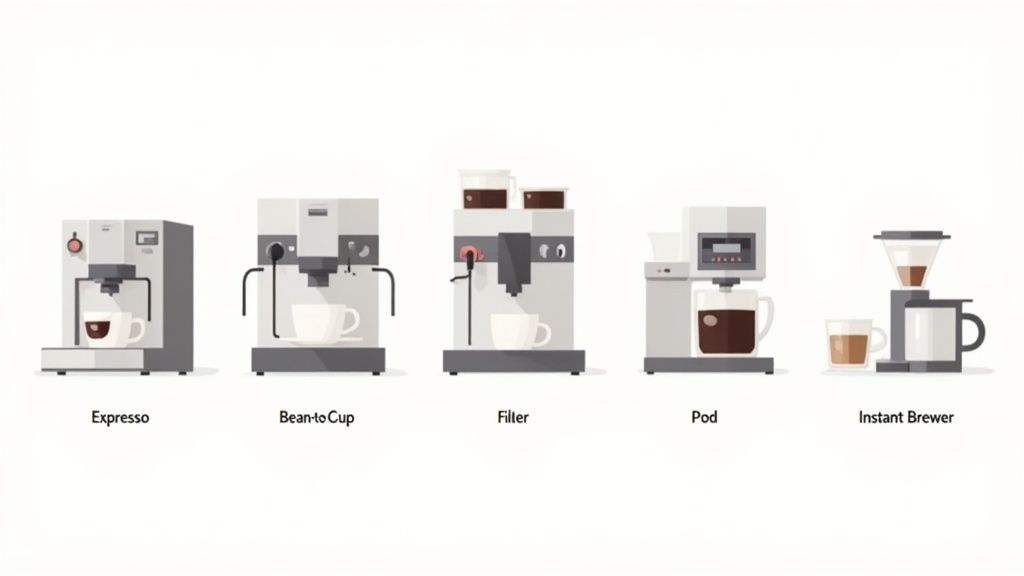
Below, explore five core styles to match throughput, flavour and maintenance demands.
Espresso Machines
An espresso machine pushes hot water through finely ground coffee under high pressure. The result is intense flavour clarity and precise microfoam control. Busy cafés chasing consistent quality almost always choose a two-group or three-group setup.
Bean-to-Cup Machines
These all-in-one workhorses grind beans and brew at the push of a button. They suit offices or petite cafés where barista skills are at a premium. For an in-depth look, see the Coffetek Vitro Series 3 Espresso Bean-to-Cup Coffee Machine.
Key considerations include:
- Throughput versus staffing levels
- Maintenance schedules and costs
- User-friendly operation for non-baristas
- Waste containment and sustainability impact
Filter Drip Machines
Need bulk brew without constant attention? Filter drip machines handle large batches through paper or mesh filters, making them staples in hotels, conference centres and canteens.
Pod And Capsule Machines
Pods and capsules deliver single-serve portions in neat, sealed filters. They excel where speed and tidiness matter—think corporate receptions and pop-up kiosks.
Instant Brewers
Using soluble coffee granules, instant brewers whip up cups in seconds. Maintenance is virtually zero, and strength stays uniform. You’ll find these in vending machines, staff rooms and compact event bars.
Comparison Of Commercial Coffee Machine Types
| Machine Type | Key Advantage | Capacity Range | Ideal Setting |
|---|---|---|---|
| Espresso | Precise extraction for flavour depth | 100–200 cups/day | Busy cafés and specialty coffee bars |
| Bean-to-Cup | One-touch brewing with built-in grinder | 50–100 cups/day | Small offices and low-staff cafés |
| Filter Drip | High-volume batch brewing | 200–500 cups/day | Hotels, conference centres, canteens |
| Pod/Capsule | Single-serve consistency and speed | 20–50 cups/day | Offices, convenience kiosks |
| Instant Brewer | Near-instant service with minimal upkeep | 10–30 cups/day | Vending machines, pop-up venues |
Use this table to align daily volume, staffing and quality before narrowing your shortlist.
Real-World Scenarios
- A city café might install a two-group espresso machine to pump out 150 cups during the morning rush.
- A suburban office often opts for a bean-to-cup model so staff self-serve lattes without training.
- Hotels favour filter drip units that deliver around 500 cups at breakfast with minimal supervision.
Balance these variables when deciding:
- Speed vs. Customisation – Espresso setups deliver unmatched shot control but require manual milk steaming.
- Cleaning Effort vs. Quality – Bean-to-cup machines simplify maintenance but sacrifice a bit of hands-on artistry.
- Upfront Cost vs. Running Cost – Filter drips are economical per cup but need continuous filter supplies.
Key Technical Specifications And Throughput
Choosing the right machine is about matching its inner workings to your busiest times. Here, unpack the essentials—boiler capacity, group head count, pump pressure and more—so you can see how those numbers translate into cups per hour.
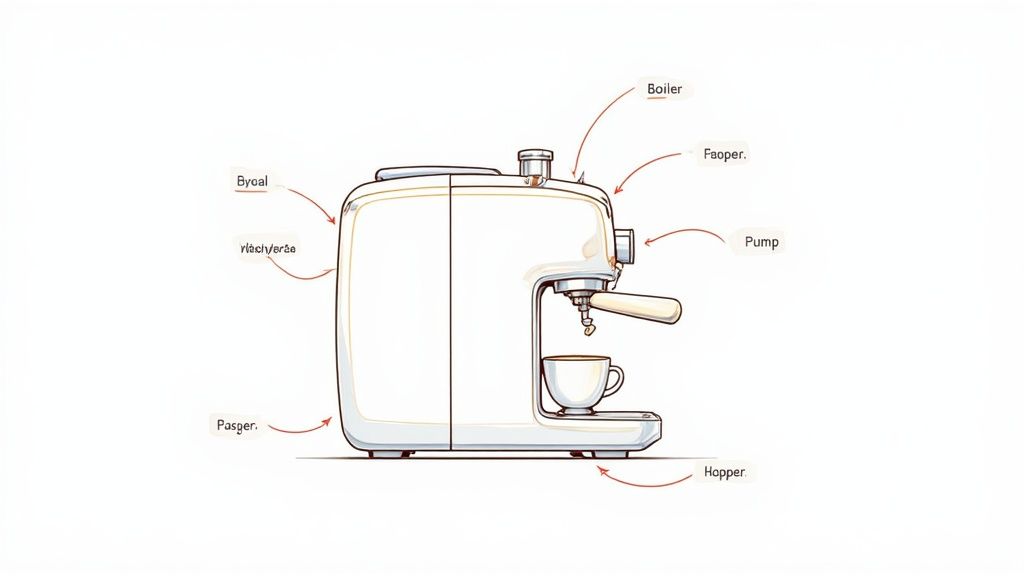
- Boiler Capacity governs steam recovery and sustained output
- Group Head Count dictates how many shots you can pull at once
- Pump Pressure & Flow Rate ensure each extraction is spot-on
- Hopper Size decides how often you’ll refill with beans
- Pre-Infusion Settings tame channeling for fuller flavour
Boiler Capacity And Group Heads
A single boiler of around 5 L will handle roughly 80–100 cups per hour, ideal for moderate traffic. Step up to a dual boiler in the 10–15 L range and you’re talking 150–300 cups per hour without breaking a sweat.
Every extra group head adds about 75–100 cups per hour to capacity. A three-group espresso machine becomes a real powerhouse at peak times.
Key Insight: More group heads boost throughput but increase maintenance steps and heat-up times.
Throughput And Real-World Output
Manufacturers quote numbers under perfect conditions. In reality, barista skill, drink size and service flow can drop throughput by 10–20%. Plan for that gap.
Machine Throughput And Specs
| Machine Type | Cups Per Hour | Boiler Size | Group Heads |
|---|---|---|---|
| Espresso Two-Group | 200 | 10 L | 2 |
| Bean-to-Cup | 80 | 5 L | 1 |
| Filter Drip | 300 | 15 L | N/A |
| Capsule System | 60 | 2 L | N/A |
Balancing Footprint And Power Draw
High-throughput models often draw around 5 kW and need a dedicated supply. Smaller bean-to-cup units run under 2 kW, plugging into a standard outlet. Check counter depth too—multi-group machines can fill a large corner.
For detailed specs see the Bezzera Otto two-group professional traditional espresso coffee machine.
Pre-Infusion And Warm-Up Time
Pre-infusion gently wets the coffee puck before full pressure hits, producing richer crema. Warm-up varies by boiler type:
- ThermoJet heaters: ready in under 30 seconds
- Larger boilers: 5–10 minutes to stabilise
Tips for smooth starts:
- Allow at least 5 minutes for boiler temperature to settle
- Run a blank shot to purge lines before the rush
- Engage eco-modes when downtime allows to hold temp with less energy
Managing Running Costs And Maintenance
Owning a commercial coffee machine is more than a one-off purchase. Budget for electricity, water and consumables to understand the true cost of brewing great coffee.
- Electricity for heating boilers and pumps
- Water for brewing and steam production
- Filter replacements and descaling chemicals
- Annual or quarterly service agreements
Eco Modes And Predictive Maintenance
Modern machines include eco modes that lower heater temperatures during downtime. Many models slash energy use by 35%, keeping you compliant with UK Energy Act standards and capping idle time under 2%.
Key Insight: In the UK, eco modes routinely cut energy consumption by 35%, while touchless interfaces and predictive maintenance features hold unplanned downtime below 2%. For official guidance, see the UK Government Energy Technology List.
Service contracts vary from simple annual checks to all-in packages:
- Basic Inspection and Calibration (under £200 per year)
- Comprehensive Cover including wear parts and labour
- Pay-as-You-Go Emergency Repairs for variable costs
Water Filtration And Chemistry
Hard water is the enemy of smooth coffee service. If scale builds up, breakdowns and repair bills rise. A robust filtration system is your first line of defence.
- Check out the Brita Purity C Quell ST C300 water filter for ideal water quality
- Replace cartridges every 3–6 months to avoid blockages
- Use manufacturer-approved descaling solutions to protect boiler internals
Maintenance Schedule Made Simple
| Frequency | Task | Benefit |
|---|---|---|
| Daily | Wipe group heads and steam wands | Ensures hygiene and flavour |
| Monthly | Deep descale using manufacturer solution | Removes internal scale |
| Annually | Professional service and gasket renewal | Extends machine lifespan |
Budget Tips For Spare Parts
- Stock essential seals, gaskets and shower screens to fix leaks fast
- Buy cleaning tablets and filters in bulk
- Negotiate parts-inclusive service contracts
- Keep a log of common failures to forecast replacements
IoT Monitoring Saves Costs
Smart machines can ping you when water levels drop, filters need changing or an error pops up. This means less downtime and fewer surprise call-outs.
- Automated alerts via email or SMS
- Usage analytics to fine-tune brewing schedules
- Firmware updates that boost efficiency
To keep energy bills down and downtime below 2%, embrace eco modes, install proper water filtration and stick to a simple maintenance schedule. For next-day delivery on filters, spares and service kits, get in touch with ADS Coffee Supplies.
Choosing A Commercial Coffee Machine For Your Business
Selecting the right machine depends on venue type. Offices, cafés and restaurants each have unique demands: daily cup counts, staff expertise and menu variety all play a part.
Office Settings And Bean-to-Cup
In an office, staff just want a reliable brew at the touch of a button. Bean-to-cup machines handle grinding, brewing and frothing, so no barista skills are needed.
Key Office Checklist:
- Intuitive touchscreen interface
- Bean hopper: 500 g (serves 50–100 cups/day)
- Built-in eco mode
- Standard 230 V power connection
Tip: Aim for consistency ratings above 95% to keep your team happy.
Independent Cafés And Espresso Machines
When customer flow picks up, you need a machine that keeps pace. A two-group traditional espresso machine can handle around 200 cups daily, delivering precise shots every time.
Pair it with a quality grinder and dual steam wands. Plan for a 600–800 mm deep counter and a dedicated 16 A circuit. Expect baristas to spend 10–15 minutes on morning prep, calibrating grind size and pressure.
For an all-in-one, see the Jura Giga X3 Gen II Professional Bean-to-Cup Coffee Machine (Chrome). Its dual grinders and high-volume capacity make it a crowd-pleaser.
Restaurants And Hybrid Models
Restaurants juggle espresso orders and filter brews. A mixed setup—single-group espresso machine plus filter brewer—gives you the best of both worlds.
You’ll need a 240 V supply, proper drainage and a footprint under 500 mm in width. Align monthly descaling with kitchen maintenance to avoid downtime.
Hotel Buffets And Filter Drip Systems
Hotel breakfasts demand high-volume, self-service coffee. Bulk filter brewers can pump out 300–500 cups in a morning rush.
Choose machines with multiple hoppers and thermal carafes. Position stations near water feeds and ensure 15 A circuits for heaters.
Essential Layout:
- Carafe slots: 3–4 for seamless refill
- Filter capacity per cycle: 1.5 kg of coffee
- Per-cup cost: £0.06 (including filters)
- Investment range: £1,200–£1,800
Vending Kiosks And Instant Brewers
Vending points need speed and minimal upkeep. Instant brewers or capsule machines serve 20–50 cups per hour with virtually no waste.
Quick Installation Steps:
- Confirm power: 13–16 A circuit and outlet position
- Fit a drip tray or connect a drain line
- Allow 200–300 mm clearance each side for service
- Test water hardness and install the right filter
Space, Plumbing And Electrical Tips
Before installation, map your space carefully. Leave 50–100 mm behind the machine for airflow and keep it away from splashing sinks.
Your water line should be a dedicated cold feed with a pressure regulator, using ¾-inch hoses at 1.5–2 bar. On the electrical side, ensure circuits match machine ratings—typically 230 V single-phase.
Commercial Coffee Machine Purchase Options And Support
Buying new, leasing or choosing a refurbished model each has advantages:
- New machines come with a 24-month parts and labour warranty.
- Lease packages often require no deposit and can bundle in servicing.
- Refurbished units offer up to 50% off the original price and cut carbon emissions.
Environmental concerns are rising in the UK. Opting for a reconditioned coffee machine supports the circular economy and keeps gear out of landfill.
Finance And Warranty
Flexible finance options include hire purchase, lease agreements and conditional sale over 12–60 months. Warranty levels vary from basic 12-month cover to extensive 36-month packages.
“Choosing the right finance and warranty plan can reduce your total cost of ownership by 30% over three years” — coffee operations consultant
ADS Coffee Supplies Support
At ADS Coffee Supplies, next-day delivery is our specialty across mainland UK. Our East Sussex warehouse stocks hundreds of spare parts, ready to dispatch.
We also offer UK-based training to sharpen barista skills and cover maintenance routines. This hands-on coaching helps teams keep uptime above 98%.
- Next working day delivery on orders over £69
- On-site installation and detailed site surveys by our certified engineers
- Comprehensive training sessions for both staff and technical teams
| Support Feature | New Machine | Refurbished Unit |
|---|---|---|
| Next-Day Delivery | Yes | Yes |
| UK Training | Yes | Yes |
| Spare Parts Stocked | Yes | Yes |
| Warranty Duration | 24 months | 12 months |
Consider our refurbished Iberital IB7 Compact. Learn more on the product page.
Ready to secure your ideal commercial coffee machine? Enquire now for a personalised quote, site survey and expert guidance. Visit ADS Coffee Supplies to get started.
Commercial Coffee Machine FAQs
Which Capacity Machine Suits Your Volume?
Different machines handle vastly different volumes under normal service conditions.
| Machine Type | Cups Per Day |
|---|---|
| Two-Group Espresso | 150 |
| Bean-to-Cup | 80 |
| Filter Drip Brewer | 300 |
For a closer look, check our Bezzera Otto Two-Group Espresso guide. Planning capacity in more depth? See the Perfect Daily Grind guide.
Running Cost Differences By Type
Energy, water and consumables dictate running costs. Traditional espresso machines draw around 4–6 kW and require daily cleaning, whereas filter brewers use power more gently but rely on batch chemicals.
Key Insight: Eco modes can cut energy use by 35%
For detailed cost breakdowns, visit our Brita Purity C Quell water filter page. Want an outside perspective? Read the Cognitive Market Research report. Testing water hardness is vital to prevent scale and protect your boiler.
Maintenance You Can Do Versus Contracts
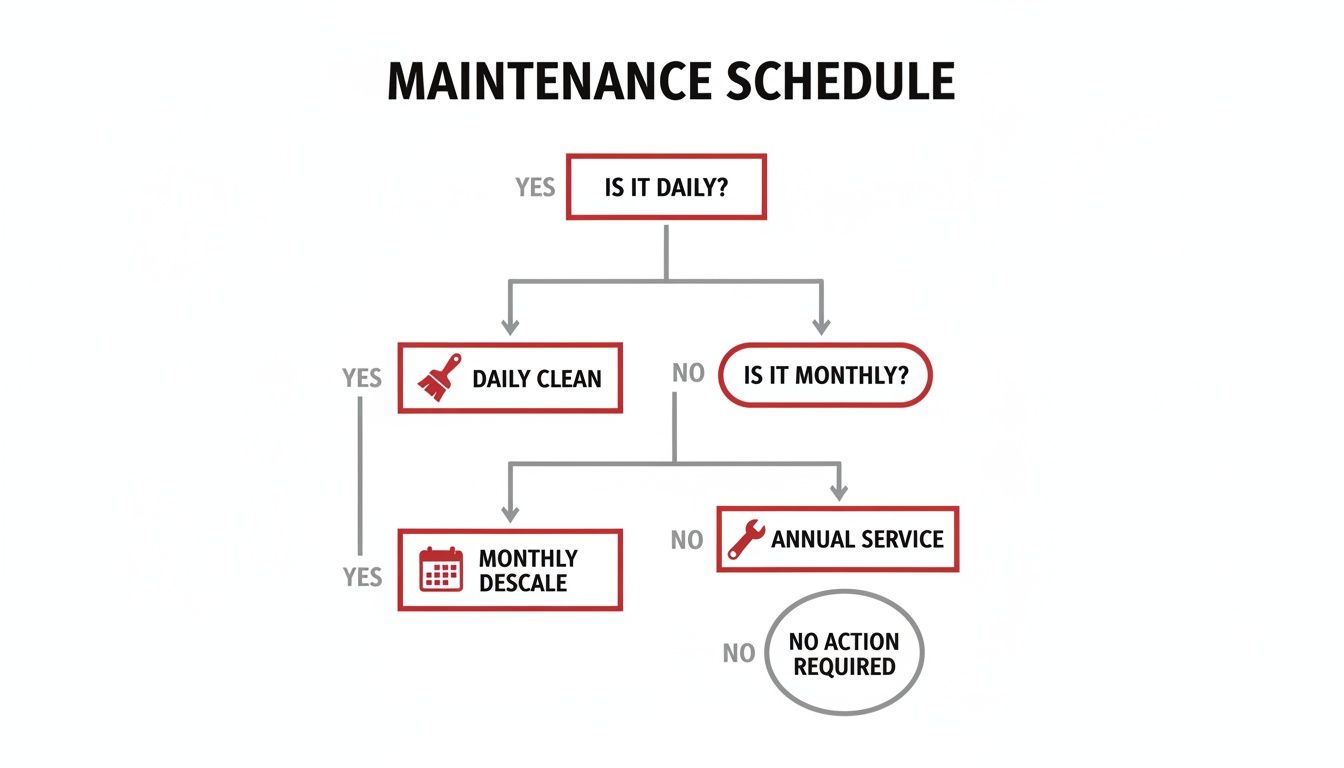
Most teams can handle quick group-head wipes and wand purges daily, plus a monthly descale. A service contract covers boiler inspections, gasket swaps and genuine spare parts.
- Daily Cleaning: Group heads & steam wands
- Monthly Descale: Manufacturer-approved solution
- Annual Service: Parts replacement & calibration
“Preventive maintenance can cut failures by over 50%” (Coffeepoint)
Explore our service packages at ADS Coffee Supplies. For extra tips, see the espresso machine maintenance guide.
Adding Mobile Ordering And Filtration
Modern outlets often pair machines with mobile-ordering systems and multi-stage filters to safeguard plumbing. The result is fewer breakdowns and happier customers.
- ADS Coffee Supplies filtration range, including Brita systems
- Integrations with Square Mobile Ordering for seamless service
Ready to find the perfect commercial coffee machine with next-day delivery? Visit Allied Drinks Systems for expert advice and complimentary site surveys.